Definition of Allicin
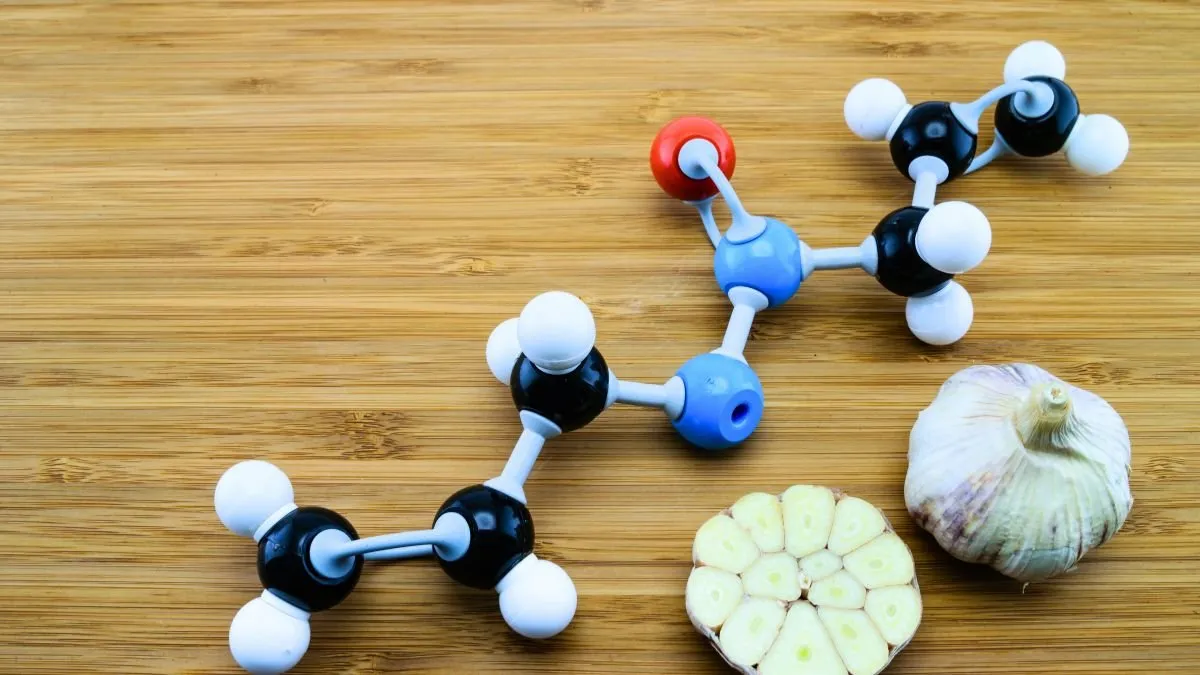
Allicin is an organosulfur compound that forms when raw garlic is crushed or chopped. This compound is responsible for many of garlic’s medicinal properties and health benefits.
It does not exist as such in the intact garlic clove. It is, in fact, the product of a chemical reaction: the conversion of alliin —present in garlic (Allium sativum)— by the enzyme alliinase, which is released and comes into contact with alliin the very instant the bulb is broken, cut or crushed. That is why whole garlic barely smells and chopped garlic smells at once: the reaction is triggered when the tissue is broken, not before.
What it is and where it comes from: the chemistry and its history
Chemically, allicin is an organosulfur compound with the molecular formula C₆H₁₀OS₂ and a molar mass of 162.26 g/mol. It belongs to the thiosulfinate group (structure R-S(O)-S-R) and its IUPAC name is S-(prop-2-en-1-yl) prop-2-ene-1-sulfinothioate. At room temperature it is an oily liquid, colourless or slightly yellow, with a density of 1.112 g/cm³. It is a chiral molecule, but in nature it occurs as a racemate, that is, as a mixture of its two mirror-image forms.
It is not a compound that popular tradition described first and science named afterwards: it happened the other way round. Chester J. Cavallito and John Hays Bailey first isolated and described it in 1944, as part of research into derivatives of vitamin B1 (thiamine); its exact structure was determined shortly afterwards, in 1948, by the researchers Stoll and Seebeck. Garlic itself, by contrast, is far older than its chemistry: it originates in central Asia, north-eastern Iran and the foothills of the Himalayas, and has been cultivated in Mesopotamia for at least 4,000 years. Well-preserved garlic has been found in the tomb of Tutankhamun, around 1325 BC. In 2024, world garlic production reached 30 million tonnes, of which China supplied 73%.
The science: how it forms and why it is so unstable
The mechanism is precise and fast. When the tissue of the garlic clove is damaged, the enzyme alliinase catalyses the conversion of alliin —its precursor, present in the intact cells— into allylsulfenic acid, an unstable intermediate that self-condenses at room temperature to form allicin, also releasing pyruvate and ammonia. The whole sequence happens “within seconds” of the clove being cut or crushed.
Allicin, however, is as reactive as it is easy to form: it is a short-lived molecule that degrades quickly if the temperature is not controlled. In dilute aqueous solutions frozen at −70 °C it can remain stable for years, “with no loss over two years”; at room temperature (23 °C), by contrast, it degrades in under 16 hours.
| Variable | Effect on alliinase or allicin |
|---|---|
| Optimum temperature of alliinase | 35-40 °C |
| Irreversible inactivation temperature | Above 80 °C |
| At 60 °C | Alliinase retains partial activity |
| Stomach pH (below 3) | Denatures alliinase: limits further allicin formation after swallowing whole garlic |
| Allicin at −70 °C | Stable for years, with no appreciable loss over two |
| Allicin at 23 °C | Degrades in under 16 hours |
As for how much allicin fresh garlic contains, there is no single, closed figure: a recent review gives a range of 2.5-5.8 mg per gram of fresh weight in single-clove (“monobulb”) garlic and 3.1-5.5 mg/g in the usual multi-clove garlic, while another source offers a different figure, of 0.22-0.24% of the weight of the garlic. The orders of magnitude are compatible, but not identical —probably due to the garlic variety or the extraction method— so it is worth treating it as an approximate range rather than as a fixed nutritional-table figure.
Biological activity: what the laboratory shows
Pure allicin has notable antimicrobial activity in laboratory trials: concentrations of as little as 0.17 mM inhibit the growth of E. coli and Staphylococcus aureus, compared with the 6.15 mM needed for the same effect by diallyl disulfide (DADS), one of its breakdown products —around 35 times more concentration. It also shows antifungal activity against Candida albicans, with a minimum inhibitory concentration of 50-100 μg/mL in monobulb garlic extract and 80-150 μg/mL in multi-clove extract.
In the cardiovascular field, the trial reported in the literature describes a marked antiplatelet effect: 0.4 mM of allicin inhibits close to 90% of platelet aggregation, compared with just 35% achieved by aspirin at a similar concentration (0.36 mM). It is also credited with a possible antihypertensive mechanism via the release of hydrogen sulfide (H₂S), and a route for reducing cholesterol synthesis by inhibiting the enzymes squalene monooxygenase and acetyl-CoA synthetase.
Translated into clinical practice, the effect on cholesterol is real but modest: studies in humans describe reductions of between 5% and 10% of LDL cholesterol (around 8-9 mg/dL) after 1 to 3 months taking between 0.5 and 1 gram of garlic extract a day. A meta-analysis cited in the literature speaks of a “significant but modest” decrease in total and LDL cholesterol with garlic powder supplements. That same literature does not, however, document any effect on triglycerides or on HDL cholesterol.
Safety: interactions and high doses
This is the section least often covered and the one carrying the greatest editorial responsibility. Supplementing with allicin at high doses can cause gastrointestinal discomfort (nausea, heartburn, diarrhoea) and, in susceptible people, systemic effects such as headaches, tachycardia or mild hypotension. In rodent studies, low or moderate doses (5-20 mg/kg/day in mice, 15-45 mg/kg/day in rats) are neutral or beneficial, while doses far above that —more than 1,000 mg/kg/day in rats— have been associated with hepatotoxicity and nephrotoxicity, as well as haematological abnormalities (oxidative haemolysis of red blood cells), weight loss and impaired spermatogenesis with prolonged exposure.
The point of most practical interest is the interaction with anticoagulants: allicin and other organosulfur compounds in garlic have antiplatelet activity, possibly by inhibiting thromboxane synthesis, and combined with warfarin, aspirin or clopidogrel they can increase the risk of bleeding. That said, a review focused specifically on the bleeding risk of “anti-atherosclerosis” supplements concluded that “garlic use appeared safe among people on warfarin therapy”, although it recommends caution if combined with antiplatelet therapy. Allicin also inhibits the liver enzyme CYP2C19, which could raise blood levels of certain antiviral drugs metabolised through that pathway. The recent literature itself acknowledges that safety evidence relies mostly on animal toxicology studies, with few clinical trials in humans and no long-term surveillance data: caution, not alarm, is the right takeaway.
How to use allicin in the kitchen
To maximise allicin’s benefits in recipes:
- Crush or chop fresh garlic: this activates allicin, and it is worth letting it rest a few minutes before exposing it to heat. As alliinase takes only seconds to act after garlic is cut or crushed, but is irreversibly inactivated above 80 °C, that rest gives more time for allicin to form than adding whole garlic straight into a hot pan.
- Add it towards the end of cooking: to preserve its properties, add the crushed garlic towards the end of preparing the dish.
Garlic, and therefore allicin, is used in many ways in the kitchen:
- Raw: in sauces such as aioli and tzatziki, adding a strong, pungent flavour.
- Roasted: roasted garlic has a milder flavour and is used in pastas, meats and purées.
- Sautéed: very common in sautéed vegetables and arroz al ajillo (garlic rice).
| Property | Culinary use | What the evidence says |
|---|---|---|
| Antibacterial and antifungal | Raw sauces, marinades | Inhibits E. coli, S. aureus and C. albicans in laboratory trials |
| Antioxidant | Slow-cooked dishes | Proposed route of cell protection against oxidative damage |
| Modest reduction of LDL cholesterol | Soups, stews, garlic extracts | 5-10% reduction of LDL in 1-3 month studies |
| Antiplatelet activity | Any preparation with raw garlic | Interacts with anticoagulants: caution if taking them |
Culinary considerations
- Temperature: avoid cooking garlic at very high temperatures for a long time. The alliinase that forms allicin is irreversibly inactivated above 80 °C, although it retains partial activity at 60 °C.
- Proportions: use 1-2 cloves of garlic per 250 ml of liquid to keep a good balance of flavour and benefits.
In the Canary Islands: garlic in mojo
In the Canary Islands there is no designation of origin or geographical indication for “Canarian garlic” as a distinct crop —unlike, for example, Ronmiel de Canarias for the spirit—: the islands’ attachment to garlic does not run through the agricultural product, but through the sauce that carries it as a regular ingredient, mojo. Mojo is a typical Canary Islands sauce whose name comes from the Portuguese molho (“sauce”); among its most common ingredients are Palmero chilli, pepper, garlic, salt, paprika, cumin or coriander, oil, vinegar, parsley and water.
Green mojo, the usual one for fish, is made with green peppers, coriander or parsley, and garlic regulates its heat; red mojo, the usual one for meats, carries Palmero chilli —the so-called “picona”— and paprika. The most typical accompaniment for both is the combination of papas arrugadas (salt-crusted wrinkled potatoes) and mojo.
At Taste 1973: Diego Schattenhofer’s aged mojo
At Taste 1973, Diego Schattenhofer develops an “aged mojo” —his own “mother mojo”—, whose base preparation consists of confit garlic, cumin seeds, salt, Palmero chilli pulp, vinagre macho (a strong aged wine vinegar), olive oil and a touch of white wine. The project began in 2018, inspired by the “mole madre” of the Mexican chef Enrique Olvera (Pujol, Mexico City), and the aged mojo has been served at the restaurant since 1 January 2022, aged in an oven kept at 50-55 °C. The original feature can be read at Mojo envejecido, la asombrosa salsa que ha desarrollado el chef Diego Schattenhofer.
In Spain and in Argentina
In Spain there is a national-level layer with its own quality label: Ajo Morado de las Pedroñeras (Cuenca, Castilla-La Mancha) is a garlic variety with Protected Geographical Indication.
In Argentina, the link comes through chimichurri, the sauce that originated in and is eaten across the country (and in others in the Americas) and that carries garlic among its core ingredients along with parsley, oregano, vinegar, oil and ground chilli, and that accompanies grilled meats, contributing to the international fame of Argentine asado.
Related terms
- Antioxidants — the mechanism credited to allicin for protecting cells from oxidative damage.
- Aromatics — garlic, among the aromatics with antioxidant and antimicrobial properties.
- Sensory appreciation — why raw garlic smells and tastes different from cooked garlic, depending on how much allicin it retains.
- Mojo envejecido, la asombrosa salsa que ha desarrollado el chef Diego Schattenhofer — confit garlic as the base of Taste 1973’s mother mojo.
Sources consulted
- Wikipedia (es): Alicina
- Wikipedia (en): Allicin
- PubChem CID 65036: Allicin
- Borlinghaus et al., “Allicin: Chemistry and Biological Properties”, Molecules (2014)
- Wu, Dong, Sun and Chen, review of sulfur compounds in garlic (2026)
- Bandyopadhyay and Pattnaik, review of single- and multi-clove garlic (2026)
- Jacobo-Velázquez, review of functional foods and cholesterol, Nutrients (2025)
- Yu, Zhu, Zhang et al., review of allicin’s therapeutic potential against viruses (2026)
- Dobre, Virgolici et al., review of anti-atherosclerosis supplements and bleeding risk (2025)
- Wikipedia (en): Garlic
- Wikipedia (es): Allium sativum
- Wikipedia (es): Mojo (salsa)
- Wikipedia (es): Chimichurri
- Mojo envejecido, la asombrosa salsa que ha desarrollado el chef Diego Schattenhofer (MassCultura, 27-07-2022)
Frequently asked questions
What is allicin and what is it used for?
How is allicin used in cooking?
What are the health benefits of allicin?
Where can allicin be found?
Who discovered allicin and when?
What is the chemical formula of allicin?
How much does allicin lower cholesterol, according to the scientific evidence?
Is it safe to take garlic or allicin if I take anticoagulants?
What relationship does garlic have with Canarian cuisine and with Taste 1973?
Also in the glossary
Amino acids
Amino acids are organic compounds that combine to form proteins, essential for the function and structure of living cells.
Amylase
Amylase, an enzyme fundamental to the digestion and culinary processing of carbohydrates, plays a critical role in both human nutrition and gastronomy.
Antioxidants
Antioxidants are molecules capable of preventing or slowing down the oxidation of other molecules.