Food photography in Tenerife: behind the plates at Taste 1973
- Published
- Section
- Multidisciplinary
The search, and what this page can answer
Someone typing “food photographer in Tenerife” is looking for a person who photographs plates on the island. The search engine answers with studios: sessions on site, light, number of photographs, price. This page is not that list and it recommends nobody. It tells something else, which is what the site can stand behind: what you see when you look closely at the photography of the plates at Taste 1973, and what lies behind those images in the archive we already publish.
The difference matters. A studio sells a commission. A restaurant shows the plate that leaves the pass. The two photographs can look alike and not tell the same thing. Here the plate has a name, tableware and a place where it was already hanging before this article.
How a plate is photographed when service is in charge
A fine-dining plate does not wait. The sauce settles, the herb tires, the ice under the shellfish clouds. That is why the trade, on the island as in any other kitchen that takes the photograph seriously, sets aside a stretch of time when the dining room is not yet full. A studio in Tenerife writes it this way on its own page: it sets the light up inside the restaurant, in the morning and on weekdays, so as not to cross the guests, and gives as an example a session of about 50 minutes for 10 plates. It is their advertisement, not our house’s work log. It helps to understand the question people bring, and nothing more. There is no contract on the site with that studio or with the others that appear in the same search.
What we do know, because it has been photographed, is the order of things. First the plate has to exist as it will be eaten. Then someone decides from where it is looked at: from above, at the height of the rim, with the hand still in the frame or with the hand already out. The menu photograph hides the gesture. The kitchen photograph leaves it in. Both are gastronomy. They are not interchangeable.
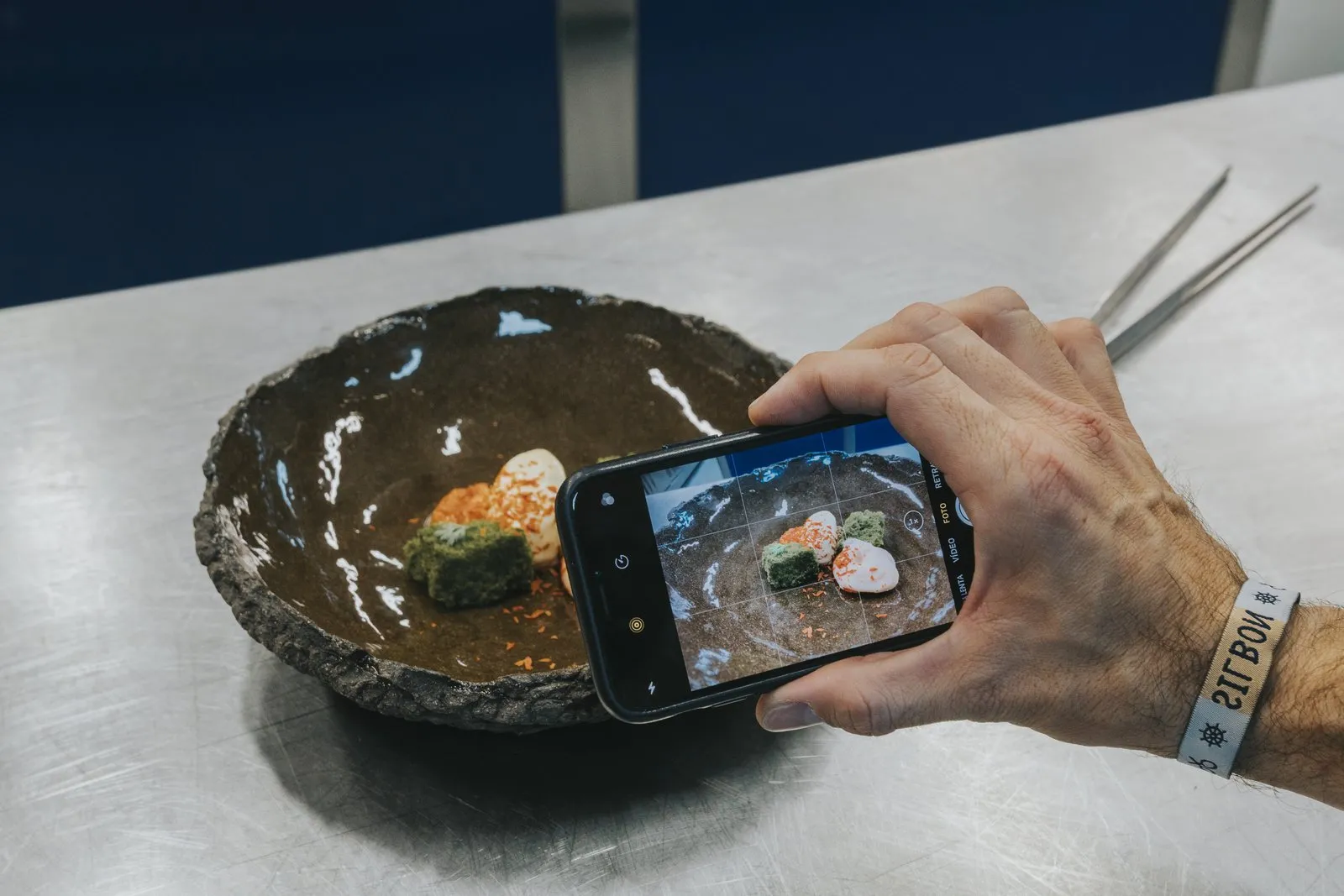
That image is in the gallery of photographs and videos. It does not say who is holding the phone or whether that was a test, a note or the photograph that was later retouched. It says that in this house the plate is also looked at with a phone, centimetres from the bowl, on a dark table. Someone looking for a studio with lights and a cardboard backdrop will not find that catalogue here. They will find the bowl.
What Taste 1973 has already published of that work
Three distinct moments coexist in the restaurant’s archive.
The first is the plate photograph on the restaurant page and in the gallery: the result, with a name. “Renacer sobre Tacande”, the royal of Canarian black pork, the “Tableta del Virrey”, the tart of Canarian bigeye tuna belly, the prawn in the clay bowl, the anchovy bone, the raviolo that a pair of hands closes over a bowl. Each one has a caption on the page. All of them belong to the restaurant archive.
The second is a whole session, told in the article on the book in preparation. There a photographer is seen portraying a plate served on a goatskin, and the team watching. The caption says “photographic session for the new book we are working on”.
The third is cinema, not a still life. On 25 June 2026 the crew of “Ecos del Mar”, the Prime Video series, filmed in the dining room, in the store where the fish mature and at the pass. We told it in the article from that day. Two cameras and a meal do not replace the photograph of the single plate: they show the house in motion. Whoever compares the two will see that the light of a documentary and the light of a still plate are not looking for the same thing.
What can be seen once the plate is still
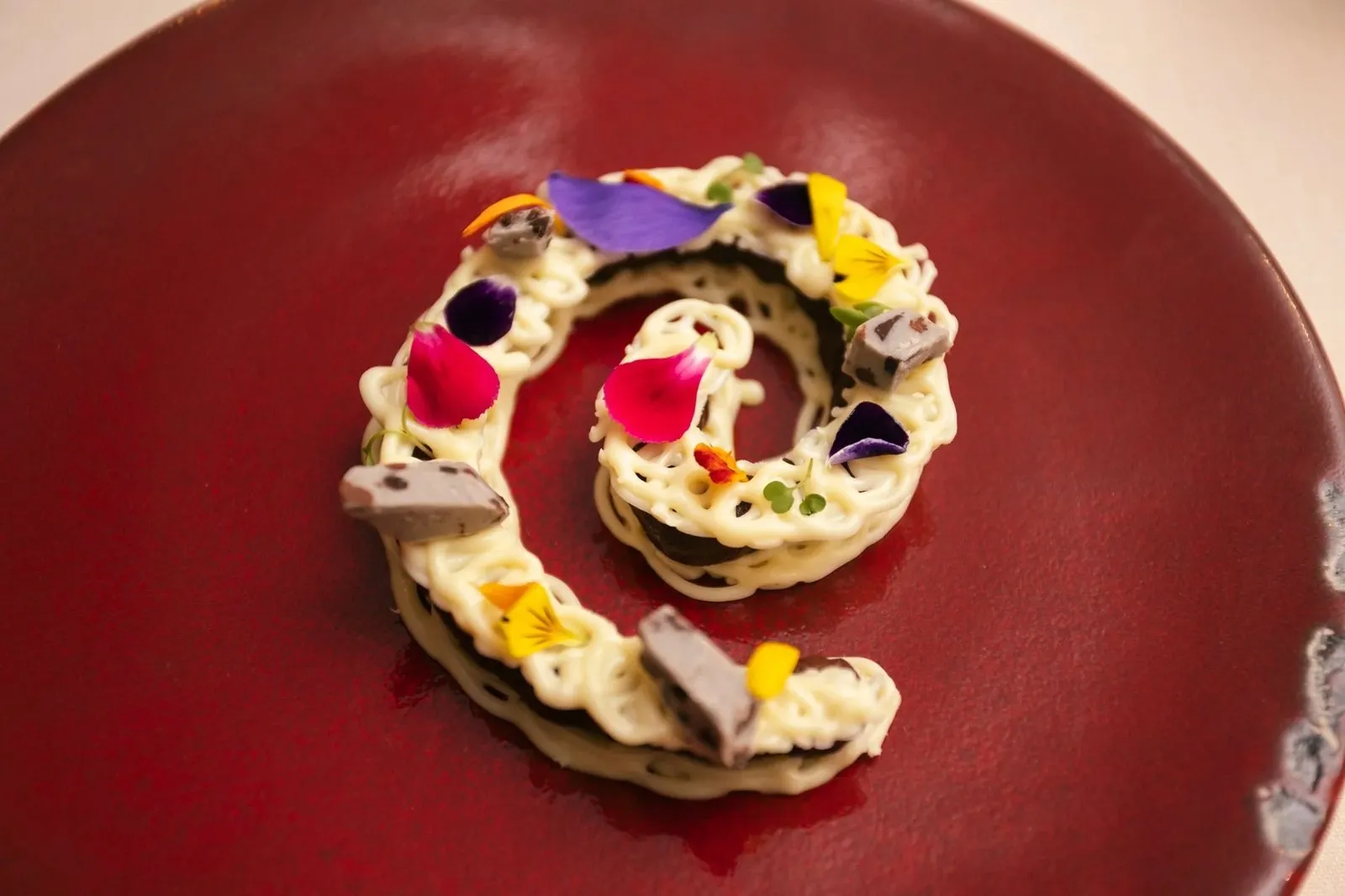
The lead image of this article is “Renacer sobre Tacande”: a red base, a pale cream, flowers and small bites. The description does not need decorating. The plate is published under that name on the restaurant page, and the photograph is the same one.
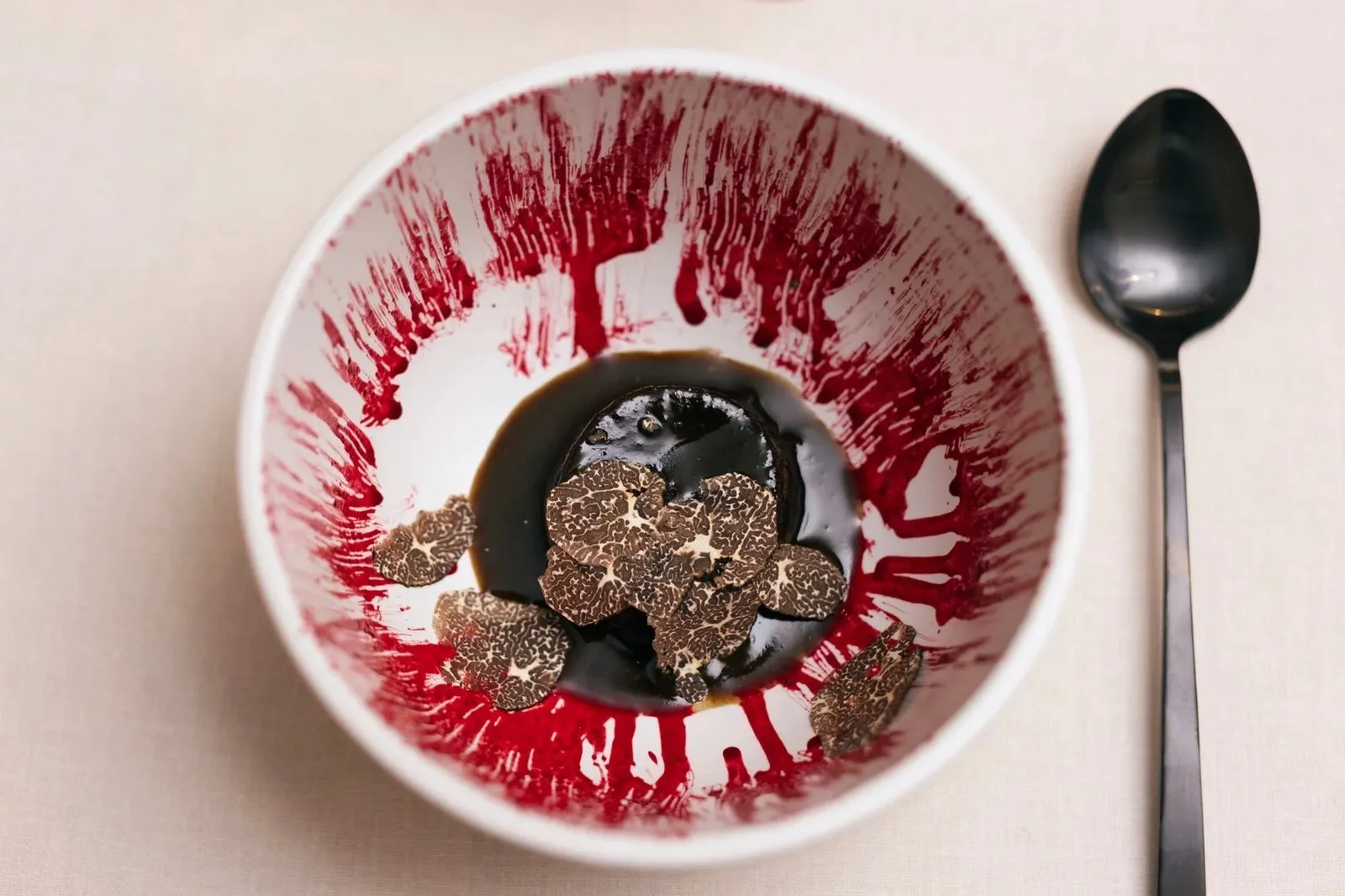
The royal of Canarian black pork sits in a white bowl, with slices of truffle and a red stroke on the rim. The contrast is not a filter: it is the decision to put a dark product on white and to let the sauce hold the rim. That can be discussed as plating, and it is what the photograph keeps.
In between is the tableware, which in this house is not a neutral prop. The restaurant page tells that replicas of Guanche vessels are made with potters from the area, after talking with historians and goatherds. The clay bowl, the stone, the red plate: the photograph has to let the material be seen, because the material is part of what one wants to say about Tenerife. A studio backdrop that cancels the clay piece also cancels that sentence.
And there is the cheese trolley. The MICHELIN Guide entry, quoted on the restaurant page, speaks of a “large trolley of Canarian cheeses with more than 50 varieties” and of the taste for matured fish. The photograph of that trolley is not a still life of one piece: it is an accumulation, and it is badly photographed if it is treated as a single plate. It is closer to a short landscape. Whoever wants the context of that trolley can continue through the article the site devoted to it after the guide, linked from the restaurant.
| What the photograph shows | Where it was already published |
|---|---|
| “Renacer sobre Tacande”, flowers and bites on red | Taste 1973 page |
| Royal of black pork, truffle and a red stroke | Taste 1973 page |
| A hand and the phone over a stone bowl | The chef’s gallery of photographs and videos |
| A photographer and the team, in the book session | Article on the book in preparation |
| Dining room, store and pass, in motion | Article on “Ecos del Mar” |
Where to keep looking, and where not
To see the plates, the Taste 1973 page and the gallery are enough. To see how a session was worked with a photographer in the frame, the book article. To see real cameras inside the dining room, the one about the shoot. None of that includes a studio’s phone number or a price per photograph. If what is needed is to hire someone in Tenerife, the first pages of the search engine are studios that do sell that commission. This text does not score them and does not copy their rates: they expire, and they are not ours.
Nor are we going to put an author’s name where the archive does not put one. Several old files carry in the filename a hint of origin that the published caption does not confirm. Until that credit exists in a visible sentence, the signature of these photographs is the archive’s. Asking it quietly and writing it as if it were already settled would be exactly the mistake this page is trying not to make.
Food photography, said from here, is this: the plate with the name it already has, the tableware that already explains the house, the gesture when the photograph leaves it inside, and the silence when we do not know who pressed the shutter. The rest is a quotation, and the quotation is asked for somewhere else.
Sources
- Restaurant page, gallery of plates and quotation from the MICHELIN Guide: Taste 1973. Guide page: guide.michelin.com.
- The chef’s gallery, including the phone photograph: galleries of photographs and videos.
- Book session: behind the scenes.
- Shoot of 25 June 2026: “Ecos del Mar”.
- Session practice announced by a studio on the island (morning, weekdays, about 50 minutes for 10 plates), with no published link to the house: the studio’s notice.
Frequently asked questions
Does this page find a food photographer in Tenerife?
Who signs the photographs of the plates at Taste 1973?
Where can the restaurant's photographs be seen?
Is the plate photographed during service?
What was filmed when a camera crew came?
Do the photographs in this article come from a stock library?
You may also like
Sustainable Innovations in Goat Farming: Towards an Eco-Friendly Future in the Canary Islands
Industry
Innovation with Guanche Roots: Chef Diego Schattenhofer and Doctor Marichu Fresno of the ICIA Work Together to Rediscover Aboriginal Canarian Cheese
Multidisciplinary
Chef Diego Schattenhofer revolutionises Canarian cuisine with his research into native goat
Multidisciplinary