Protected designation of origin (PDO): what the name demands
- Term
- Designation of origin, protected (PDO)
- Tags
- Seals · Canary Islands · Spain
- Published
A protected designation of origin is a European name that identifies a food born of a specific place, with all its stages carried out there. Before the list of Canarian products, the rule comes first: without it, the list looks like a catalogue of prestige. With the rule, every name can be checked: either it meets the article that defines it, or it is another category, or it is an adjective on a menu.
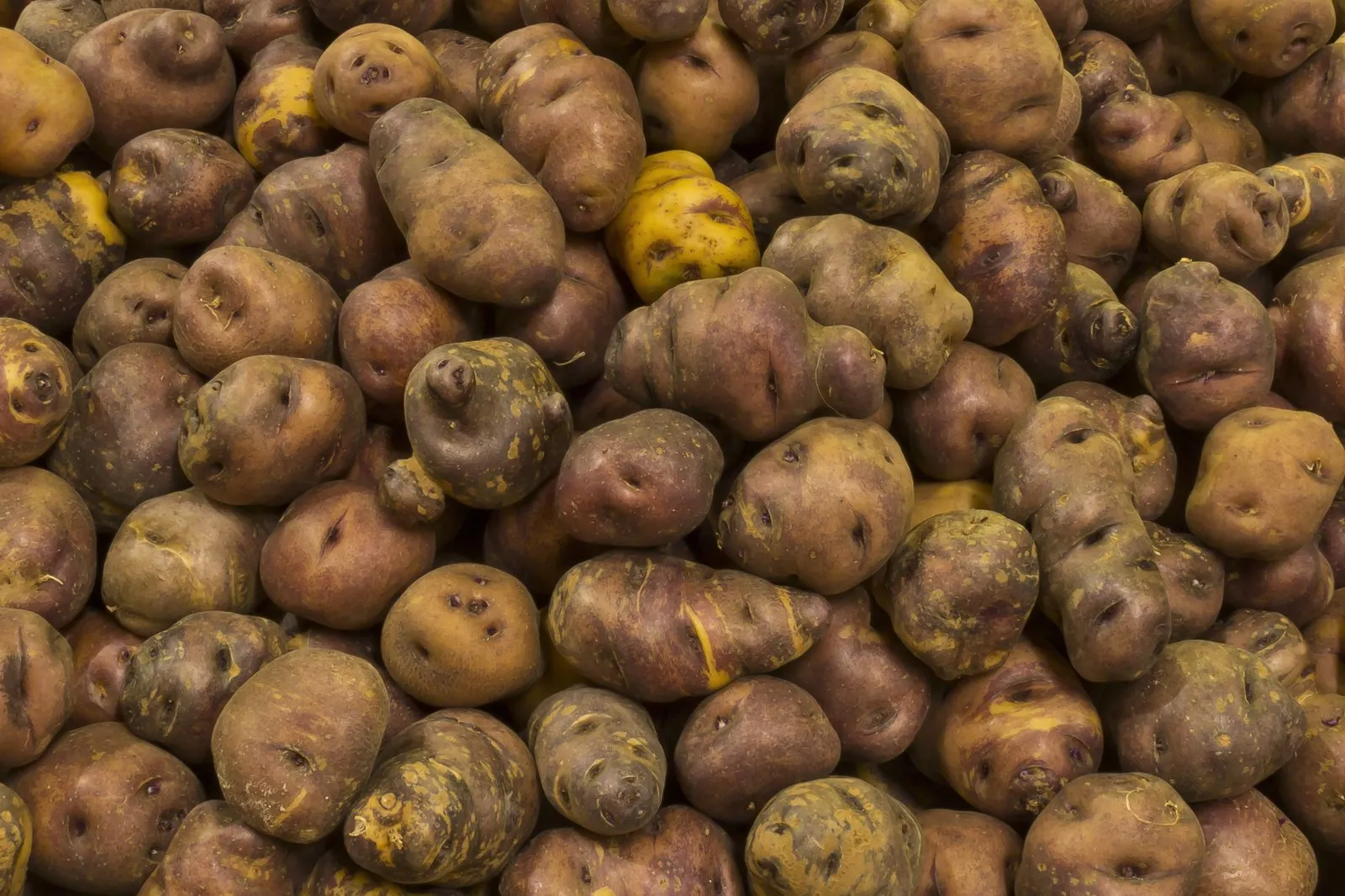
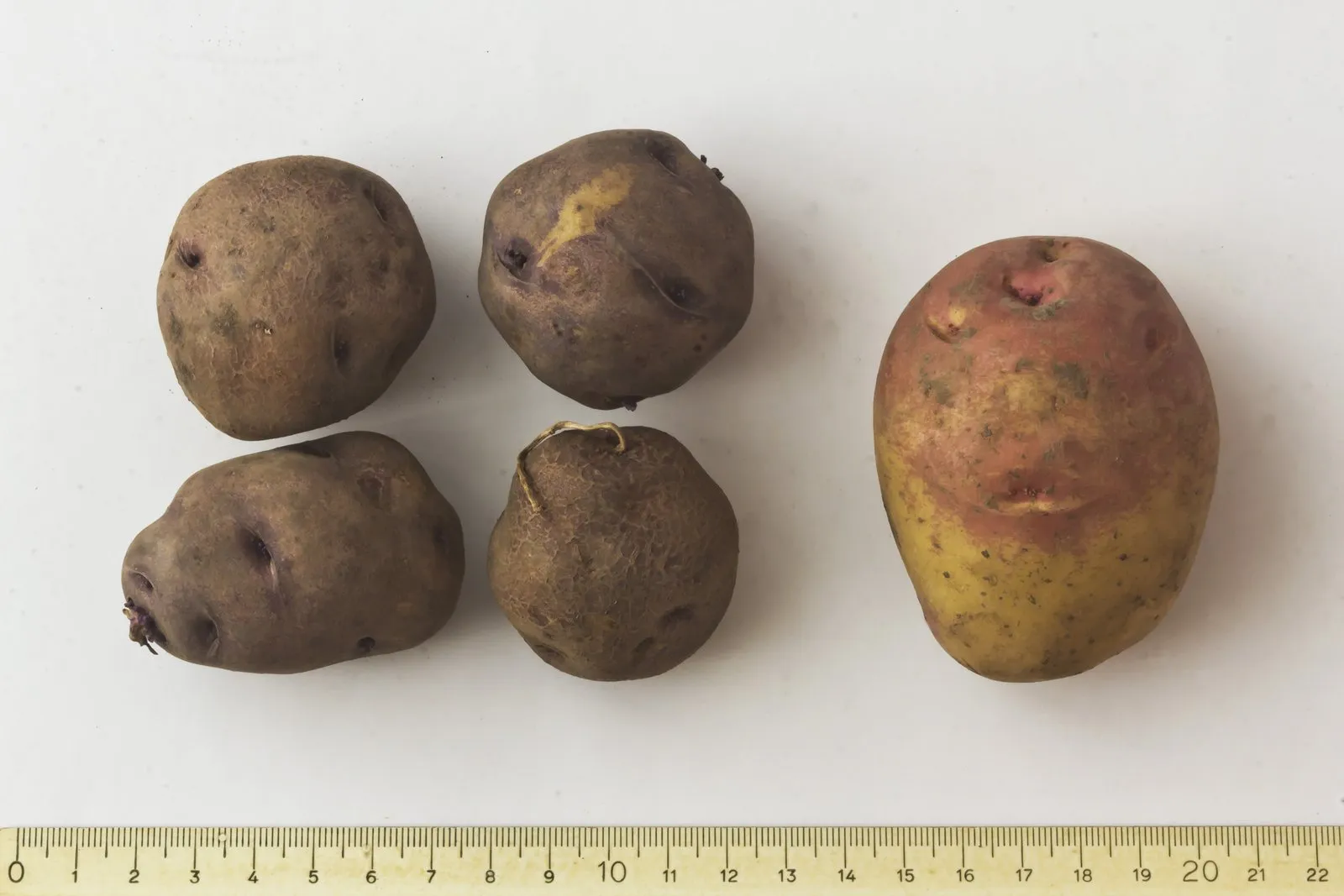
The photos show potatoes of the “Papas Antiguas de Canarias” PDO. They are not the blue and yellow logo of the European Union, which is an institutional mark and does not appear in these photos. The tuber is one of the products the seal covers. The rest of the list (cheeses, honey, cochineal, wines) does not fit on a single plate.
What the regulation demands
Regulation (EU) 2024/1143, applicable since 13 May 2024, calls a name a designation of origin, in its Article 46, when it identifies an agricultural product meeting three conditions at once. It must originate in a specific place, a region or, exceptionally, a country. Its quality or characteristics must be essentially or exclusively due to a particular geographical environment, with the natural and human factors of that environment. And the production stages must all take place in the defined geographical area. Those three conditions were already in Regulation (EU) No. 1151/2012, of 21 November 2012, which the regulation in force repealed.
The three conditions travel together. An excellent food made in the Canary Islands with a decisive stage outside the archipelago fails the third. A food made entirely on the island, if its character is not due to that environment, fails the second. The geographical name alone, on a decorative label, is not a PDO.
Regulation (EU) 2024/1143 covers wine, spirit drinks and agricultural products. The definition of the designation of origin for agricultural products is that of Article 46. Wine has a chapter of its own. That is why a “designation of origin” on a Canarian bottle is not, word for word, that agricultural definition: for wine, the traditional term may replace “protected designation of origin” on the label when that wine chapter allows it. European protection exists in both cases. The legal drawer is not the same, and mixing them produces impossible lists.
PDO, PGI and geographical indication
The protected geographical indication asks for less and asks for something different. The product is still from a place, a region or a country. It must have a given quality, a reputation or another characteristic that can be essentially attributed to that origin. And of its production stages, at least one must take place in the area. They need not all do so. The character need not be due fundamentally or exclusively to the environment: the link of a quality, of fame or of a trait is enough.
| Category | What ties the name to the place | How many stages, in the area |
|---|---|---|
| PDO | Quality or characteristics due to the environment, fundamentally or exclusively | All |
| PGI | A quality, the reputation or another characteristic attributable to the origin | At least one |
| GI for spirit drinks | The regime proper to spirit drinks, not Article 46 for agricultural products | Whatever its specification sets |
The third row avoids a very Canarian mistake: calling ronmiel a PDO. Ronmiel de Canarias is a geographical indication for a spirit drink. It shares with PDOs the pride of the name and does not share the article. Its honey percentage and its strength belong to its own specification, which will have a separate entry. It is enough not to seat it at the cheese table.
Nor is a PDO the same as a product “from the Canary Islands” with no registration. The geographical adjective is free until a specification reserves it. Once registered, using it on a food that does not comply is an offence, not a style. The MAPA FAQ says it in the opposite direction to propaganda: a PDO is not a competition prize; it is a quality regime with an area, stages and a link.
Those the Canary Islands have registered
The MAPA food and agriculture list records, for the Canary Islands, 6 PDOs and 3 PGIs. The designations of origin on that list are these:
- Cochinilla de Canarias
- Papas Antiguas de Canarias
- Miel de Tenerife
- Queso de Flor de Guía, Queso de Media Flor de Guía and Queso de Guía
- Queso Majorero
- Queso Palmero, also called the cheese of La Palma
The three protected geographical indications on the same list are Canarian gofio, the avocado of the Canary Islands and the banana of the Canary Islands. Gofio is toasted and milled under a PGI. Majorero cheese is indeed a PDO, and its specification ties the milk to the goat of the island.
For wine, the MAPA list records 11 Canarian PDOs:
- Abona
- El Hierro
- Gran Canaria
- Islas Canarias
- La Gomera
- La Palma
- Lanzarote
- Tacoronte-Acentejo
- Valle de Güímar
- Valle de la Orotava
- Ycoden-Daute-Isora
“Islas Canarias” on that list is a wine designation that covers the archipelago, not a summary of the other ten. A bottle may fall under the island or under the regional designation according to its specification, and the two do not add up in the glass as if they were eleven different wines on a single label.
These counts (6, 3 and 11) are those of the ministerial list of the MAPA. A new registration would move them. The rule of Article 46 does not move with them.
When buying
The seal serves to read the label, not to guess the flavour. A protected old potato must be of the varieties and from the area its specification states. A Majorero cheese must meet its own, set out in its entry. A Lanzarote wine with a PDO does not become Majorero for being in the same autonomous community. The protected name is a short contract: place, stages, link. What the kitchen does afterwards (wrinkling the potato, smoking the cheese, pairing the wine) is no longer the seal; it is the recipe.
The commonest abuse on a menu is writing “designation of origin” next to a product that is merely from the island. If it is not on the list, the honest adjective is another: local, from Tenerife, from the cooperative, from the farm. Those adjectives can be true and they are not a PDO. The diner paying for the protected name is paying for the specification, not the demonym.
In the Canary Islands
The regime is rooted in the seven islands with a registration on one of the lists: Tenerife (honey, several wine PDOs, potatoes), Gran Canaria (flor cheese, wine, potatoes), Fuerteventura (Majorero cheese), La Palma (Palmero cheese and wine), Lanzarote, La Gomera and El Hierro (wine, and the archipelago-wide designations that cover them). Cochineal, potatoes, gofio, avocado and banana are defined over the whole or over the area each specification draws, not over a single capital.
The photo of the potatoes fixes one of those areas in what is visible: irregular skin, different varieties, a market-garden product and not a generic supermarket brand. It does not say that every potato on the island carries the seal. It says that these, in Koppchen’s shot, are those of the designation.
What the seal does not do
The seal does not score the dish. A protected old potato can arrive green, overripe or badly wrinkled, and still belong to the designation if the tuber met the specification on leaving the area. The failure, then, lies in the kitchen or in storage, not in the register. Conversely, an excellent potato from outside the area does not become “Papas Antiguas de Canarias” merely by being roasted in Tenerife. The place of the stages is that of the protected product, not that of the restaurant that cooks it.
Nor does it rank the archipelago. That Fuerteventura has the Majorero and La Palma the Palmero does not leave the islands without a cheese of their own beyond that sentence: it leaves out of the protected name the cheese that does not fit the specification. Calling it “Majorero-style” or “Palmero-style” is another practice, and the regulation looks closely at evocations. The Majorero entry tells what its specification does demand. The warning is about reading: resemblance is not registration.
Cochineal of the Canary Islands is a reminder that a PDO need not be a dish. It is an agricultural product (the dye insect, in this case) with an area and a method. Honey from Tenerife is food and is a PDO, and it is not exhausted by one dessert. Avocado and banana, being PGIs, show the sibling category in fruit: one stage and a reputation can be enough when the specification says so, and that does not make them designations of origin.
In the dining room, the useful phrase in front of the diner is short. If the cheese is Majorero, say Majorero and the PDO can be pointed out. If the wine is from the Lanzarote PDO, say that designation, not simply “a Canarian wine with a designation”, because the 11 do not taste alike nor obey the same specification. If the gofio is the PGI one, say PGI. The diner who asked about Canarian products with a designation of origin deserves the separated list, not a heap. Memorising the names matters less than knowing which question to ask: is it registered, is it a PDO or a PGI, and which stage does the specification demand? With that question, the label stops being an ornament and becomes a purchasing fact, as much in an island market as on the menu of a restaurant that boasts of its produce.
The MAPA PDFs are the current list; eAmbrosia is the European register to which those lists refer. If a regulatory board announces a name that is not yet on that list, prudence is to treat it as an application, not as a PDO. The kitchen can back it and the label cannot get ahead of the seal.
Related terms
- Majorero cheese — one of the 6 agri-food PDOs, with the goat’s milk its specification demands.
- Gofio — PGI, not PDO: the practical contrast with the table above.
- Canarian goat — the breeds the milk of the cheeses with a protected name comes from.
- Fermentation — the route of wine and cheese, which the seal does not replace.
- Potatoes in the kitchen of the baifo — the accompaniment the Majorero recipe book puts beside the young animal, distinct from the seal of the old potatoes.
Sources
 — view the full-size photo
Varieties within the Papas Antiguas de Canarias PDO. The photo shows the protected product, not the drawn seal. 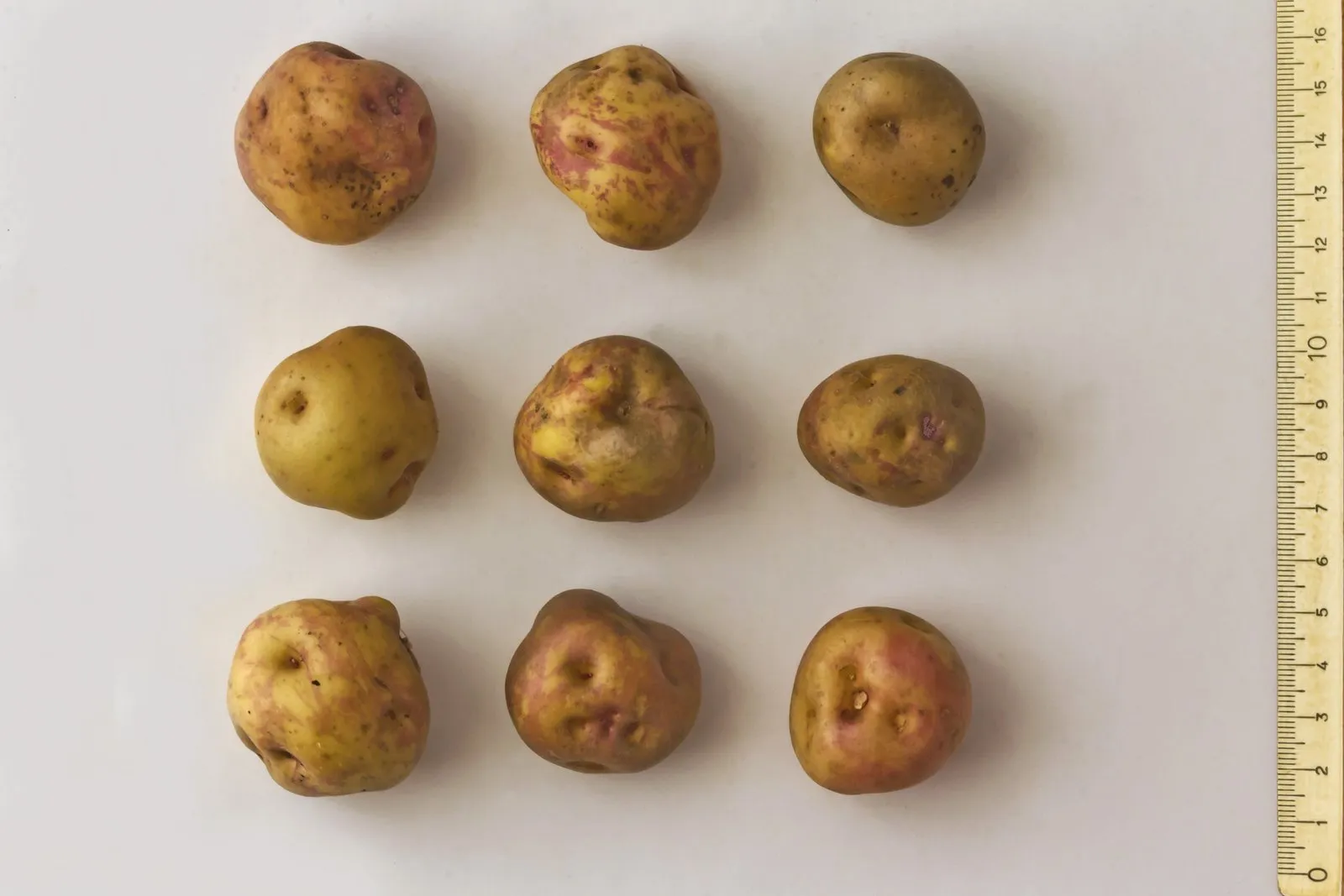 — view the full-size photo
Detail of the skin. They are still potatoes of that designation, not a map of every PDO in the archipelago.
Photos: 1. Koppchen (opens in a new tab) (CC BY 3.0 (opens in a new tab)) · 2. Koppchen (opens in a new tab) (CC BY 3.0 (opens in a new tab))
Frequently asked questions
What is a protected designation of origin?
How does a PDO differ from a PGI?
How many PDOs are there in the Canary Islands?
Is Canarian gofio a PDO?
Which Canarian cheeses have a PDO?
Why do the old potatoes appear on a page about quality marks?
Also in the glossary
Esferificación (spherification)
Spherification encloses a liquid in a thin skin of alginate gelled with calcium, so that the sphere bursts in the mouth.
Fermentation
Fermentation is the microbial transformation of a food: lactic in milk, alcoholic in must and acetic when wine turns to vinegar.
Gofio
Canarian gofio is the flour obtained on the islands by milling toasted cereals, with or without sea salt, covered by a PGI.