Fermentation: lactic, alcoholic and acetic
- Term
- Fermentation
- Tags
- Food science · Techniques · Preservation
- Published
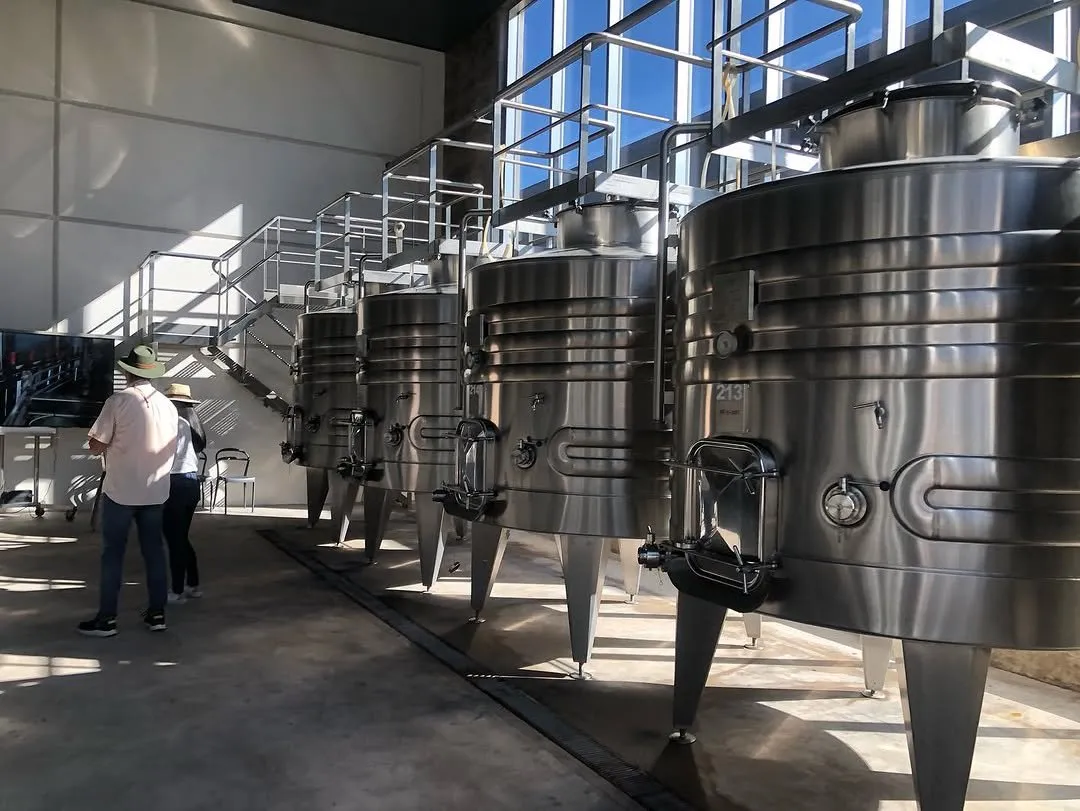
Fermentation is the microbial transformation of a food: lactic in milk, alcoholic in must and acetic when wine turns to vinegar. All three words come up in any search, and the three are not the same process. One happens in the cheese vat, another in the wine tank, another in the mother of vinegar, in the air. Cramming them into a single verb without saying which is the quickest way to explain a cheese, a Canarian wine or gofio badly.
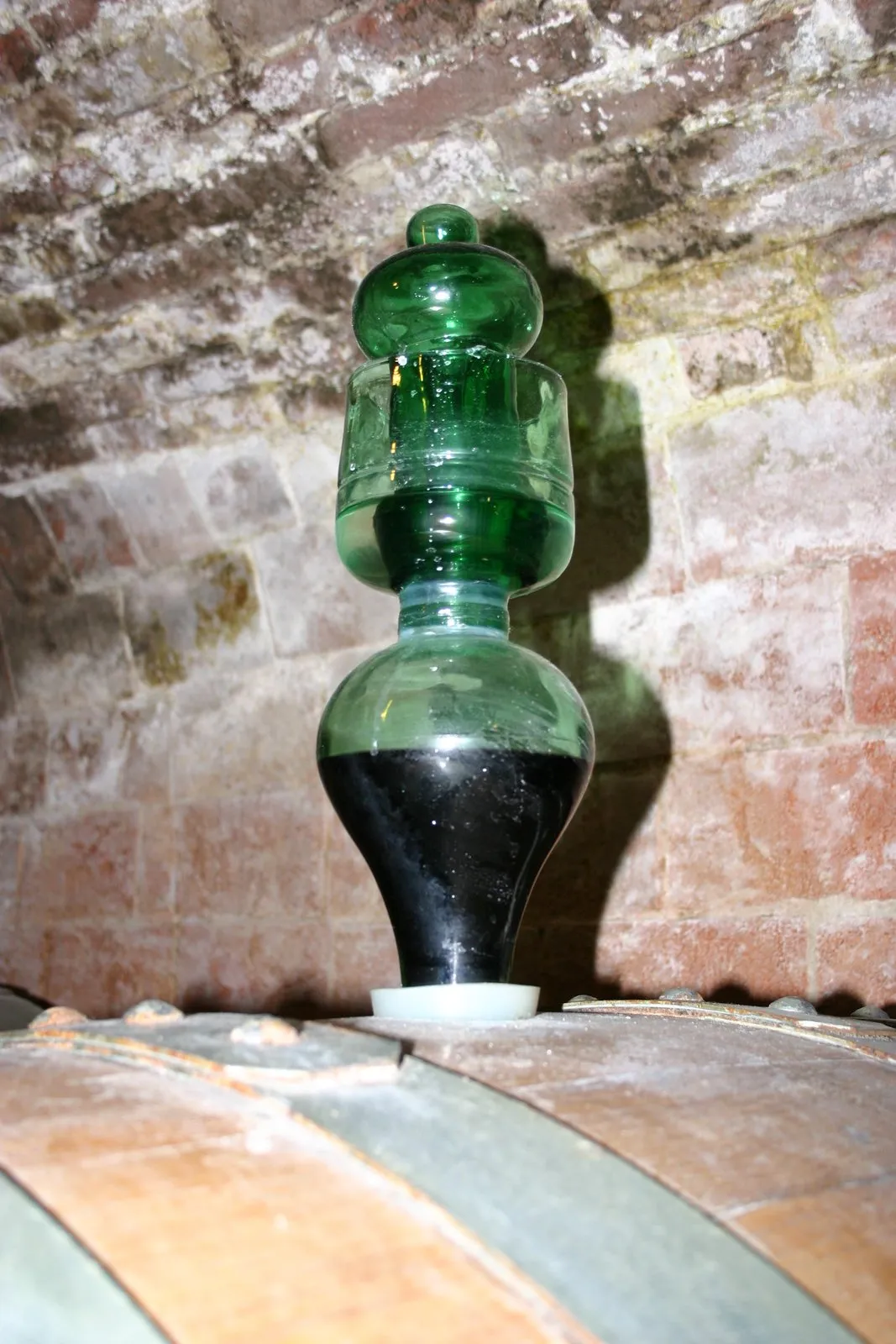
The lead image shows tanks from a winery in Tarija, Bolivia, not a winery in Lanzarote or Tenerife. The airlock is a generic barrel seal. The glasses are finished wine. None of the photos claims to be the portrait of a Canarian designation. The archipelago enters the text, through its wines and cheeses, not in the image caption.
Three results, not one
OpenStax, in its chapter on microbial metabolism, describes two anaerobic fermentations that the kitchen recognises at once. In the lactic one, pyruvate ends up as lactic acid. It is the route of the bacteria that sour milk and give cheese and yoghurt their acid. In the alcoholic one, pyruvate ends up as ethanol and carbon dioxide. It is the route of the yeasts of wine and beer: the sugar of the must is split into alcohol and gas. The airlock in the gallery exists to let that gas out without opening the tank to the air.
The third, the acetic, does not fit that strict definition of anaerobic fermentation. Acetic bacteria take the ethanol and, in the presence of oxygen, oxidise it to acetic acid. In the kitchen and in the vinegar cellar it is still called acetic fermentation, and the name is useful if the air is not forgotten. A sealed must seeks alcohol. An aerated wine, with the right mother, seeks vinegar. Sealing vinegar too much stops it; opening wine too much diverts it.
| Route | Who carries it out | What it produces | Air |
|---|---|---|---|
| Lactic | Lactic bacteria | Lactic acid | Not needed |
| Alcoholic | Yeasts | Ethanol and carbon dioxide | Not needed |
| Acetic | Acetic bacteria | Acetic acid | Needed |
The table is not a recipe. It gives no vat temperatures and no days in the vat. It gives the contract of each route, which is what stops anything that smells being called “fermented”.
In the kitchen
Cheese is the lactic example that any island kitchen has to hand. The milk acidifies because the bacteria produce lactic acid, the curd changes texture and, over time, the cheese keeps evolving. That drop in acidity is the subject of acidification: not all acidification is biological (vinegar or an acid can be added) but that of fresh cheese is. Majorero cheese is the Canarian case with a specification, not the only possible cheese.
Wine is the alcoholic example. The must ferments, the gas pushes, the ethanol stays. The glasses in the gallery have already passed that stage. In the Canary Islands that wine, when it meets a specification, carries a designation of origin under the wine regime, which is not the same legal drawer as that of a cheese. The list of those designations is in the entry on protected designation of origin. Fermenting does not grant the seal. The seal asks for area, varieties and the rest of the specification. A wine fermented in a garage is not, for having fermented, a PDO.
Vinegar closes the chain. It is wine that has carried on, with oxygen, towards acetic acid. In the kitchen it acidifies salads, pickles and marinades (that of the Majorero baifo contains wine vinegar) and it is not “half-fermenting”. It is on the third route. Using it as if it were still wine is a purchasing error, not a stylistic one.
Available water decides whether any of this can happen. A dry food does not host the same life as a vat. That measure is water activity. That is why drying, salting or toasting are conservation strategies distinct from fermenting: they remove the medium or change it, instead of inviting the microorganism to finish the job.
In the Canary Islands, and gofio apart
The archipelago ferments wine on every island that has vines and a designation, and ferments milk in the dairies. That is real rootedness: there is no need to invent a generic “Canarian ferment”. Each winery and each dairy has its vat, its culture and its specification if it has one. What they share is the route, not a single recipe.
Gofio calls for a different sentence, because the mistake is common. Grain is toasted and milled. The PGI specification describes cereals, optional sea salt, a ceiling on toasting temperature and the hand of the miller. It does not describe a yeast inoculation or a wait in a vat. Gofio is not a fermented food. It can accompany a fermented cheese, or be worked into an escaldón with broth, and still be toasted flour. Calling it a ferment because it is “ancestral” confuses antiquity with metabolism.
Nor is mojo, for containing vinegar, a fermentation taking place in the mortar. The vinegar arrives already made. Garlic and cumin do not turn the oil into another microbial route merely by being mixed. If someone ferments a chilli on purpose, that will be another preparation, with another time and another vessel, and it will have to be named as such.
What to look at when someone says “fermented”
The word has become a menu adjective. Before believing it, four questions fit. Which microorganism was invited, or which was already in the milk or the must? Is the result lactic acid, alcohol or acetic acid? Was there air or was it avoided? Did the food have enough water for it to happen? If the answer is “we toasted it and milled it”, there was no fermentation. If the answer is “the milk set”, the route is lactic. If it is “the must frothed with gas in the tank”, it is alcoholic. If it is “the wine turned in the air”, it is acetic, even if the involuntary souring is not the vinegar one wanted.
Those four questions hold in an island winery and in a cheese vat. They also hold for not buying a bread, a grain or a flour with an adjective the process does not support. Gofio is the local reminder. Wine and cheese are the proof that, when fermentation does happen, the Canary Islands have it registered, protected and put on the table.
Preserving is not the same as fermenting
Salting, drying, smoking, refrigerating and freezing extend a food without inviting a lactic, alcoholic or acetic route. Sometimes they coexist: a cheese is salted and has also fermented; a wine is kept cold after having fermented. The order matters. First the transformation happens, if it happens. Afterwards, preservation slows it or steers it. Saying that a food “was salt-cured and therefore fermented” skips that order. Salting lowers the available water and usually hinders many microorganisms. It can select others, and then there is indeed a specific fermentation that must be named. If neither the microorganism nor the result is named (acid, alcohol or acetic), the word is just decoration.
On the islands, cheese and wine are the two most visible fermented products with a protected name. The wine vinegar that goes into marinades is the third, already converted. Gofio, freshly made mojo and baifo meat in the pan do not join the list for being Canarian. They join only if someone, on purpose, has steered one of the three routes. That discipline of vocabulary is what keeps the word useful on a menu and in a textbook at the same time.
The carbon dioxide of the alcoholic route explains the airlock and also the danger of a completely sealed tank: the gas needs an outlet. It is not an amateur’s detail. It is the same physics that swells a vat. The lactic route does not seek that froth of gas as its main signal; it seeks the acid and the curd. Confusing the two signals (bubble versus acidity) is another way of naming the process wrongly.
In kitchen practice, the order of work also separates the routes. The milk is tempered, seeded or left to its own culture, and the curd is awaited: that is lactic, and the clock is measured in acidity, not in beer bubbles. The must is put in the vat, the density and the gas are watched, and it is protected from the air until the sugar that was meant to be transformed is already ethanol: that is alcoholic. The wine destined for vinegar is moved to a wide vessel, with the mother, and left to breathe: that is acetic. Doing all three in the same bucket, on the same day, does not produce a “fermented superfood”. It produces a liquid nobody can tell which route it is on.
The Canary Islands have all three in plain view without needing a laboratory. The goat cheese of the dairies, with or without a PDO, shows the first. The wineries of the eleven wine designations (the count is in the entry on the seal) show the second. The wine vinegar of the marinade shows the third, already finished, bought ready-made. Gofio, once more, shows the limit: toasting is not fermenting, even if the toasting smells intense and the powder is ancient. Intensity and antiquity are not metabolism. That is why the word, on a Canarian menu, gains precision when accompanied by the real food: cheese, wine, vinegar. It loses precision when stuck to any product in the pantry just because it sounds like an old craft. The old craft of gofio is the toasting and the stone or the mill. The old craft of wine is the vat. They are not interchangeable, and the diner notices on the first sip: one rasps of toasted cereal and the other brings alcohol or acid, depending on the route that has been allowed to finish.
Related terms
- Acidification — the drop in pH, biological in cheese and also chemical when the acid is added.
- Water activity — the available water without which the microorganism does not work.
- Gofio — toasted, milled cereal: the Canarian example of what is not a fermentation.
- Protected designation of origin — the regime that covers wines and cheeses, distinct from the mere vat.
- Majorero cheese — a cheese with a PDO whose milk has gone through the lactic route.
- Baifo — the Majorero marinade contains wine vinegar, already on the acetic route, not a fermentation of the meat.
Sources
 — view the full-size photo
Airlock on a barrel. It lets the gas of alcoholic fermentation out and makes it harder for air to get in.  — view the full-size photo
Finished wine, red and white. It is the result of alcoholic fermentation, not the must inside the tank.
Photos: 1. Marco Daniele (opens in a new tab) (CC BY-SA 3.0 (opens in a new tab)) · 2. A.Savin (opens in a new tab) (CC BY-SA 3.0 (opens in a new tab))
Frequently asked questions
What is fermentation?
What is the difference between lactic and alcoholic fermentation?
Is vinegar a fermentation?
Is gofio fermented?
What does it have to do with acidification?
Why does the water in the food matter?
Also in the glossary
Gofio
Canarian gofio is the flour obtained on the islands by milling toasted cereals, with or without sea salt, covered by a PGI.
Hydrocolloids
Hydrocolloids are polysaccharides that, dispersed in water, thicken or gel a food: agar, xanthan, gellan, carrageenan and pectin.
Indication, geographical, protected (PGI)
A protected geographical indication is a European name that identifies a product from a specific place when at least one of its stages takes place there.