Hydrocolloids: agar, xanthan, gellan, carrageenan and pectin
- Term
- Hydrocolloids
- Tags
- Gelling agents · Gums · Thickeners · Food science
- Published
Hydrocolloids are polysaccharides that, dispersed in water, thicken or gel a food: agar, xanthan, gellan, carrageenan and pectin. The name frightens more than the function. They are the gums and gelling agents that decide whether a sauce flows, whether a flan wobbles or whether a jam sets. They are not a single ingredient with five nicknames. Each has a European code, a temperature or a pH, and a different failure if asked to do another’s job.
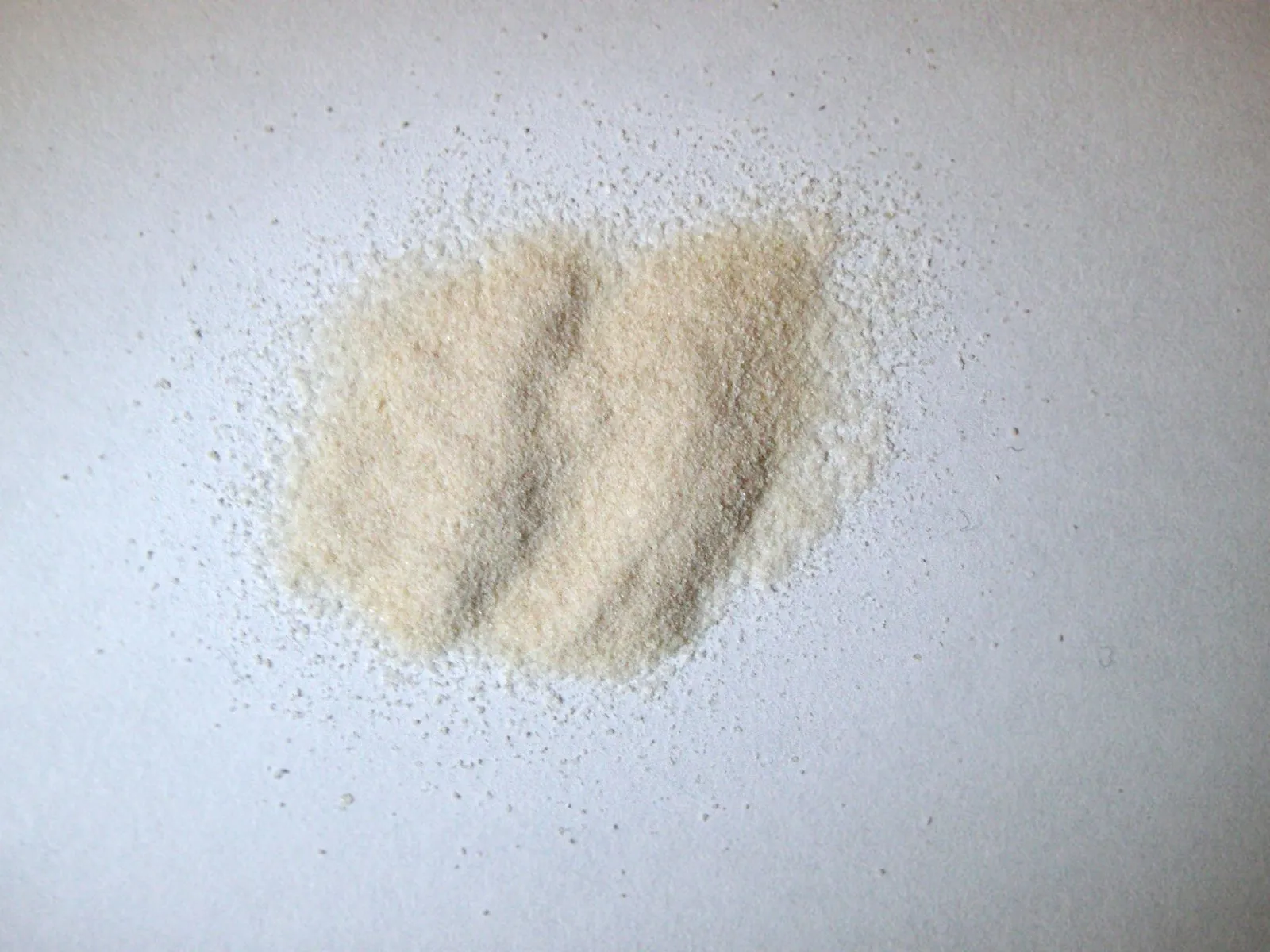
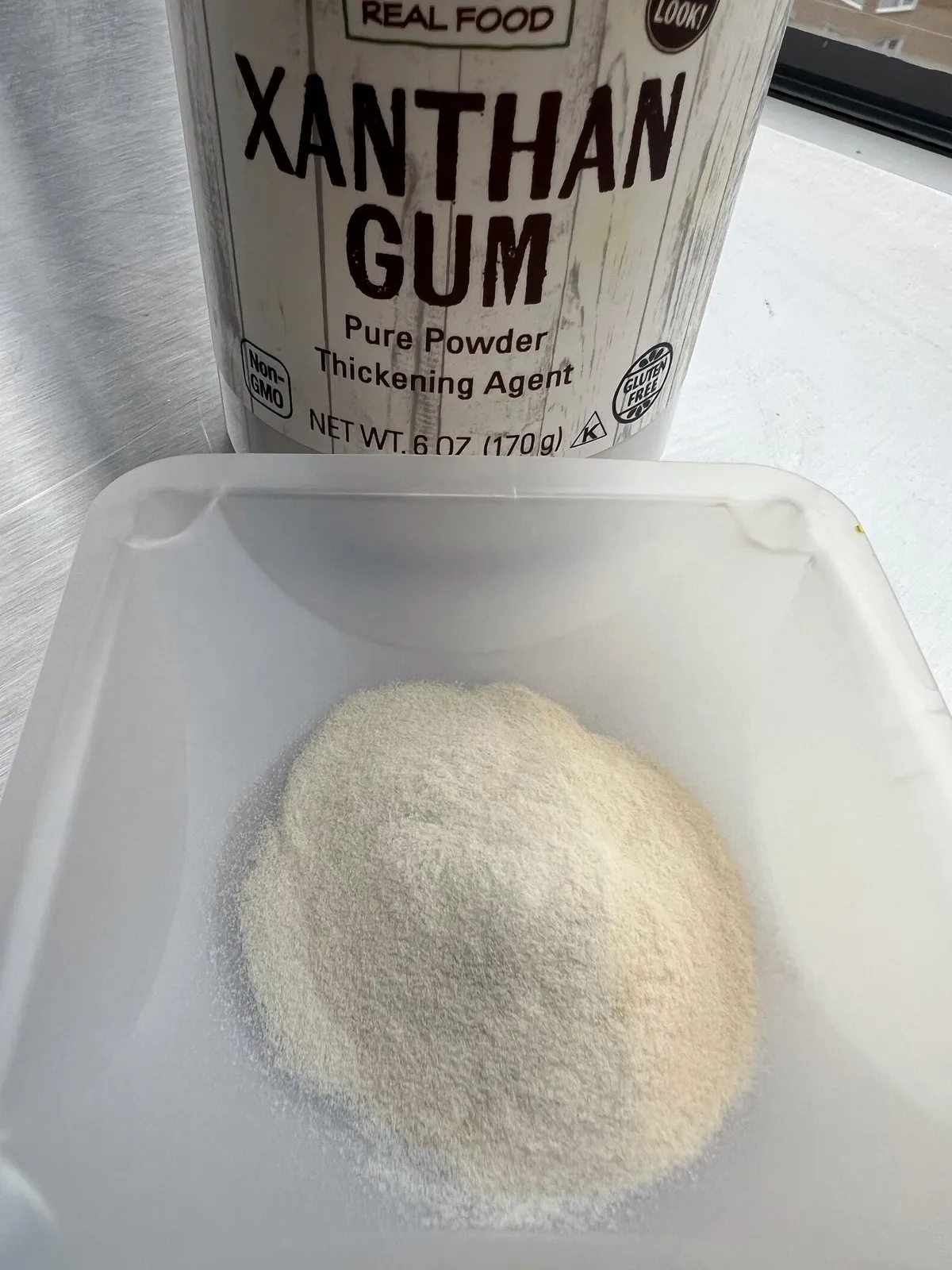
The lead image is dry strips of agar. The second photo is xanthan powder, distinct from the tub that already illustrates the xanthan entry. The third is a historical plate of kanten, the seaweed agar comes from, in the public domain. None is a plated dish. They are the raw material before the pot.
Five, not a single drawer
A hydrocolloid disperses in water and forms a network. If the network traps the water and the whole stops flowing, there is a gel. If it only slows the flow, there is thickness. Xanthan lives almost always in the second group. Agar, gellan, carrageenan and pectin know how to do the first, each with its own key: temperature, salts, sugar or acidity.
The codes used by European legislation, which EFSA re-evaluates one by one, are E 406 for agar, E 415 for xanthan, E 418 for gellan, E 407 for carrageenan and E 440 for pectin. The code does not give a restaurant’s dose. It says which substance it is. The figures in the table below come from those opinions or, for agar, from the range its own entry already fixes with the source cited there. They are not the recipe of an avant-garde manufacturer.
| Hydrocolloid | Code | What it does, with the source alongside |
|---|---|---|
| Agar | E 406 | Gels between 32 and 42 °C and melts above 85 °C. |
| Xanthan | E 415 | On its own it gives no firm gel; with locust bean gum, that gel appears below 40 °C. |
| Gellan | E 418 | Thermoreversible gels, stable up to 90 °C and at a pH of 3.5 to 8. |
| Carrageenan | E 407 | Temporary group ADI of 75 mg per kg of body weight per day. |
| Pectin | E 440 | High-methoxyl pectin gels below a pH of about 3.6 if the sucrose exceeds 55 %. |
Reading the table as a “cook’s dose” is the mistake to avoid. The xanthan test in the opinion mixes the gum with locust bean gum to identify it, not to say how many grams go into a sauce. The carrageenan ADI is a group toxicological limit, temporary in the 2018 opinion, not a spoonful. The 55 % of sucrose for pectin is the gel condition of the high-methoxyl type, cited by EFSA, not the sugar of just any dessert.
Each one in the pot
Agar (E 406) dissolves hot and sets on cooling, between 32 and 42 °C, but does not melt again until it passes 85 °C. That hysteresis is what allows gels that hold up on a warm plate where animal gelatine would already have gone. The detail, the seaweeds and the uses are in the entry on agar-agar. The kanten plate recalls where it comes from: a dried seaweed, not an anonymous powder.
Xanthan (E 415) is the thickener for sauces that have to flow without splitting, cold too. The European re-evaluation opinion describes the firm gel only in the company of locust bean gum, when the mixture drops below 40 °C; a solution of xanthan alone, prepared the same way, does not form it. In kitchen practice, that means xanthan does not replace agar if what is wanted is a block. It replaces, if anything, a long reduction when body is needed without gelatine. The entry on xanthan goes down to the organism that produces it and the uses already published.
Gellan (E 418) forms gels on heating and cooling. EFSA records, from the literature it reviews, that those gels hold up to 90 °C and a pH between 3.5 and 8. Native gellan, with its acyl groups, gives soft, elastic gels. The deacylated one gives firm, brittle gels. This is not a catalogue nuance: it changes the bite. A brittle gel in a dish that asked for a wobble, or an elastic one where a clean cut was wanted, means the wrong variant of the same code was chosen.
Carrageenan (E 407) is the classic gelling agent of many dairy products. The 2018 opinion maintained a temporary group acceptable daily intake of 75 mg per kg of body weight per day, shared with processed Eucheuma seaweed, pending the closing of uncertainties the panel left in writing. For the kitchen, the useful sentence is neither to frighten nor to over-reassure: it is to know that carrageenan has a numerical toxicological ceiling, unlike others on this list for which the panel did not set an ADI with a figure. The doses of an industrial dessert and those of a restaurant trial cannot be deduced from that 75.
Pectin (E 440) is the one in fruit and in jam. EFSA distinguishes pectin and amidated pectin. In the high-methoxyl type, more than half the carboxyl groups are methylated; in the low-methoxyl type, fewer than half. The high-methoxyl type gels when the pH drops below about 3.6 and there is a co-solute (almost always sucrose) above 55 % by weight. The low-methoxyl type can gel with calcium, without that mountain of sugar. That is why a firm jam and a light nappage do not carry “pectin” plain: they carry one of the two, and swapping them changes the dessert.
Beside spherification
Alginate is also a hydrocolloid, and it is not in the table because its famous job is not to thicken a block but to make a skin with calcium. That technique is spherification. Asking agar for a liquid sphere, or asking alginate for the hysteresis of agar, mixes two mechanisms. Both come from seaweeds. They do not make the same gel.
Nor does this list exhaust the gums. Locust bean gum appears only as xanthan’s companion in the European test. Animal gelatine is not a hydrocolloid of this group: it is protein, it melts in the mouth, and agar was defined for decades precisely by not being it. If the dish needs that melt, agar is redundant. If it needs to withstand heat, gelatine is redundant.
In the kitchen
The generic name comes first. Agar, xanthan, gellan, carrageenan, pectin. A commercial house may pack them and give a range of grams per litre in its datasheet. That range is a fact about that product, useful in the workshop, and it holds for that product: the exact dose is always fixed by the pack in front of you.
Those five names are not lent to one another. Agar sets with the cold and melts again with a great deal of heat. Xanthan, on its own, thickens and does not build the block that it does build together with locust bean gum. Gellan changes the mouthful according to whether it is native or deacylated. Carrageenan gets along with milk. Pectin asks for sugar and acidity, or for calcium, according to the type. The table separates those keys. The pack in front of you fixes the amount, and no brand turns its range into a law for the rest.
The practical order, when trying a new gel, is short. Identify the code. Know whether the key is temperature (agar, gellan), the partner (xanthan with locust bean gum), sugar and pH (high-methoxyl pectin) or calcium (low-methoxyl pectin, alginate). Disperse without lumps, normally with the powder mixed into sugar or oil according to one’s own datasheet, and do not boil blindly what the opinion describes as sensitive. Carrageenan, besides, is looked at with the ADI figure in mind if the preparation is industrial and the portion is large; in a restaurant tasting the problem is usually one of texture before one of milligrams.
Mistakes the table already avoids
Asking xanthan for a flan is asking it to do the work of agar or gellan. Asking agar to thicken a cold vinaigrette in a minimal amount, without setting it, is moving closer to xanthan. Asking high-methoxyl pectin to set a purée without sugar and without acidity is ignoring the 3.6 and the 55 %. Asking the low-methoxyl type for a classic high-sucrose jam, without looking at the calcium, is the symmetrical error. Carrageenan in a dairy product and agar in a clear broth are not interchanged just because both “gel”: the first works with milk protein and the second with water and heat.
Dispersion is the other failure, prior to temperature. A badly wetted hydrocolloid makes lumps that no longer break up on boiling. That is why the powder is mixed with sugar, with oil or with a strong whisking, according to the product, before asking for the network. The table does not replace that gesture. It only prevents choosing the wrong polysaccharide and then blaming the fire.
When the gel comes out opaque, brittle or excessively elastic, the cause is usually in the variant (native or deacylated gellan, high- or low-methoxyl pectin) and not in “having boiled too little”. Turning up the heat does not turn one code into another. Turning it down does not either. The thermometer is useful with agar, between 32 and 42 °C for setting and above 85 °C for melting again, and useful with gellan up to the 90 °C ceiling that the literature cited by EFSA gives as stability. Outside that, the instrument that counts is the datasheet on the pack, not a spoonful inherited from another gum. And if the gel weeps water after a few hours, the technical name is syneresis: the network releases part of the liquid it had trapped. It is not always a hygiene defect. Sometimes it is the wrong gum for the time the dish will wait in the chamber. Changing hydrocolloid, not “fixing” it with more heat, is the correction the table suggests.
Related terms
- Agar-agar — E 406, with the hysteresis between 32 and 42 °C and the melting above 85 °C.
- Xanthan — E 415, a thickener that does not gel on its own.
- Spherification — alginate and calcium: another hydrocolloid, another skin.
- Acidification — the pH that high-methoxyl pectin needs below 3.6.
- Amino acids — not hydrocolloids; if the gel tastes of anything, the flavour is in another chemical family.
Sources
 — view the full-size photo
Xanthan powder. It thickens; the firm gel of the European opinion appears when it is combined with locust bean gum. 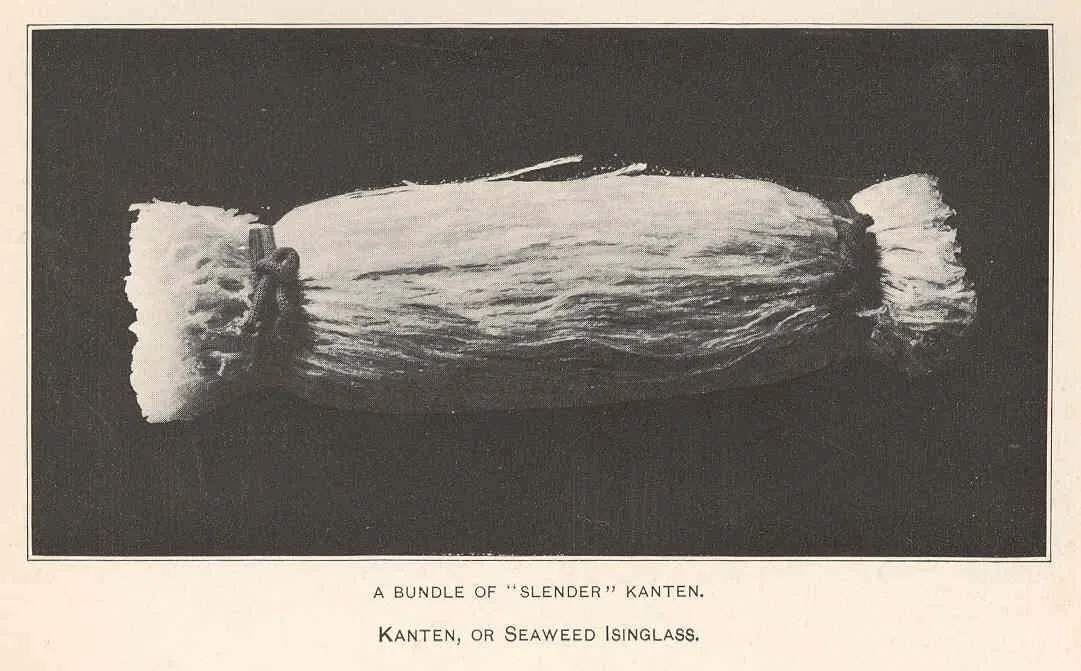 — view the full-size photo
Kanten, the dried seaweed of agar, in a plate from the early twentieth century. It is the origin of the ingredient, not an assembled gel.
Photos: 1. Awkwafaba (opens in a new tab) (CC BY-SA 4.0 (opens in a new tab)) · 2. Hugh McCormick Smith (opens in a new tab) (Public domain)
Frequently asked questions
What is a hydrocolloid?
At what temperature does agar gel?
Does xanthan gel on its own?
What is the difference between gellan and carrageenan?
When does pectin gel?
Is spherification a hydrocolloid from this list?
Also in the glossary
Indication, geographical, protected (PGI)
A protected geographical indication is a European name that identifies a product from a specific place when at least one of its stages takes place there.
Jamón ibérico
Iberico ham is the cured hind leg of the Iberian pig, with a sales denomination that obliges the label to state the feeding, the breed and the seal.
Kombu
Kombu is the brown seaweed Saccharina japonica, dried or rehydrated, from which dashi is made and from which glutamate took the name umami.