Kombu: the seaweed of dashi and glutamate
- Term
- Kombu
- Tags
- Seaweed · Avant-garde cuisine
- Published
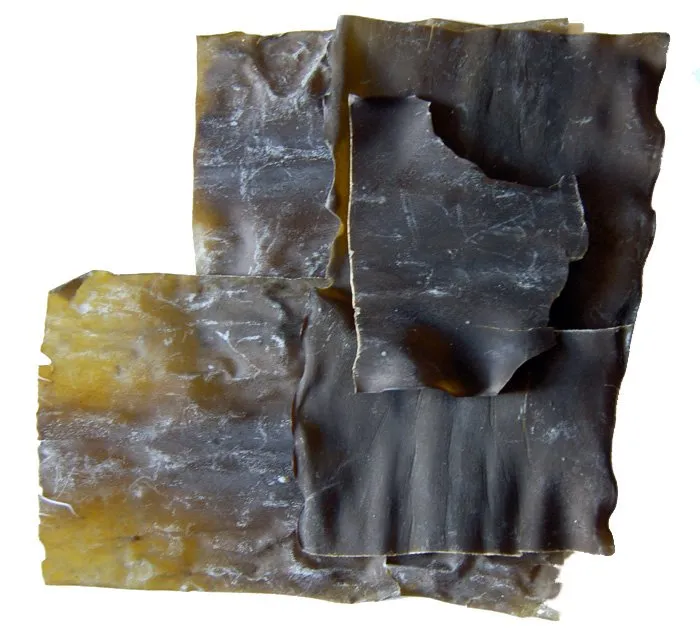
Kombu is the brown seaweed Saccharina japonica, dried or rehydrated, from which dashi is made and from which glutamate took the name umami. In the pantry it looks like dark leather. In water it releases a clean stock, without the toasting of a roasted base. That difference —infusion against reduction— is what avant-garde cooking went looking for when it wanted umami without passing through a roast.
The photos show the seaweed, not the wind instrument of southern India that is also called kombu. The lead image is a dried piece. The gallery adds the long pantry sheet and the fine cut that in Japan is called suki kombu. All three are the same organism presented another way.
The seaweed and the name
Saccharina japonica is a brown seaweed. The Spanish Agency for Food Safety and Nutrition names it so and keeps beside it the name under which it circulated earlier in the opinions: Laminaria japonica. Both point to the kombu of the iodine note. They do not point to just any coastal seaweed. A wrack, a moss or a sea lettuce can be kitchen seaweeds and are not this species.
The seaweed is dried to keep it and to concentrate what it will later yield to the water. The piece in the photo, wrinkled and dark, is that format. Rehydrating it does not turn it into a long-sauté vegetable: the spent blade is removed from the stock, or cut into strips when the cut is that of suki kombu and the destination is the stew. Treating it like spinach —high heat, large quantity— changes the dish and sends the iodine soaring, which is the other matter here.
The name travels. In a spice catalogue it may appear beside katsuobushi, the dried bonito that often completes dashi. The bonito brings another flavour molecule, inosinate, which reinforces itself with the glutamate of the seaweed. That pair is classic dashi. The seaweed alone already has work to do: it is the half that Ikeda isolated.
Dashi, glutamate and 1908
In 1908, Kikunae Ikeda, professor at the Tokyo Imperial University, identified in kombu the component of taste that did not fit sweet, sour, salty or bitter. He called it umami. The Japan Patent Office summarises the next step: he obtained a method to crystallise monosodium glutamate from that component and leave it as a seasoning. Commercial production came with Saburosuke Suzuki, the origin of the company that sold it. The discovery and the industrial salt share the year and are not the same gesture. One describes the seaweed. The other manufactures a powder.
The glutamate Ikeda speaks of is the anion of glutamic acid, an amino acid. In kombu it is in the tissue. In the tub it is as the sodium salt. That is why a dashi can taste deep without anyone having added the powder: the seaweed already carries it, and the water draws it out if temperature and time do not boil the blade until it turns bitter. The kitchen practice —water below boiling, blade out before the stock tightens— is craft. The grams per litre change with the blade and with the stock sought, and do not come from a branded tub.
Umami does not stay in the seaweed. The same amino acid appears in a ripe tomato, in a mature cheese and in a long-cured ham. The iberico ham entry covers the curing; this one covers the stock. Both reach the same taste through different pantries. Calling any enhancer “kombu” is skipping the species.
In sensory appreciation umami is a basic taste, not an ornament of the description. Whoever names it in a tasting of dashi is naming the glutamate of the seaweed, at times added to the inosinate of the bonito. Whoever names it in a meat reduction is in another product. The word serves in both places if it is not used to say that everything tastes of seaweed.
Iodine
AESAN published consumption recommendations precisely because of the iodine in brown seaweeds, and singled out kombu as the high case. The note rests on opinions of EFSA and of the agency’s own scientific committee, and on the 2019 prospective study of metals and iodine in seaweeds sold in Spain, EP 10 19 ALG. In that study the iodine of kombu (Laminaria japonica, Saccharina japonica) stood out. Recommendation (EU) 2018/464 is the control framework the note cites.
The recommendation, while the European Commission sets no other risk management, is addressed to specific populations. Whoever has a thyroid dysfunction, or takes medicines that contain iodine, should avoid foods with seaweed and kombu in particular. In the absence of sufficient data to measure the risk in the child population, the agency recommends that seaweed be avoided by children, and also by pregnant or breastfeeding women.
That is not a ban on dashi in a professional kitchen serving adults without that condition. It is a limit of menu and of house: the quantity of seaweed is not neutral, and “natural” does not mean “unlimited”. A short stock, from which the blade is removed, is not the same as eating the whole sheet or taking a seaweed supplement. The note does not publish, in the paragraph used here, a milligram per kilo: it publishes the risk group and the name of the species. That is enough not to treat kombu as just another vegetable.
In the kitchen
The basic gesture is infusion. The sheet is cleaned of the white surface powder only in part: that powder is often the glutamate itself and other solutes, and sweeping it all off impoverishes the stock. It is submerged in cold or lukewarm water and heated without holding a violent boil. When the stock takes on body, the blade comes out. If the cut is wanted, suki kombu goes into the stew as a strip, not as the whole sheet of the infusion.
Stored, dry kombu wants an opaque jar and little humid air. A sheet that softens in the pantry yields worse and smells of warehouse, not of clean sea. It is broken by hand or with scissors: the knife slips on the dry blade and splinters it. One piece is enough for a generous litre of stock; the rest goes back in the jar. That piece, once infused, can follow into a stew if it is cut, or be removed if the dish only wanted the water.
Kombu also salts and softens pulses in some kitchens, through the same solutes. That use does not erase the iodine: it spreads it through the pot. It balances out, in a dish for adults, with little blade and with the rest of the meal. It does not balance out in a children’s dish or a pregnancy menu.
In avant-garde cooking the seaweed appears where umami is needed without the sugar of a reduced wine or the crust of a roast: a vegetable stock, a pil-pil, a cream, a short marinade. The generic name is kombu or Saccharina japonica. The brand on the packet is an example of a purchase, not the definition. A powder labelled seaweed extract may be another concentration: the pack is read, because the AESAN caution looks at the iodine, not at the prestige of the stock.
The product is Japanese in origin and in name. It reaches the professional pantry through dashi and through glutamate, just as other seaweeds arrive through the gel. Agar, which is also a seaweed, gels; kombu flavours. Putting the two in the same bowl confuses a hydrocolloid with a stock.
Related terms
- Amino acids — the glutamate that Ikeda isolated from kombu in 1908.
- Sensory appreciation — umami as a taste, not as a loose adjective.
- Iberico ham — another food where long curing releases glutamate.
- Spherification — another avant-garde technique, which does not use the seaweed as a gel.
- Hydrocolloids — the family of agar and xanthan, distinct from this stock.
Sources
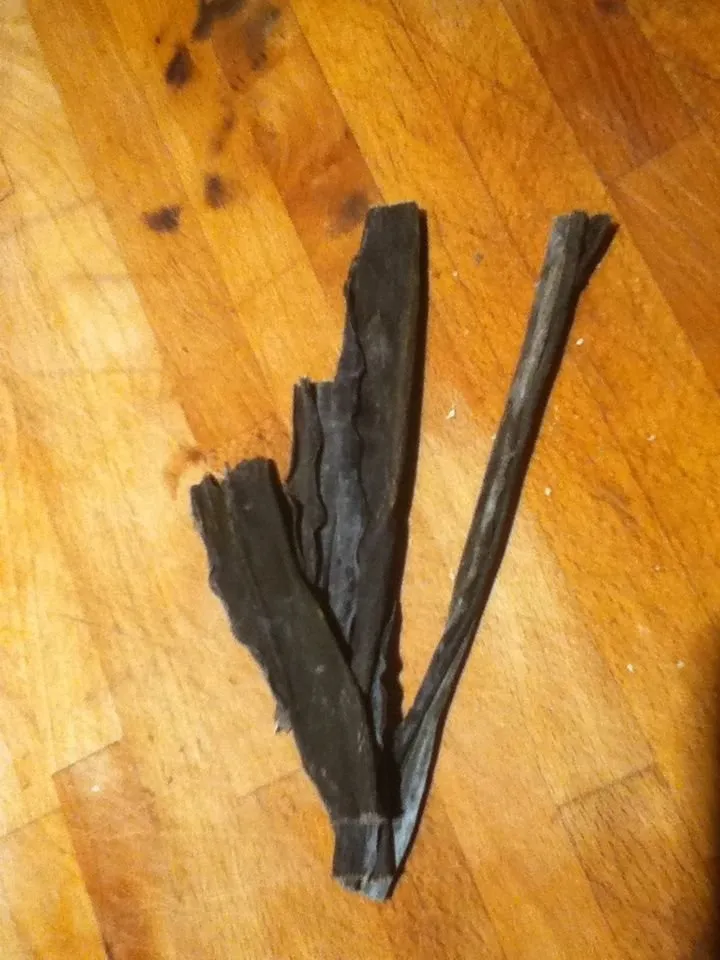 — view the full-size photo
Dried kombu in sheets. This is how it travels and how it is infused: the blade is not eaten whole like a pan-fried vegetable. 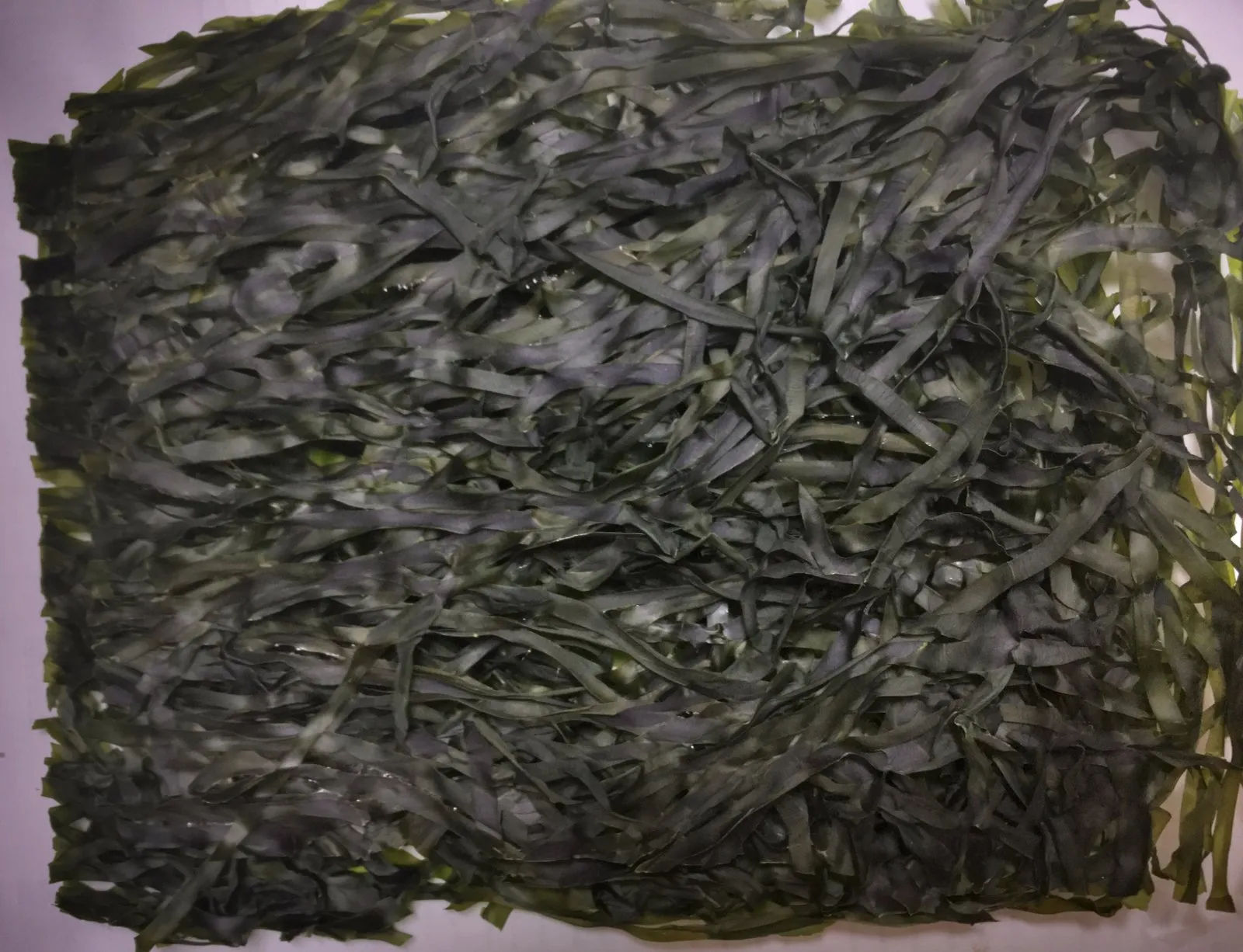 — view the full-size photo
Suki kombu, the seaweed cut in thin strips. It is still Saccharina japonica, presented for the stew and not only for the stock.
Photos: 1. Selinarif (opens in a new tab) (CC BY-SA 3.0 (opens in a new tab)) · 2. Nesnad (opens in a new tab) (CC BY 4.0 (opens in a new tab))
Frequently asked questions
What is kombu?
What is dashi?
Who linked kombu with umami?
Can kombu be eaten without limit?
Is kombu the same as the instrument?
Is the glutamate of kombu an additive?
Also in the glossary
Lapas (Canarian limpets)
Limpets are molluscs of the genus Patella clinging to the rock; in the Canary Islands some are gathered subject to a size limit and a closed season, and the majorera cannot be taken.
Majorera goat
The Majorera goat is the native goat breed of Fuerteventura that the Official Catalogue has recognised since 2003, and the dairy base of Majorero cheese.
Majorero cheese
Majorero cheese is a pressed-paste cheese with a protected designation of origin, made on Fuerteventura with milk from goats of the Majorera breed.