Limpets: the genus Patella and the protected majorera
- Term
- Lapas (Canarian limpets)
- Tags
- Shellfish · Canary Islands · Recipes
- Published
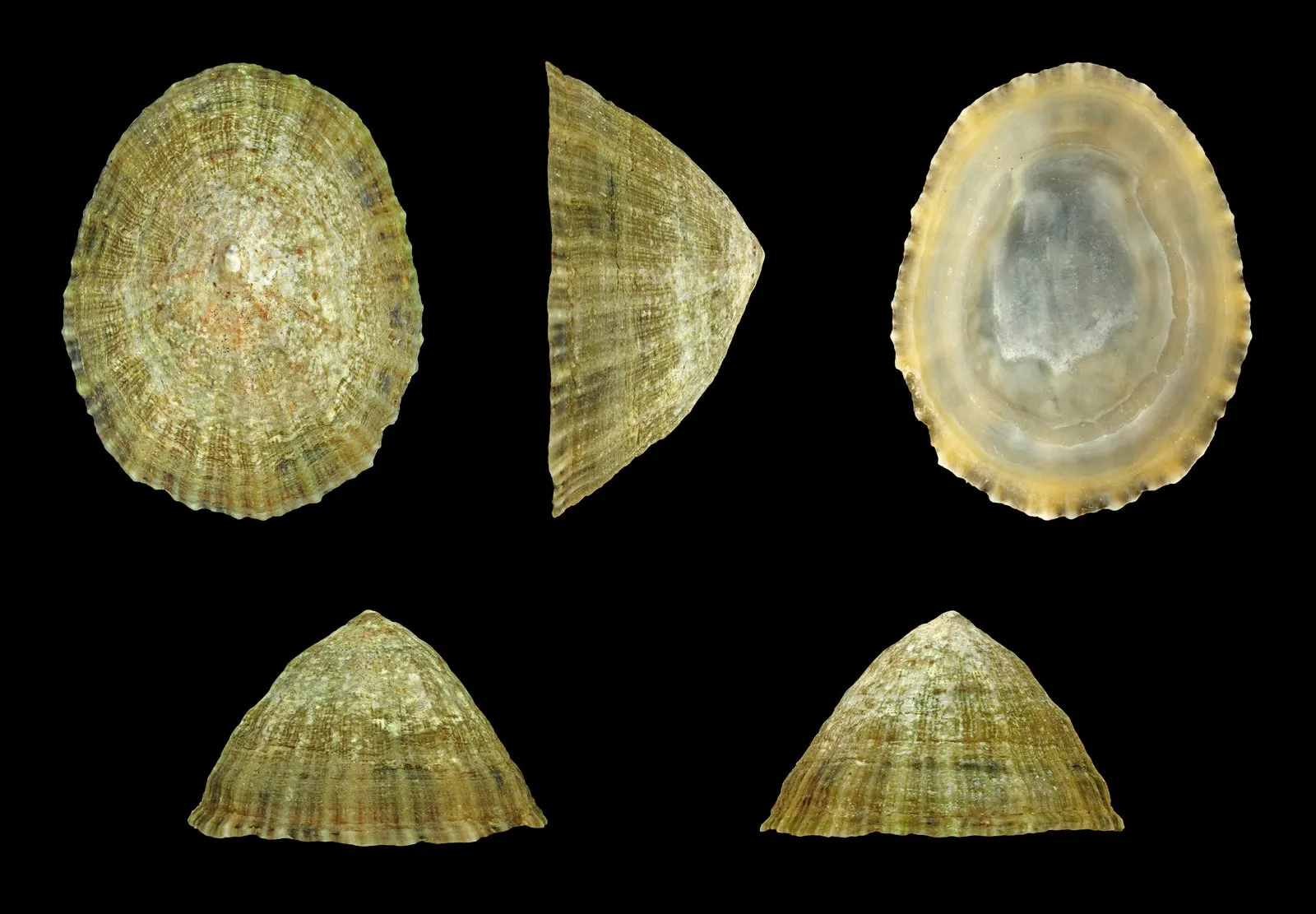
Limpets are molluscs of the genus Patella clinging to the rock; in the Canary Islands some are gathered subject to a size limit and a closed season, and the majorera cannot be taken. The sentence separates two things that are confused at the table: the mouthful and the species. A conical shell on the griddle may be legal or may be an animal in danger of extinction. The genus is not enough to decide.
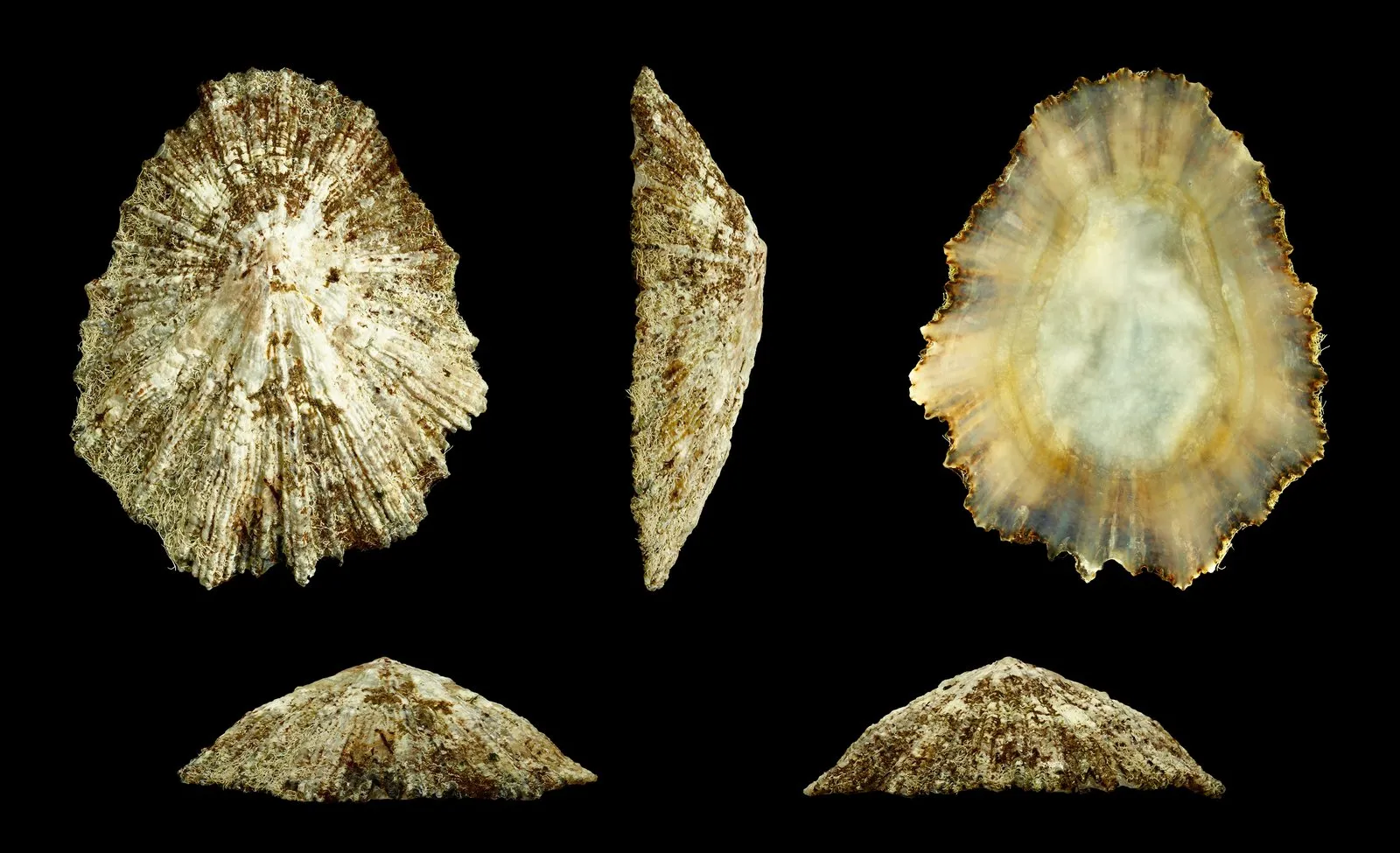
The photos are collection shells. The lead image is Patella vulgata, a limpet of the European Atlantic, useful for seeing the shape and not on the Canarian gathering list as if it were the white or the black. The gallery adds Patella aspera, close to the white limpet of the islands, and another radiate vulgata. None of the three is the majorera limpet. None replaces a piece measured on the shore.
The animal
Patella is a gastropod of the family Patellidae. The shell is a low cone that the animal fits into the rock of the intertidal zone. It feeds on the biofilm of that rock and returns to the same fit, so that shell and stone wear down together. Prising it off is easy with a blade and that is precisely why the pressure is hard to undo: the animal does not swim, does not hide in a deep bottom and low tide leaves it within reach of the hand.
In the Canary Islands local speech distinguishes by foot and by sun. The white limpet, or white-footed, is Patella ulyssiponensis aspera. The black limpet, or black-footed, is Patella candei crenata. The curvina limpet, or sun limpet, is Patella rustica, also cited as Patella piperata. The majorera limpet is Patella candei, the form Patella candei candei. They share a genus and do not share a regime. Candei crenata is in the gathering order. Candei candei is in the catalogue of protected species. The likeness of the scientific name is a label trap, not a permit.
The majorera limpet
The Government of the Canary Islands describes the majorera as a Macaronesian endemic that, within the archipelago, is now found only on the coast of Fuerteventura. In old shell middens it appears on other islands. Gathering pressure reduced the majorera populations to small groups and to a situation that the recovery plan itself calls extremely delicate.
That situation put it in the category “in danger of extinction” of the Spanish Catalogue, through Royal Decree 139/2011, of 4 February, and of the Canarian Catalogue, through Law 4/2010, of 4 June. The Canary Islands Biodiversity Data Bank records, for Fuerteventura, taking as totally prohibited. The Recovery Plan was approved by Decree 161/2015, of 3 July: to conserve the species and its habitat, to zone the majorera shoreline and to widen what is known about so local an animal.
On the shore, the prohibition comes before the plate. There is no minimum size for the majorera because there is no legal size: it is not taken, not transported, not sold. A large limpet from Fuerteventura is not “rounded up” to white because of its size. If it is Patella candei candei, it is left on the rock. The other two that the order does allow on that island —white and black— have their own closed season, longer than in the rest of the archipelago.
Sizes, closed seasons and quotas
The Consejería responsible for fisheries publishes the minimum gathering sizes and refers to the Order of 2 May 2011. For the three authorised limpets, the major axis of the shell must measure at least 45 mm:
| Name in the islands | Species | Minimum size |
|---|---|---|
| White limpet, white-footed | Patella ulyssiponensis aspera | 45 mm |
| Black limpet, black-footed | Patella candei crenata | 45 mm |
| Curvina limpet, sun limpet | Patella rustica or Patella piperata | 45 mm |
The Order of 18 May 2011 rewrote the closed seasons so as not to coincide with spawning. Limpets and top shells (burgados) are not gathered between 1 December and 30 April, both included. In Fuerteventura the calendar narrows: only white and black, and they are not gathered between 1 July and 30 September either, both included. The curvina is not covered by the permit on that island.
The volume of the same order is 10 kg of limpets. In Fuerteventura the cap rises to 25 kg a week, which may be taken in one day or spread out. Those kilos do not include the majorera. A full quota of the wrong species is not a quota: it is a different infringement, that of the catalogue, not that of the weight.
The 2011 order also provided for closures by zone, in an annex, to let the resource recover. The calendar of the preceding paragraphs is the one that the amendment left written in the article on closed seasons, and it is the one that the Consejería’s size-limits section still uses as the framework for gathering on foot. Before a specific outing, the provision in force that day governs, not the memory of an open season.
Measuring the major axis avoids the argument of “this one looks big”. 45 mm is a shell length, not a weight of meat. A limpet below it goes back into the water, like any accidental catch below the size. Gathering on foot, professional or recreational, shares that measure.
In the kitchen
The Canarian mouthful of the legal limpet is grilled. A note on Canarian words circulated in the education network of the Government of the Canary Islands, when defining mojo, adds the phrase of the trade: when limpets are grilled, they are given a mojito of parsley or coriander. Mojo, in that same definition, is the sauce of oil and vinegar, with or without chilli and herb. No restaurant recipe with weights is needed to know the gesture: griddle, shell, mojito.
Fran Mora, in La Gomera, tells in Pellagofio of a service accident —someone did not want to eat them in the shell— and of a green mojo of miso and ginger. That is a signature dish, from 2010 onwards in his account, not the definition of the Canarian word. It serves to show that the limpet is still in the kitchens of the islands and does not serve to replace the mojito of parsley or coriander with a Japanese ingredient as if it were the rule.
The griddle has a limit that Mora himself points out: if after grilling they are passed through butter, they turn hard. The point is the moment they release from the shell, not that of a long stew. A limpet below 45 mm, or a majorera, is not “put to use” in the kitchen however small the portion. Size and species are decided on the rock, before the fire.
Mojo contains vinegar, and so the acid of the sauce connects with acidification, although the limpet is not an escabeche. The fish of the islands —the vieja, the peto— appears in recipe books next to the limpet, as in the Pellagofio pieces, and that does not turn the limpet into a fish. It remains Patella. Pollack is another entry and another animal.
In the Canary Islands
The rooting is coastal, on the seven islands with a rocky shoreline, under a regime that is not the same on all of them. Tenerife, Gran Canaria, Lanzarote, La Palma, La Gomera and El Hierro share the closed season from 1 December to 30 April and the three species of 45 mm, within what the order and the zones allow. Fuerteventura adds the second closed season, restricts the white and the black, raises the weekly quota to 25 kg and, above all, guards the majorera, which today has no other island.
La Graciosa and the islets come under Lanzarote in the fisheries administration of the reserve, with rules of their own for that area that are not summed up in the general size. Whoever goes gathering there looks at the provision of the reserve, not only at the order of 2011. The animal, in contrast, is the same genus.
On the menu of a restaurant on the island the honest name is that of the legal species and the season. “Limpets” in December, or “majorera limpet” in any month, is not a dish of produce: it is a piece outside the rule. The diner need not know the Latin. The kitchen does have to know which shell it bought.
Related terms
- Acidification — the vinegar of the mojo that goes with the grilled limpet.
- Pollack — another product of the Canarian sea, in this case a fish, not a Patella.
- Gofio — the cereal powder that sometimes shares the table with shellfish, without being the limpet.
- Canarian goat — the livestock of the island, distinct from this gathering.
- Sensory appreciation — how to describe the mouthful without confusing species and size.
Sources
- Gobierno de Canarias · Recovery plan for the majorera limpet
- Biodiversidad de Canarias · Patella candei, taking prohibited
- BOC · Decree 161/2015, recovery plan
- Consejería de Pesca · minimum sizes, Order of 2 May 2011
- BOC · Order of 18 May 2011, closed seasons and quotas
- Canarian education network · Canarian word mojo and grilled limpets
 — view the full-size photo
Patella aspera, close to the Canarian white limpet (Patella ulyssiponensis aspera). It is a collection shell, not a piece taken in the closed season. 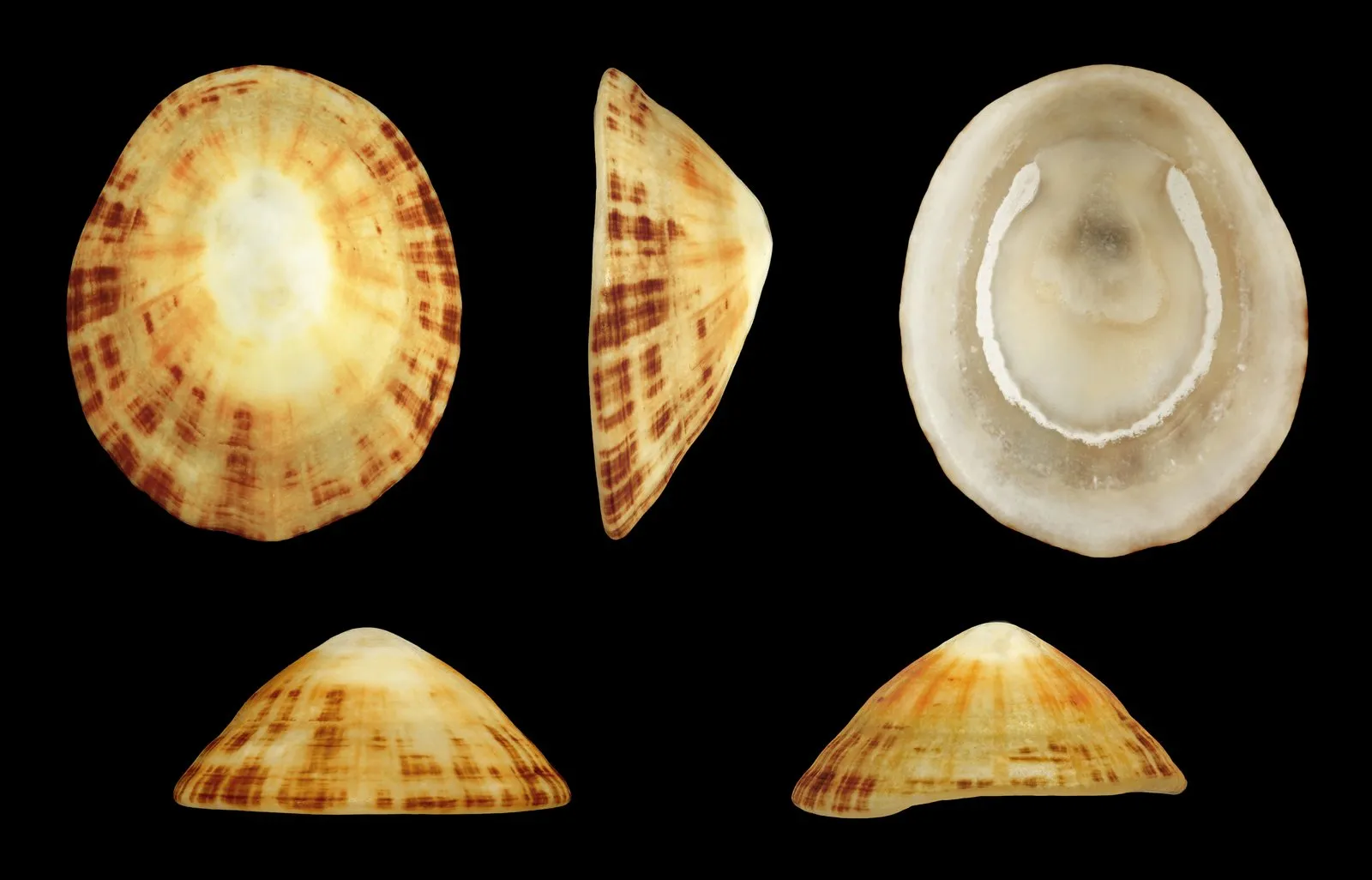 — view the full-size photo
Another Patella vulgata, radiata form. It shows the pattern of the shell. It is not the majorera limpet.
Photos: 1. Llez (opens in a new tab) (CC BY-SA 3.0 (opens in a new tab)) · 2. H. Zell (opens in a new tab) (CC BY-SA 3.0 (opens in a new tab))
Frequently asked questions
What is a limpet?
May the majorera limpet be gathered?
What is the minimum size of the limpets that may be taken?
When is the limpet under a closed season?
How many kilos may be taken?
How are limpets eaten?
Also in the glossary
Majorera goat
The Majorera goat is the native goat breed of Fuerteventura that the Official Catalogue has recognised since 2003, and the dairy base of Majorero cheese.
Majorero cheese
Majorero cheese is a pressed-paste cheese with a protected designation of origin, made on Fuerteventura with milk from goats of the Majorera breed.
Meat ageing
Meat ageing is the cold rest that lets the muscle's enzymes work, in the air of a chamber or under vacuum in its own juice.