Canarian goat: what it is and how its breeds differ
- Term
- Canarian goat
- Tags
- Canary Islands · Meat
- Published
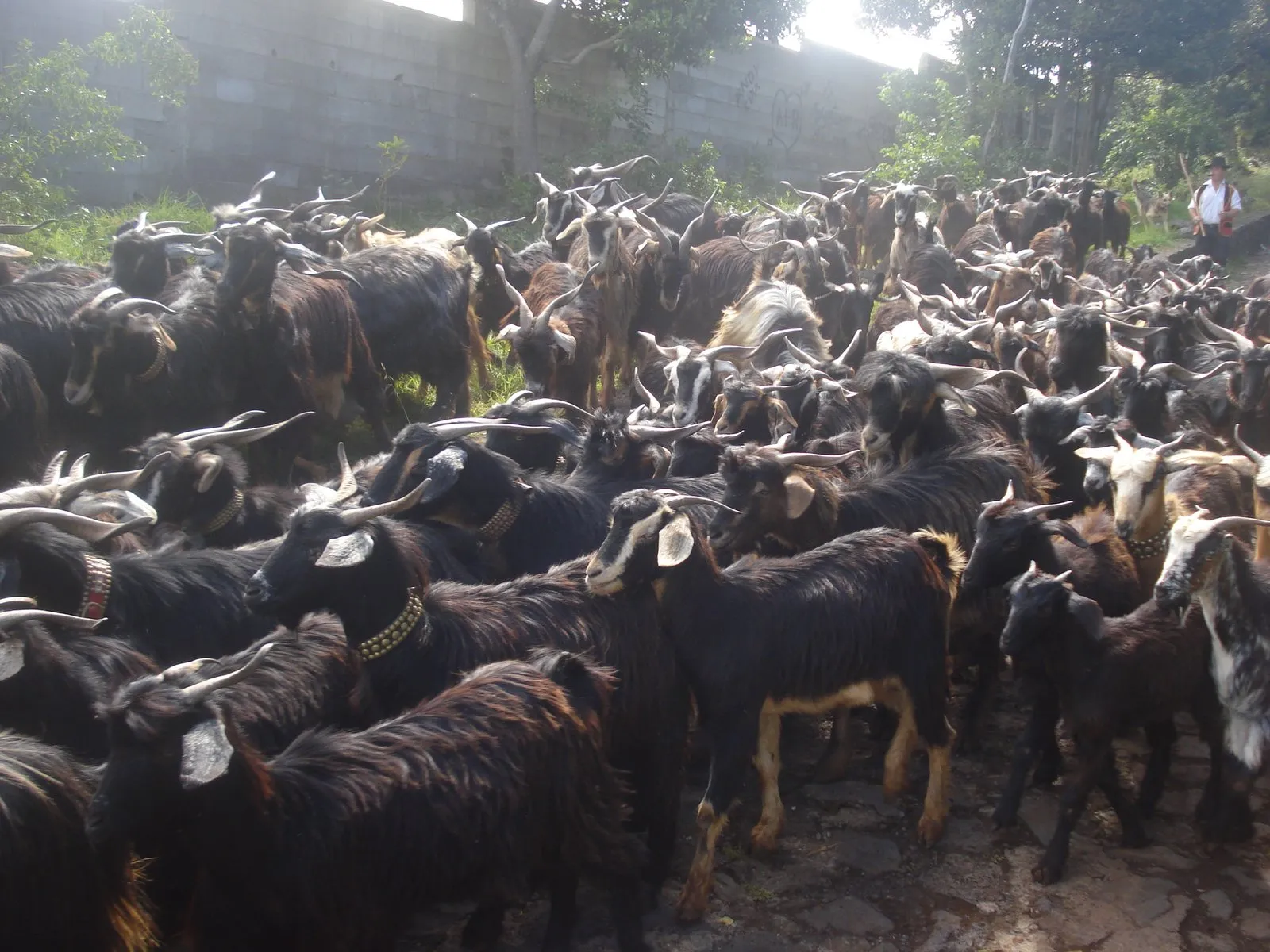
“Canarian goat” is not, today, the name of a breed in Spain’s Official Catalogue of Livestock Breeds: the catalogue lists Majorera, Palmera and Tinerfeña. Anyone who looks up the name in the singular meets a popular usage that the official register took apart in 2003, when the Agrupación Caprina Canaria ceased to exist and the three breeds entered the catalogue separately. What follows answers that query: what the phrase names, how the three differ, and which part of what one reads about the meat comes from the catalogue and which part comes from Diego Schattenhofer’s work with the ICIA.
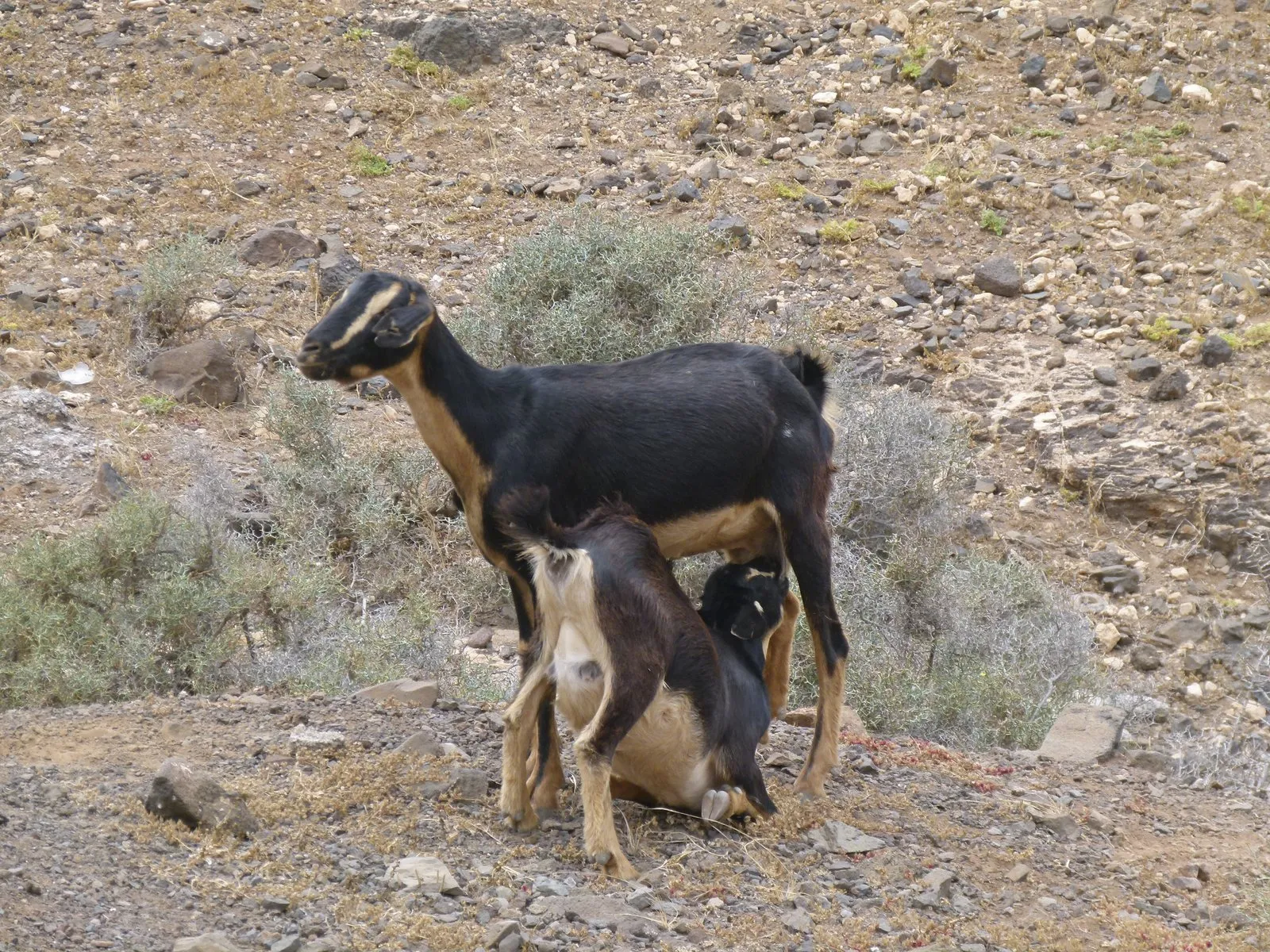
The lead image is not a generic “Canarian goat”. It is a flock of northern Tinerfeña goats, long-haired, photographed at the Tegueste romería. The two gallery photographs were taken at El Cofete, in Jandía (Fuerteventura): they show goats in that landscape, with nothing to indicate that they are registered animals.
From one grouping to three breeds
The name has an administrative history, and it is worth telling it with the two orders that change it, without going beyond what those texts say.
The Order of 25 April 1985 approved the herd book of the Agrupación Caprina Canaria. Its preamble speaks of an earlier register of “raza caprina canaria”. It was published in the BOE on 6 July 1985. During those years, the goats of the archipelago could be treated as a single grouping, and much of the speech that still says “the Canarian goat” as if it were one breed comes from there.
That grouping left the catalogue with Order APA/2420/2003, of 28 August. The order suppresses the Agrupación Caprina Canaria and adds the goat breeds Majorera, Palmera and Tinerfeña. The BOE published it on 5 September 2003. From that date, anyone who wants the official name has to choose one of the three. The current catalogue, for the goat species, still lists Majorera, Palmera and Tinerfeña, and it does not list a breed called Canarian goat.
| Date | What changed |
|---|---|
| 25 April 1985 | The herd book of the Agrupación Caprina Canaria is approved. The BOE is dated 6 July 1985. |
| 28 August 2003 | Order APA/2420/2003 suppresses the grouping and adds Majorera, Palmera and Tinerfeña. The BOE is dated 5 September 2003. |
| 31 December 2023 | ARCA census of the Majorera cited by its federation: 14,512 animals and 78 farms, in the Canary Islands. |
The three are breeds of the domestic goat, Capra hircus. They are not three species. Separating them in the catalogue is a matter of breed, herd book and morphology, not of species taxonomy.
How each breed is told apart
The catalogue does not describe “the Canarian goat”. It describes three breeds, and within the Tinerfeña two varieties. The table brings together only what those sheets publish. Where the catalogue consulted gives no figure, the cell stays empty of a number: it is not filled in by analogy.
| Trait | Northern Tinerfeña | Southern Tinerfeña | Majorera | Palmera |
|---|---|---|---|---|
| Frame | Sub-hypermetric, long-lined, dairy type | Eumetric, long-lined | Large head, long ears | Eumetric, long-lined |
| Coat | Black or chestnut | Multi-coloured | Multi-coloured, pigmented mucous membranes | Red |
| Hair | Long, with beard, forelock and wattles | Short | Bristly hair frequent in males | Frequent pelliza, calzón, harropos and beard |
| Horns | Prisca type | No detail in the catalogue | Two, arched, sometimes twisted at the tip | Spiral |
| Withers height, males | 79.5 cm | Not published | 71 cm | Not published |
| Withers height, females | 70.2 cm | Not published | 65 cm | Not published |
| Weight, males | Not published on the sheet consulted | Not published on the sheet consulted | 65 kg | Not published |
| Weight, females | Not published on the sheet consulted | Not published on the sheet consulted | 50 kg | Not published |
In the language of those sheets, sub-hypermetric and eumetric speak of the animal’s frame, and long-lined of the predominance of lengths over diameters. Beard, forelock and wattles are the tuft on the chin, the one on the poll and the appendages of the neck. Pelliza, calzón and harropos are quoted as the Palmera catalogue writes them, as long hair on certain regions of the body, without a measurement added here.
The northern Tinerfeña, besides its size, is associated on the use sheet with management that includes grazing where there is access to it. The southern one is associated with an intensive system without grazing. The main use the catalogue states for the Tinerfeña is milk. Meat appears as a secondary use. Those two sentences matter because much of the search for “Canarian goat meat” arrives expecting an animal of meat aptitude, and the official record of the Tinerfeña says something else.
The Majorera is developed on its own entry: large head, long ears, a neck that is fine and long, often with wattles, a deep chest, a wide rump, a high-set tail, an udder of great development with fine skin and black or slate pigmentation. The breeders’ federation describes it as a dairy type, adapted to an arid climate. The detail and the census are on Majorera goat.
The Palmera remains, in what the catalogue consulted publishes, a eumetric, long-lined breed, with a red coat and spiral horns, and with pelliza, calzón, harropos and beard frequent. The Palmera’s catalogue sheet does not record a height or a weight.
Census: what is published
The only census published in a table, the one the Majorera federation cites, is that of that breed. At 31 December 2023, ARCA counts 14,512 animals and 78 farms, all in the Canary Islands. We do not drag that figure onto the Tinerfeña or the Palmera, and it is not clear whether any of the three is endangered or in a promotion programme: the federation’s page mixes the two formulas.
In the kitchen
In the kitchen, “Canarian goat” usually names the meat of the islands’ breeds, and sometimes also the milk the cheeses are made from. The two products should not be mixed.
Milk is the use the catalogue puts first for the Tinerfeña, and the use that supports the designation of Majorero cheese: milk from goats of the Majorera breed, with an occasional and limited percentage of Canarian sheep’s milk. To talk about the archipelago’s goat and skip the milk is to skip what the livestock register treats as primary.
Meat is the use Diego Schattenhofer has worked on in more detail with the ICIA, and not a yield the catalogue publishes. When a menu says “Canarian goat” without naming the breed, the guest cannot know whether the animal was Majorera, Palmera or Tinerfeña, nor whether the weight and the maturation are those of the report or others. Breed, age and days in the room are purchasing facts, not ornaments.
The most frequent mistake when reading the catalogue sheets is to take the catalogue weight for the kitchen weight, or the reverse. A catalogue Majorera male weighs 65 kg. The culinary parameter cited by the report published here is another one, and it is explained in the next section, with its link.
Anyone arriving from the query “types of Canarian goats” or “breeds of Canarian goats” can close the question in the table: three breeds, and within the Tinerfeña two varieties. There is no fourth official type under the name of the autonomous community. Island speech can go on saying Canarian goat for a stew, a cheese or a flock, and that sentence is understood. What is not precise is to treat it as a synonym of a single morphology. A long-haired, black-coated northern Tinerfeña is not described with the same sheet as a red-coated Palmera with a spiral horn, nor with that of a long-eared, multi-coloured Majorera.
In purchasing practice, the useful question is which of the three, and for what. If the destination is a cheese with a designation, the breed the Majorero specification requires is the Majorera, not “a Canarian goat” with nothing further. If the destination is matured meat, the reference fact is the one in the report: a breed among the three, age, weight and days. Without those four, “Canarian goat” on a menu is a loosely stated geographical origin, not a product sheet.
In the Canary Islands
The rooting belongs to the three breeds, not to a fourth. The Tinerfeña is the breed of Tenerife, with a northern variety and a southern one. The Palmera is that of La Palma. The Majorera takes its name from Fuerteventura — Maxorata is the pre-Hispanic name of the island, according to the breeders’ federation — and that same federation treats it as spread across the archipelago, with the largest census on Fuerteventura and Gran Canaria. That is why this term is associated with four islands and not one: Tenerife, La Palma, Fuerteventura and Gran Canaria.
The local names that are fixed in the catalogue are those of the breeds and, for the Tinerfeña, those of the two varieties. We do not add fairground synonyms the catalogue does not record.
The Tegueste photograph shows the northern variety in a romería setting, which is where the long hair and the dark coat are recognised from a distance. Those of El Cofete show the dry country of Jandía, the landscape associated with the Majorera, without turning every photographed goat into a herd-book animal.
In the work of Diego Schattenhofer
The article that summarises the MassCultura report says Diego Schattenhofer spent 3 years, with the ICIA, on the Palmera, the Majorera and the Tinerfeña, and sets kitchen working conditions: animals of about 3 years, 90 kg and at least 122 days of maturation. Those are the conditions of that work, not the catalogue’s: a catalogue Majorera male weighs 65 kg, and the 90 kg are the parameter of the study, not the official average of the breed. The text is in the research on the native goat.
On 6 July 2023 the restaurant hosted a sensory-analysis workshop on goat meat, framed in an ICIA project. What that day supports, and what it does not, is separated in the workshop chronicle. The book of the Gobierno de Canarias, signed by Marichu Fresno and by the chef, is told in La Magia de la Carne de Cabra Madurada. We do not copy here the figures those pages do not need for this definition.
The history and tradition of the goat in the islands have their own page: History and tradition of the Canarian goat.
Related terms
- Majorera goat — the breed of Fuerteventura, with its catalogue morphology and the census of 14,512 animals.
- Majorero cheese — the protected designation made with milk of that breed.
- History and tradition of the Canarian goat — the historical narrative of the goat in the islands.
- The research on the native goat — the 3 years with the ICIA and the parameters of 90 kg and 122 days.
- La Magia de la Carne de Cabra Madurada — the book of the Gobierno de Canarias.
- Sensory-analysis workshop of 2023 — the session of 6 July 2023 at Taste 1973.
Sources consulted
- MAPA · Official Catalogue of Livestock Breeds of Spain
- BOE · Order of 25 April 1985, herd book of the Agrupación Caprina Canaria
- BOE · Order APA/2420/2003, of 28 August
- MAPA · Tinerfeña, morphological data
- MAPA · Tinerfeña, uses and farming system
- Gobierno de Canarias · Northern Tinerfeña goat
- MAPA · Majorera, morphological data
- MAPA · Palmera, morphological data
- ARCA · Majorera census, query 4199
- FECAMA · Breeders’ federation of the Majorera goat
 — view the full-size photo
Goat and kid at El Cofete (Jandía, Fuerteventura). The photograph does not show that they are entered in a herd book. 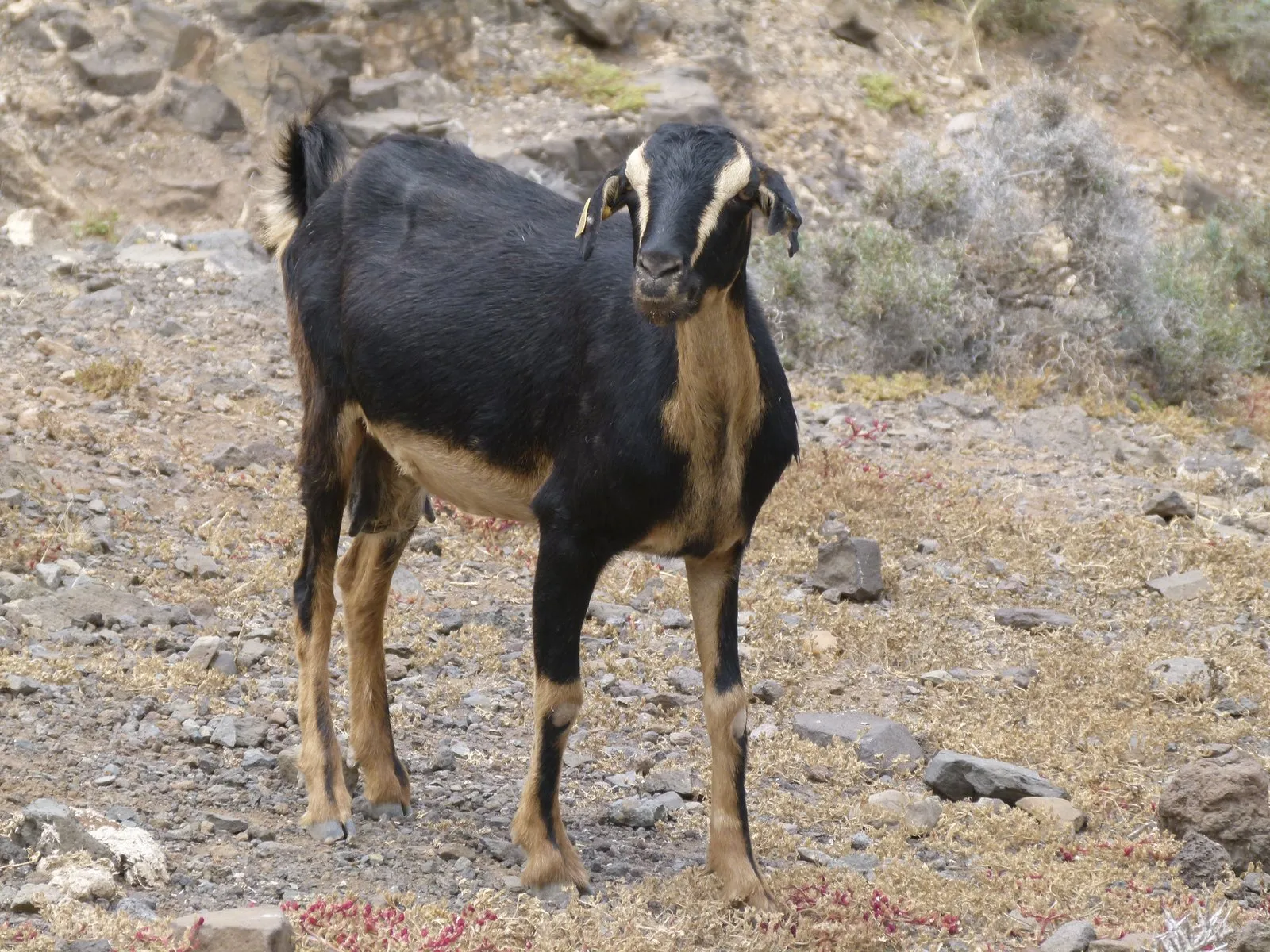 — view the full-size photo
An adult at El Cofete. It shows the grazing landscape of Jandía, not a registered breed.
Photos: 1. Norbert Nagel (opens in a new tab) (CC BY-SA 3.0 (opens in a new tab)) · 2. Norbert Nagel (opens in a new tab) (CC BY-SA 3.0 (opens in a new tab))
Frequently asked questions
Is the Canarian goat a breed?
What are the goat breeds of the Canary Islands?
How do the northern and southern Tinerfeña differ?
What is Canarian goat meat?
How many Majorera goats are registered?
What does Taste 1973 have to do with the Canarian goat?
Also in the glossary
Designation of origin, protected (PDO)
A protected designation of origin is a European name that identifies a food born of a specific place, with all its stages carried out there.
Esferificación (spherification)
Spherification encloses a liquid in a thin skin of alginate gelled with calcium, so that the sphere bursts in the mouth.
Fermentation
Fermentation is the microbial transformation of a food: lactic in milk, alcoholic in must and acetic when wine turns to vinegar.