First goat meat sensory analysis workshop: Taste 1973 and the ICIA's CAIA project
- Published
- Section
- Research
A table set for scoring, not for eating
Taste 1973, Hotel Villa Cortés (Arona, Tenerife). 6 July 2023.
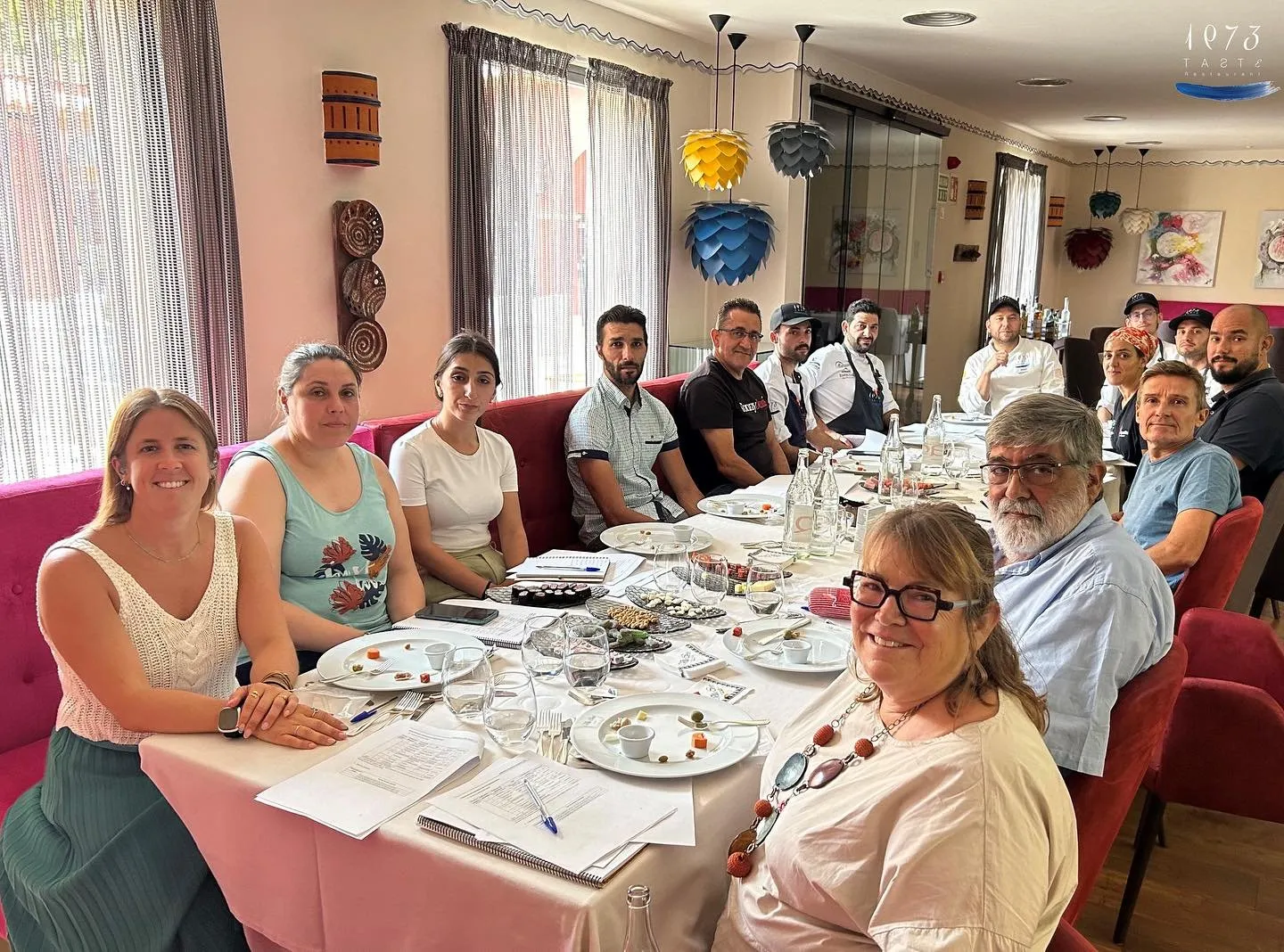
On 6 July 2023 we set up the Taste 1973 dining room in an unusual way: white plates with tiny bites, glasses of water, teaspoons and, in front of each chair, a notebook and a sheet with boxes to fill in. That morning we held the first “Sensory analysis of goat meat” workshop, training delivered by specialists from the Centro Tecnológico de la Carne (Xunta de Galicia) as part of the ICIA project the restaurant takes part in. We told it that same day on the house account, without further ceremony: “Today we held the first ‘Sensory analysis of goat meat’ workshop, training delivered by specialists from the Centro Tecnológico de la Carne -Xunta de Galicia- as part of the ICIA CAIA 2023-03 project our restaurant takes part in”.
Around the table there was more than just the kitchen. In the photograph from that day you can see about ten people seated and several more standing in the background, some wearing the restaurant’s chef’s jacket and cap: kitchen people and people from outside the kitchen, mixed at the same long table. That’s logical for a session like this. A tasting panel isn’t trained with palates that are expert in fine dining, but with people capable of describing the same thing with the same words, session after session.
Why a tasting is so unlike a meal
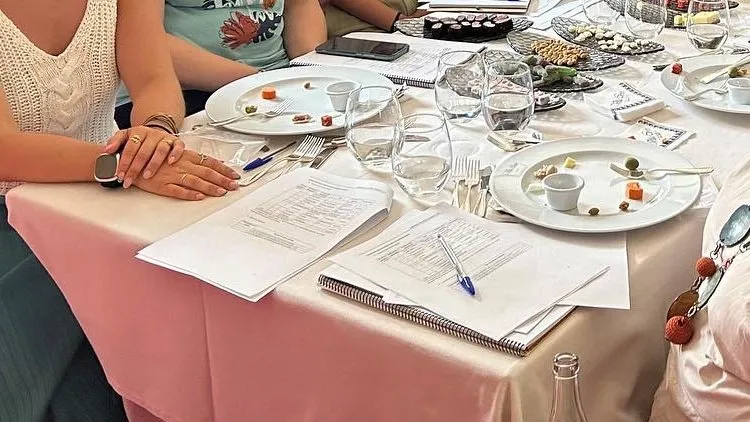
What you see on the tablecloth explains quite a lot. The samples are cut into small, similar bites, served on identical plates, with water to hand to cleanse the palate between one and the next. And what takes up half the space isn’t the plate, it’s the paper. At the table of a sensory analysis workshop, no one decides whether something tastes good: what’s perceived is described — colour, smell, texture, juiciness, intensity — and noted down with a criterion shared by everyone seated there. That’s why the session is called training, not a tasting.
For us that change of outlook was exactly what was needed. We had long been working on the maturation of Canarian goat meat in the kitchen, with our hands and with the judgement of the trade, which is the one we have. But research doesn’t hold up on “I like this one better”: it needs a language that someone else can repeat somewhere else and get the same result. That morning, the people who came to teach us this were a team from the Centro Tecnológico de la Carne of the Xunta de Galicia, a centre specialised in that discipline that travelled to Arona to give the workshop. That’s how we wrote it that day, and that’s how we’re leaving it here, with its name exactly as we used it then.
CAIA is not the name of the workshop
It’s worth clarifying the acronym, because it appears in the original text and can confuse. CAIA is the Consejo Asesor de Investigaciones Agrarias, the body that approves the strategic projects of the Instituto Canario de Investigaciones Agrarias. The Gobierno de Canarias explains it like this when presenting the research into matured goat: it is “a strategic CAIA project (approved by the Consejo Asesor de Investigaciones Agrarias)”, funded with the ICIA’s own resources and with researcher Marichu Fresno in charge of the research, from the institute’s Animal Production, Pastures and Forages Unit for Arid and Subtropical Areas. The “CAIA 2023-03” in our text is, in all likelihood, the internal file identifier for that year; that code is only stated by our own post, so we present it as such.
What came after
Half a year later, the project came into public view. The ICIA presented its studies on cocoa cultivation and goat meat maturation at Madrid Fusión 2024, held from 29 to 31 January at IFEMA, and it did so alongside Marichu Fresno and Diego Schattenhofer, as reported by the Gobierno de Canarias news portal. In 2025, that same work crystallised into a pioneering book on the culinary potential of matured goat meat, published by the Gobierno de Canarias.
Seen from today, with the restaurant now distinguished with a Michelin star and a Repsol Sun, that July morning looks like the first documented link in all of this: the session in which we stopped talking about the goat using only the words of the kitchen. But it has to be said carefully, because it isn’t proven.
What we cannot prove
There is no press piece or institutional statement that tells the story of this workshop from 6 July 2023. We’ve looked and it doesn’t appear: not on the Gobierno de Canarias news portal, not at the ICIA, not at the Centro Tecnológico de la Carne. Everything specific to that day — the date, who delivered the training, the project code, our participation — comes from a single Instagram post.
And there’s a second nuance. The official sources that vouch for the “ICIA CAIA project to revalorise goat meat through maturation” are from 2024 and 2025, and none of them mentions a workshop in 2023 or the Galician centre. That it’s the same line of work is reasonable — same institute, same acronym, same parties — but it isn’t a fact confirmed by an official source, and we’ve put that in writing. If the paper that closes it ever turns up, we’ll add it here.
The original post, on the restaurant’s account: the workshop from 6 July 2023.
Frequently asked questions
What was the Taste 1973 goat meat sensory analysis workshop?
What does CAIA mean and what is the ICIA project?
Was there press coverage of this workshop?
You may also like
Science in the kitchen: the University of La Laguna researches Canary Islands marine resources with Taste 1973
Research
Science in the kitchen: Taste 1973 visits the Canary Islands Oceanographic Centre (IEO-CSIC)
Research
Diego Schattenhofer Brings Enzymatic Fish Maturation to the Basque Culinary Center
Congresses