Majorero cheese: the designation of Fuerteventura
- Term
- Majorero cheese
- Tags
- Cheeses · Canary Islands
- Published
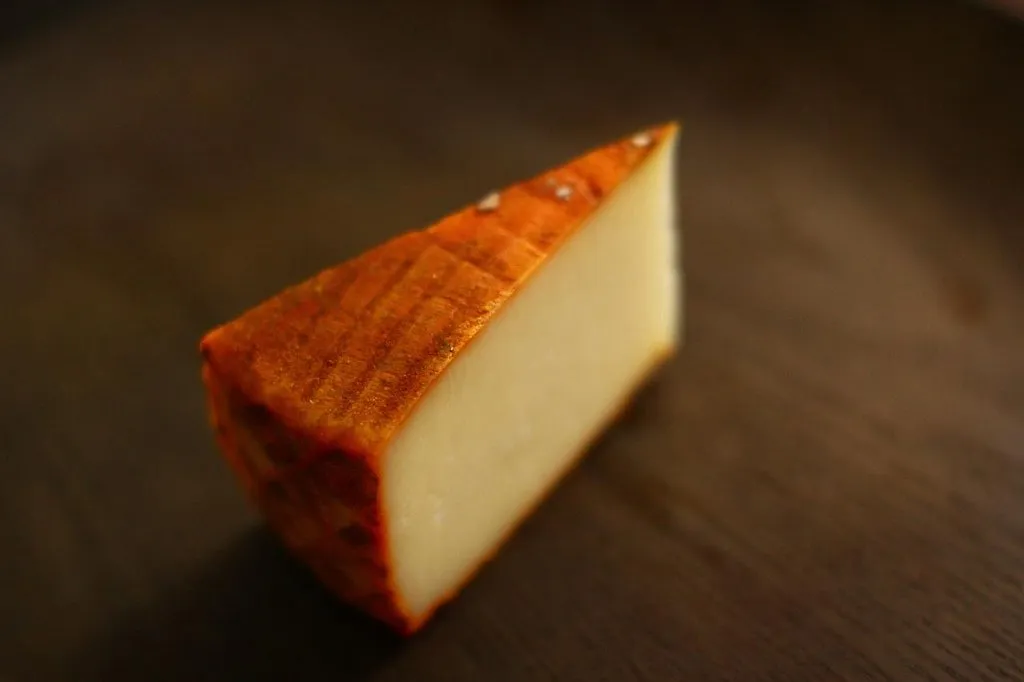
Majorero cheese is a pressed-paste cheese with a protected designation of origin, made on Fuerteventura with milk from goats of the Majorera breed. The sentence settles the main query: it is a cheese with a protected name, not a generic goat’s cheese of the islands. What follows is the specification in force in 2026, set apart from what the texts of 1996 and of 1999 said, because a resolution of this same year removed caps that for decades were cited as if they were the law.
The lead image is a wheel with the pleita mark on the side and paprika on the rind, photographed in December 2011 at a cheese club.
What the designation requires in 2026
The single document in force describes it as follows. It is a pressed-paste cheese. The milk is from goats of the Majorera breed, raw or pasteurised. An occasional addition of up to 15 % Canarian sheep’s milk is allowed. It may carry the mention “Artesano” when the operator makes it with the milk of their own flock. Those three conditions — breed, percentage and the artisan mention — are what distinguish a protected wheel from a goat’s cheese made on the island with other milk.
The breed is not an ornament of the story. Without the Majorera goat there is no designation, even if the cheese is made on Fuerteventura and looks the part. The animal’s entry, its morphology and its census are in Majorera goat. The set of the archipelago’s breeds, and why “Canarian goat” is no longer the official name of a single one, is in Canarian goat.
The 15 % of Canarian sheep’s milk is an occasional ceiling, not an obligation. A Majorero may be goat’s milk only. When it carries sheep’s milk, the milk has to be Canarian sheep’s milk and it cannot go past that percentage. The single document does not turn that mixture into another cheese: it is still Majorero if the rest is met.
Shape, rind and paste
The wheel is a cylinder with flat faces. The minimum height is 6 cm. The maximum diameter is 35 cm. The weight runs from 0.5 kg to 10 kg. On the side remains the mark of the moulds or pleitas — braided palm leaf — and on the faces the impression of the pinta, or quesera. That geometry is what is recognised at the table before cutting: the braided edge is not a later ornament, it is the trace of the mould.
| Measure | Single document of 2026 |
|---|---|
| Shape | Cylinder with flat faces |
| Height | Minimum of 6 cm |
| Diameter | Maximum of 35 cm |
| Weight | From 0.5 kg to 10 kg |
| Side | Mark of the mould or pleita of braided palm |
| Faces | Impression of the pinta or quesera |
The paste is compact, of a creamy texture. The flavour is acidic and becomes somewhat sharp as it matures. The colour runs from white to ivory. In general it has no eyes. It is not, then, a cheese of large eyes or a soft paste with a bloomy rind: it is a pressed goat’s cheese, and the sharpness arrives with time, not on the first day.
The rind may be rubbed with oil, paprika or gofio, provided it keeps its appearance and the casein plate can be read. Paraffin, or an authorised inactive transparent coating, is also allowed. The paprika on the lead image falls under that permission. Rubbing does not excuse the plate: if the coating hides what identifies the wheel, it stops meeting what the text asks.
How long it has to mature
The minimums depend on the type and, for the semi-cured and the cured, on the weight. The 2026 single document does not set a maximum time. A wheel may stay in the room beyond the minimum. What it cannot do is go to market under the name before meeting it.
| Type | Weight of the wheel | Minimum maturation |
|---|---|---|
| Fresh | The text does not split the minimum by weight | 8 days |
| Semi-cured | 1.5 kg or more | 35 days |
| Semi-cured | 1.5 kg or less | 20 days |
| Cured | 1.5 kg or more | 105 days |
| Cured | 1.5 kg or less | 60 days |
The kitchen reading is direct. A fresh cheese does not behave like a cured one: the document sets 105 days when the large wheel is called cured, and 60 when the small one reaches that category. The semi-cured sits in between, with 35 days or with 20 according to whether it weighs 1.5 kg or more, or 1.5 kg or less. To ask for “cured Majorero” and receive a wheel of three weeks is to ask for a name the specification does not yet authorise.
The cut-off weight, 1.5 kg, is not the maximum weight of the designation. The maximum for the wheel is 10 kg and the minimum is 0.5 kg. 1.5 kg only decides which row of the days table applies to the semi-cured and the cured.
Where it is made
The zone is the island, named by municipalities: Antigua, Betancuria, La Oliva, Pájara, Puerto del Rosario and Tuineje. It is not enough for the dairy to be in one of them. The milk, the making and the maturation have to take place inside the zone. A cheese matured outside, even if the curd was born on Fuerteventura, does not meet that sentence of the single document.
That list is the map. We do not add municipalities of other islands or an exception for maturation on the mainland: the text does not bring one.
What the 2026 resolution removed
The ICCA Resolution of 15 July 2026, published in the BOC on 28 July 2026, approves modifications that the text itself calls normal. It removes the restriction of a maximum maturation time, the maximum percentages of protein and of fat, and the previous minimum and maximum sizes. It publishes the consolidated specification and the single document now in force.
The measures given above — 6 cm, 35 cm, 0.5 kg, 10 kg and the days in the table — are those of the single document in force, not a mixture with the previous specification.
How it was described in 1996 and in 1999
This is not the specification in force. It serves to read what still circulates on old sheets and on the council’s website, and not to take it for the rule of 2026.
The BOC of 23 February 1996 regulates the designation in the Canary Islands. Even then it requires Majorera goat’s milk and allows up to 15 % Canarian sheep’s milk only in the matured cheeses. The sheep’s-milk percentage, then, is not a novelty of 2026: it was already there. What 2026 remakes is another part of the conditions.
The MAPA file of 1999 describes the same 15 %. It adds a way of making that specification wrote in detail: rennet from dried stomachs of baifo — the kid — preferred; milk between 28 and 32 °C for about 1 hour; a grain of 5 to 15 mm; sea salt dry or wet, and if wet, a maximum of 24 hours and 20 °B. None of that is presented here as a legal obligation after the 2026 resolution. It is the description of 1999.
The same file gives a chemical profile with a margin of 10 %, in this order: fresh, semi-cured and cured. The regulatory council still shows that profile on its website. After the resolution of 15 July 2026 they are not legal caps on protein or on fat.
| Profile of the 1999 file | Fresh | Semi-cured | Cured |
|---|---|---|---|
| Protein | 17.4 | 25.5 | 27.5 |
| Fat on dry extract | 52.0 | 54.0 | 55.5 |
| Dry extract | 50.0 | 57.0 | 63.0 |
The margin of 10 % is that of the file.
The council dates the recognition of the designation to 1996. It is the date the house itself uses, and it coincides with the BOC of that February.
The file quotes Le Canarien and the range of 50,000 to 60,000 goats, with cheese from goat’s milk, before the conquest. It is a quotation from the specification, not a current census. The breed census that is read in a table of 2023 lives in the entry for the Majorera goat, and it is not mixed with the medieval chronicle.
In the kitchen
At the table, the three names — fresh, semi-cured, cured — are not marketing intensities. They are the minimums in the table. A fresh cheese of 8 days cuts moist and still little sharp. The sharpness the single document associates with maturation appears when the wheel has had time, and the cured is the one that accumulates the most minimum time: 105 days on the wheel of 1.5 kg or more, 60 on that of 1.5 kg or less.
The rub changes the first bite more than the paste does. Paprika, gofio or oil are allowed if the casein plate can be read. Anyone who tastes only the rind is tasting the rub. The paste, white to ivory and in general without eyes, is what says whether the cheese is the pressed one the specification describes.
The mention “Artesano” does not mean “handmade” in a loose sense. It means the operator makes the cheese with the milk of their own flock. Without that link, the single document does not authorise the word.
Pairing at the table is craft, not specification. The specification fixes neither a wine nor a bread. What it does fix, and what a cheese trolley can check, is the breed of the milk, the zone and the type of maturation. A cured Majorero beside a fresh one of the same designation is not a repetition: they are two rows of the table.
Do not confuse this PDO with the rest of the archipelago’s goat’s cheeses. The site has a general page on goat’s-milk farmhouse cheeses. There, Majorero is one among others. Here it is the only subject, and the figures are those of the single document, not those of a summary of several islands.
In the Canary Islands
The rooting is Fuerteventura, and within Fuerteventura the six municipalities of the zone. The sheep’s milk, when it enters, is Canarian sheep’s milk, up to that 15 %, but the cheese is not for that reason made outside the zone: the sheep’s milk that is allowed does not move the place.
The baifo of the 1999 file — the kid whose dried stomach was preferred as rennet — is vocabulary of the island and of that specification. We leave it in the historical section so the word is understood when it appears in an old text. We do not say that every protected dairy still uses that rennet: the 2026 single document, in what we have summarised, does not impose it.
The palm pleita is the other mark of place a consumer can see without a laboratory. Braided palm leaf, a mark on the side. In December 2011, the wheel in the lead image already showed it, with paprika. The 2026 single document still describes that mark. The photograph does not prove a specific wheel of today; it proves that the gesture — pleita and rub — is the one the text recognises.
Majorero and aboriginal cheese: two different cheeses
In the chronicle of Gastronomika 2024, Majorero cheese figures among the Canarian products named at the congress, without details of making, maturation or weight.
Canarian aboriginal cheese, the project developed with the ICIA, is another cheese: it is not the protected designation, it is not governed by this specification and it does not inherit the 1999 profile. They should not be confused.
Related terms
- Majorera goat — the breed whose milk the single document requires, and the census that must not be confused with Le Canarien.
- Canarian goat — why the generic name does not replace the breed in the specification.
- Goat’s-milk farmhouse cheeses — the map of goat’s cheeses, where Majorero is one of the pieces.
- Canarian aboriginal cheese — the project with the ICIA, which is not this PDO.
- Gastronomika 2024 — the chronicle that names the cheese without describing the making.
Sources consulted
Frequently asked questions
What is Majorero cheese?
How long does Majorero cheese mature?
Where can it be made?
What is the pleita of Majorero?
Are the 1999 protein and fat percentages still in force?
Is it the same as Canarian aboriginal cheese?
Also in the glossary
Meat ageing
Meat ageing is the cold rest that lets the muscle's enzymes work, in the air of a chamber or under vacuum in its own juice.
Nitrogen, liquid
Liquid nitrogen is nitrogen in its liquid state, which at one atmosphere boils at around −196 °C and freezes whatever it touches on contact.
Non-essential amino acids
Non-essential amino acids, those our body can synthesise by itself, play crucial roles both in our health and in the culinary world.