Liquid nitrogen: −196 °C and care in its use
- Term
- Nitrogen, liquid
- Tags
- Avant-garde cuisine · Techniques · Equipment
- Published
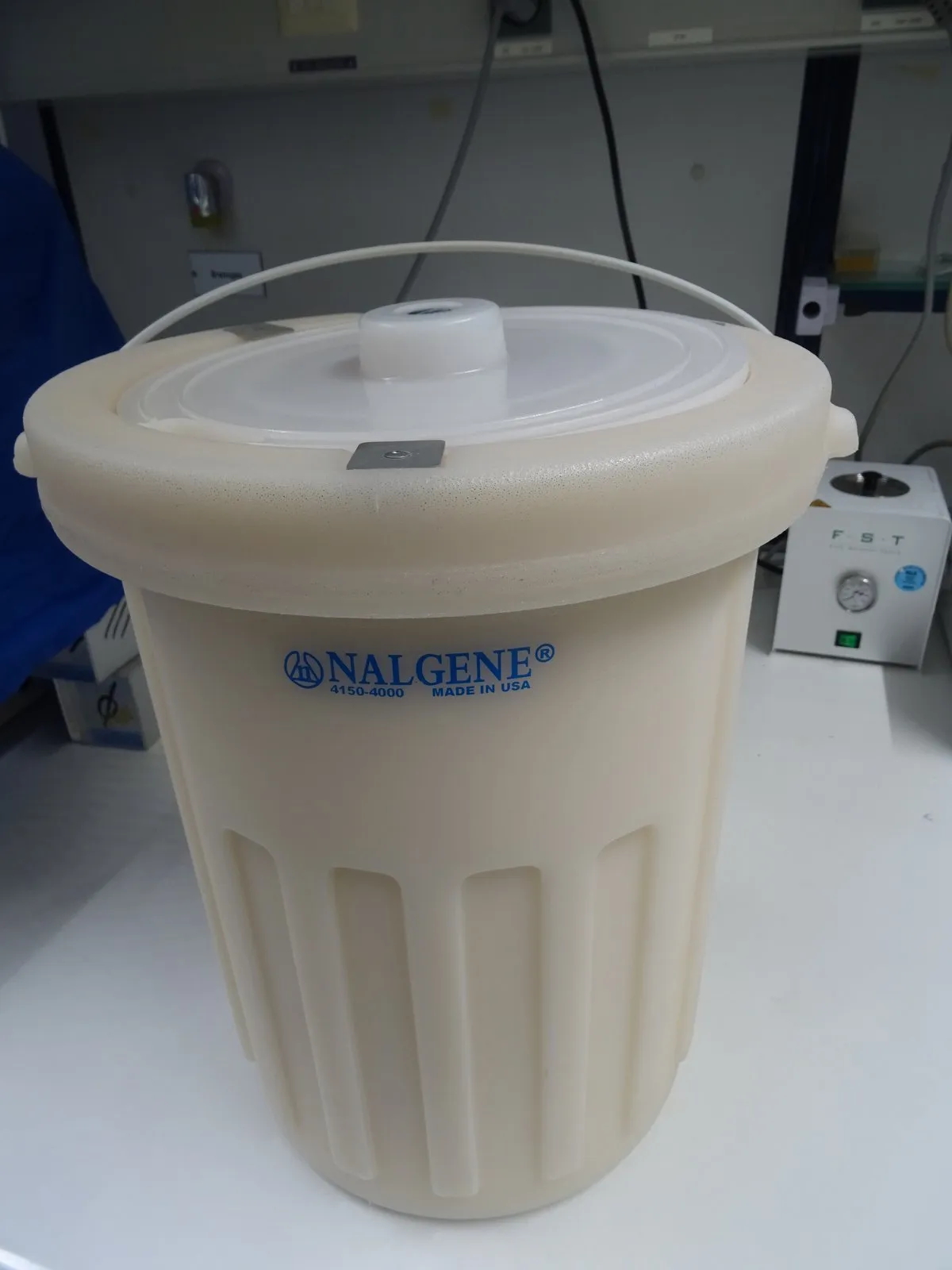
Liquid nitrogen is nitrogen in its liquid state, which at one atmosphere boils at around −196 °C and freezes whatever it touches on contact. In avant-garde cooking it is used for that jump: a surface goes from soft to solid at the instant of contact, and the centre can stay creamy if the bath is brief. The same jump burns the skin and, as it evaporates, fills a room with gas.
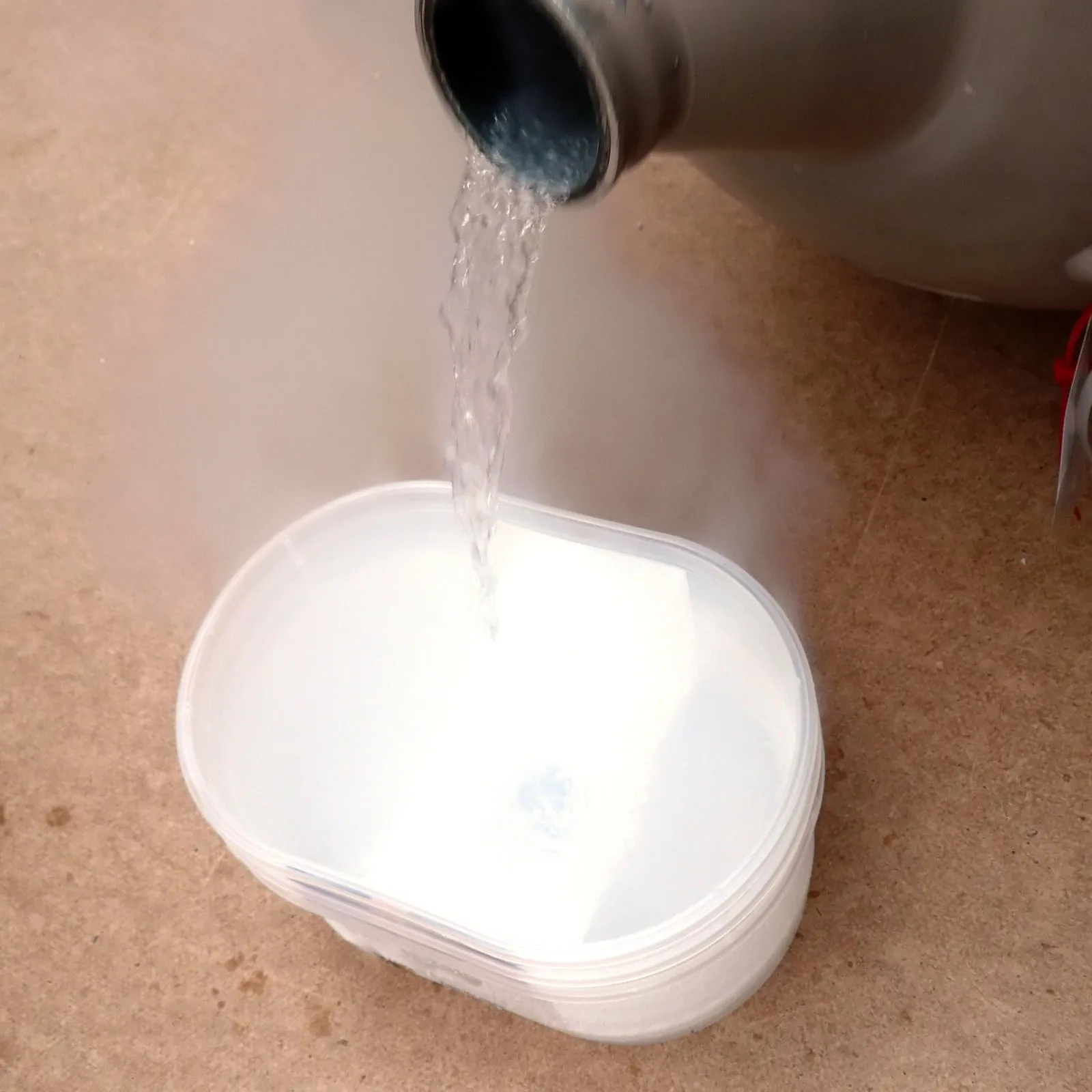
The photos show the container, not a dessert. The Dewar in the lead image is the narrow-mouthed laboratory flask, made to lose little cold. The smoking glass shows the vapour. The tank is the store. None of the three is a catalogue ice cream.
The liquid and the temperature
At atmospheric pressure nitrogen boils at −196 °C. The safety data sheet for the liquefied gas and the IdiPAZ handling manual record it so: −196 °C when the liquid is boiling at one atmosphere. The International Chemical Safety Card, the ICSC for nitrogen, writes −195.8 °C. Both figures describe the same point; one is rounded to the degree and the other keeps the decimal. For the kitchen, a difference of two tenths does not change the gesture. In a laboratory document, the figure of the paper in front of you is the one cited.
The gas is not flammable. The hazard statement that the CLP classification repeats is H281: contains refrigerated gas; may cause cryogenic burns or injury. The precautionary advice that goes with it asks for cold-insulating gloves, face or eye protection, thawing frozen parts with lukewarm water without rubbing, and storing in a well-ventilated place.
The white vapour in the photo is not the nitrogen. Nitrogen gas is invisible. The white is the water of the air, condensed and frozen into microdroplets by the cold. Seeing “smoke” does not mean seeing the gas that displaces oxygen. The serious danger is the one that cannot be seen.
One litre of liquid does not stay one litre. The IdiPAZ manual calculates that, at 15 °C and 1 atmosphere, 1 litre of liquid nitrogen produces 691 litres of gas. That expansion is the reason for the container: a Dewar loosely closed, or a tank without a relief valve, is not a jar of sauce. The liquid wants to be gas and suddenly takes up the volume of the room.
In the kitchen
The culinary use fits in one physical sentence. At −196 °C the contact steals heat so fast that the water of a cream, a purée or a meringue crystallises at the surface before the centre knows. If the bath is an instant, an icy crust and a soft interior remain. If the bath is prolonged, the whole piece ends up hard. The time is not a branded recipe: it is the distance between the crust and the block.
That contrast explains ice creams made to order, herbs that turn to powder at a tap because the cold has made them brittle, and sorbets assembled at the table. The name of the equipment is generic: a Dewar, a cryogenic flask, a vessel approved for the liquid. The catalogue brand is an example of a purchase, not the technique.
It does not replace a blast chiller or a walk-in freezer. Those cool a food in minutes or hours, within a kitchen range far above −196 °C. Liquid nitrogen is not a “more powerful” cold of the same appliance: it is another state of nitrogen, with another vessel and another risk. Putting it in any steel container, or closing it like a jar of sauce, ignores the expansion from 1 litre to 691 litres. The Dewar in the lead image is not a coffee flask: the narrow mouth slows the heat that comes in and lets the gas out. An airtight lid turns that outlet into pressure. The craft is the opposite of jam making: here the perfect seal is the fault.
Before opening the vessel, the pass checks three things that do not depend on the recipe: that the room has a draught of air, that the glove covers the wrist and that the face is not over the mouth of the flask. The liquid is poured slowly, towards the working bowl and never towards the body. When finished, the remainder goes back into the Dewar and the lid is left in the position that lets the gas out. Cling film, a cork or an improvised screw cap is the closure that expansion turns into an accident.
Nor is it a spherification. There the skin is alginate and calcium, and the interior stays liquid at room temperature. Here the skin, if there is one, is ice. The two tricks can share an avant-garde menu and are explained by different sciences. Hydrocolloids thicken or gel; nitrogen is not a gelling agent.
The water of the food, the same that water activity measures, is what crystallises. Freezing is not drying. On returning to room temperature, if the piece was left to go all the way, the water returns and the texture that the cold had fixed is lost. That is why the nitrogen mouthful is eaten within the minute, not kept at the pass like a sauce.
Burn and asphyxia
Contact with the liquid, or with a metal that contains it and is not insulated, freezes the tissue. A cryogenic burn does not look like a fire burn in the first second: sometimes the area is white and numb, and hurts afterwards. The safety data sheet asks not to rub. Rubbing tears off skin that the ice has made fragile. The thawing water is lukewarm, not hot.
NTP 383 of the National Institute for Safety and Health at Work, on liquefied gases at low temperature, sets a concrete limit for that water: above 42 °C burns are added to the cold injury. Clothing that has stuck on through frozen moisture is not torn off by pulling. Those two gestures —lukewarm water, clothing left still— are the first aid that the technical note writes, pending medical judgement.
Asphyxia is the other risk, and it belongs to the room, not the skin. At high concentrations nitrogen displaces oxygen. The safety data sheet says so: there may be loss of consciousness or of mobility, and the person may not realise. The IdiPAZ manual adds the number that makes the risk visible: 691 litres of gas for every litre spilled, at 15 °C and 1 atmosphere. A flask knocked over in a small pantry is not an anecdote of pretty vapour. It is an oxygen-poor cloud.
That is why storage is a ventilated place, decanting is not done in a windowless room, and nobody enters an area where liquid has been spilled without checking that it can be breathed or without self-contained equipment. Oxygen detectors exist for this gas precisely because the sense of smell gives no warning: nitrogen has no smell. The taste of an ice cream says nothing about the atmosphere of the kitchen.
In restaurant practice, the liquid is handled by whoever has the right vessel, the gloves and the ventilation, and the quantity for the pass. It is not an ingredient to leave beside the oil. The tank in the photo, with its valves, recalls the true format: a vessel of liquefied gas, not a bottle of water.
Related terms
- Spherification — another avant-garde skin, of alginate and calcium, not of ice.
- Hydrocolloids — gels and thickeners, different from this cold.
- Water activity — the water of the food, which here freezes instead of evaporating.
- Meat ageing — a cold rest in a chamber, a few degrees above zero, not at −196 °C.
- Fermentation — a microbial transformation; liquid nitrogen halts it by temperature, it does not cause it.
Sources
 — view the full-size photo
The white vapour is moisture from the air that the cold condenses, not the nitrogen, which is invisible. The liquid is below, at around −196 °C. 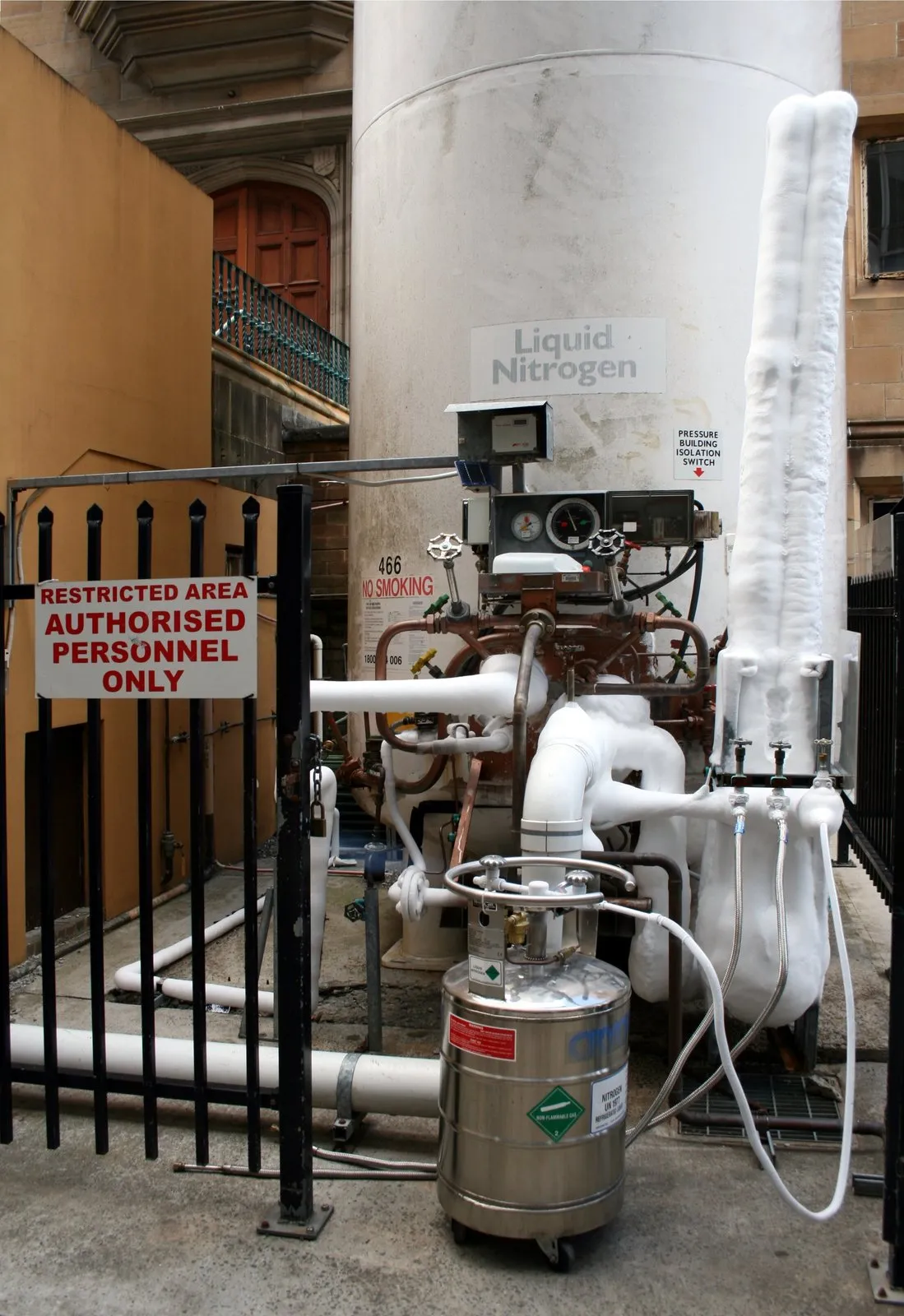 — view the full-size photo
Storage tank. The liquid is not kept in an open kitchen container: the Dewar or the tank are designed for the cold and the pressure.
Photos: 1. Cory Doctorow (opens in a new tab) (CC BY-SA 2.0 (opens in a new tab)) · 2. Toby Hudson (opens in a new tab) (CC BY-SA 3.0 (opens in a new tab))
Frequently asked questions
What is liquid nitrogen?
Why is it used in the kitchen?
What burn does it cause?
Why must it be ventilated?
Does hot water help after a splash?
Is it the same as spherification?
Also in the glossary
Non-essential amino acids
Non-essential amino acids, those our body can synthesise by itself, play crucial roles both in our health and in the culinary world.
Omega-3 fatty acids
Omega-3 fatty acids are a type of essential polyunsaturated fat, meaning the human body cannot produce them on its own and they must be obtained through the diet.
Omega-6 fatty acids
Omega-6 fatty acids are a type of essential polyunsaturated fat, meaning the body cannot produce them and they must be obtained through the diet.