Meat ageing: dry, wet and with goat
- Term
- Meat ageing
- Tags
- Maturation · Meat · Food science · Canary Islands
- Published
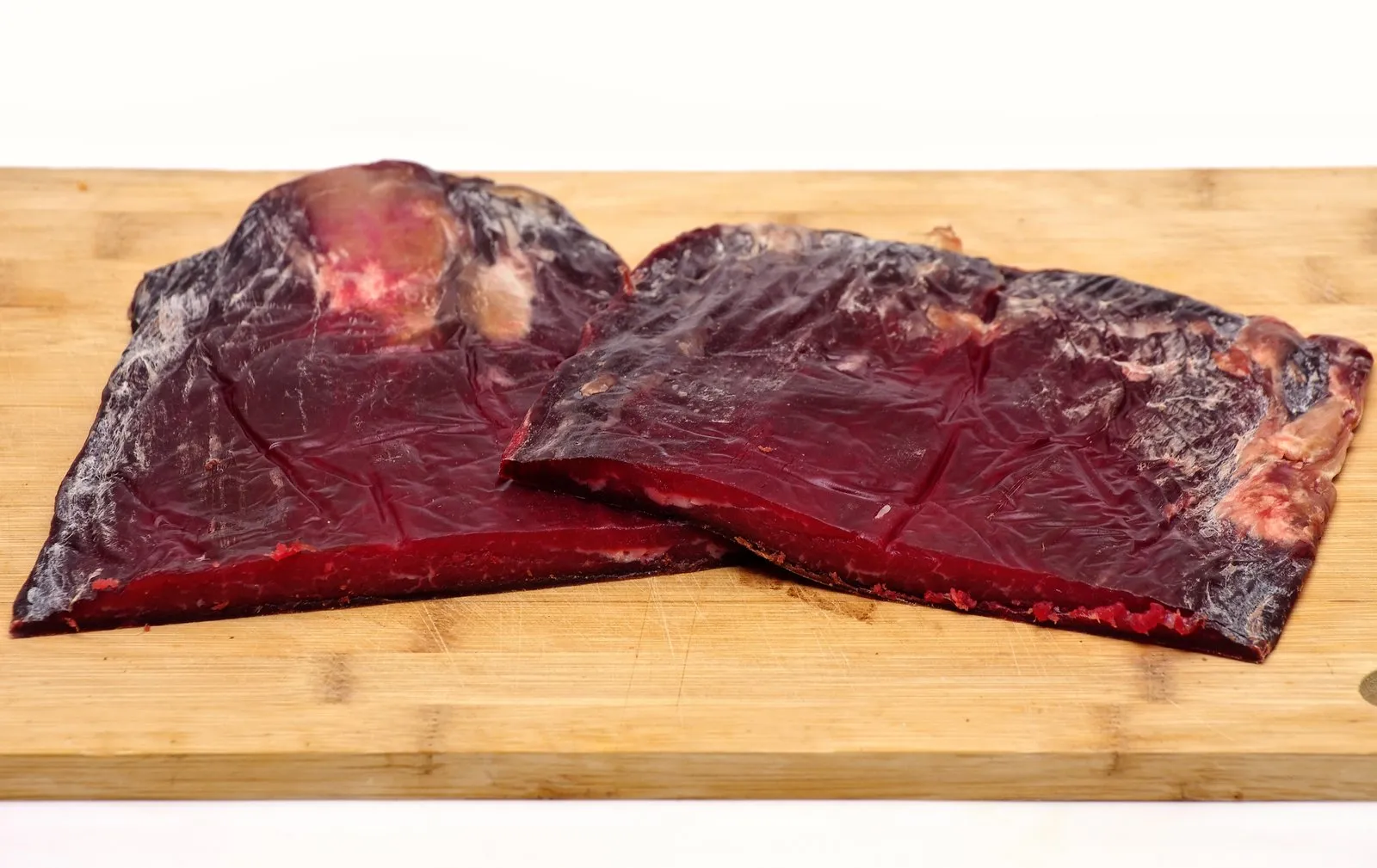
Meat ageing is the cold rest that lets the muscle’s enzymes work, in the air of a chamber or under vacuum in its own juice. It is not the salting of a ham or the freezing of a blast chiller. It is a measured time, with the cut already butchered, in which the fibre loosens and the flavour either concentrates or stays in the juice, depending on the method. The two routes have trade names: dry and wet.
The photos show beef. They show the dark surface of dry ageing and a rib steak already cut. They are not the chamber of Taste 1973 or a piece of goat. The goat has its own posts. The beef in these images serves to show the look of dry ageing when there is no free photo of that chamber.
Dry and wet
In dry ageing, the cut —carcass, primal or large joint— hangs or rests without a bag, in a chamber with cold, humidity and moving air. The surface dries, darkens and is trimmed at the end. What is eaten is the interior, where the water that remains is more concentrated and the enzymes have worked.
In wet ageing, the cut goes under vacuum. It rests in its own juice, without the crust or the large shrinkage of air. Industry adopted it because it asks for less time, less weight loss and less space. The EFSA scientific opinion on the microbiological safety of aged meat, published in 2023, recalls that turn: since vacuum packaging, most beef, pork and lamb is aged this way.
Both methods seek tenderness and flavour. They do not seek the same in shrinkage or in surface aroma. A rib steak with a dry-aged crust and a ten-day vacuum cut can be equally safe and smell different. Calling both “aged” without saying the method leaves the menu half told.
| Route | Where it rests | What is lost |
|---|---|---|
| Dry | Chamber air, unpackaged | Water by evaporation and trimmed crust |
| Wet | Vacuum bag, in its juice | Little shrinkage; the juice stays in the bag |
Enzymes, flavour and weight
What tenderises is proteolysis: the muscle’s own enzymes break proteins of the fibre. The post on the science of ageing names it so, and sensory appreciation is the way to describe the result in the mouth. A list of enzymes with EC numbers is not needed to understand the gesture. What is needed is not to confuse it with putrefaction: cold and limited time are the frame, and the crust of dry ageing is set aside.
The water that goes changes the flavour because it concentrates what remains. It also changes the price. The EFSA opinion of 2023 puts the weight loss of dry ageing at 6–15 %, to which the trim is added. A cut that goes in at one kilo does not come out as one servable kilo. Wet ageing avoids that bill and that is why it is the majority route. Dry is justified when the concentrated aroma is the one the dining room wants to charge for.
The water activity of the surface, in the dry studies that EFSA summarises, tends to sit between 0.95 and 0.99, with a pH of 5.5 to 6.0. It is not drying down to tasajo, the dried salted beef. It is a partial loss. The interior is still fresh meat, not a salt cure like that of iberico ham, where the days are counted from salting and the legal minimum runs to hundreds of days.
The glutamate that the rest and the cooking release connects with amino acids. Dry ageing does not invent a new basic taste: it concentrates and lets proteolysis work. The umami of ham and that of the aged rib steak resemble each other in the molecule and not in the process.
Temperature, humidity and time
EFSA reviews the academic studies on dry ageing and summarises the most repeated package: 0–4 °C, relative humidity of 70–80 % and an airflow of 0.5–2.5 m/s, for 14–35 days. Wet ageing of beef, pork and lamb in that review falls mostly between −0.6 and 4 °C. These are ranges from the literature, not a single chamber recipe. A commercial house can be at the edge of that range and still be within what is described.
For moulds, the same opinion records a condition in which the cited studies see no mycotoxin production: surface temperature between −0.5 and 3 °C, relative humidity of 75–85 % and airflow of 0.2–0.5 m/s, up to 35 days. Visible mould is not an automatic ornament of quality. It is a chamber datum, and the crust is trimmed.
The USDA, through its inspection service, says that beef is aged in industry under controlled temperature and humidity, that the period can run from 10 days to 6 weeks, and that it does not recommend doing it in the home refrigerator. The reason is one of control, not romance: a domestic fridge does not sustain the air, the humidity and the cleanliness of a chamber.
A 2016 review in the Journal of Animal Science and Technology describes dry ageing as a rest at 0–4 °C and 75–80 % relative humidity, and stresses the cost of the shrinkage. It fits the European opinion on the cold and on the idea that dry is paid for. It sets no magic day. From about two weeks the change in tenderness is already debated in that literature; lengthening it is a decision of flavour and shrinkage, not an obligation of the muscle.
In the kitchen
The cut arrives after the trim. Serving the whole crust is serving the dry zone that the chamber formed to protect the interior. The diner may want an edge; the kitchen decides how much. The degree of doneness is another variable, after ageing: a dry-aged cut cooked well-done loses what the rest had concentrated in juice.
The menu gains clarity if it states the method and the approximate time, and if it does not call a one-week vacuum cut “aged 40 days”. The number, when written, has to be that of that piece. The EFSA ranges —14 to 35 days in most dry studies— explain the trade. They do not authorise stamping any figure.
Wet ageing is not a failed dry. It is the method by which almost everything that does not advertise a chamber is aged. To despise it in the dining room and use it in the economics of purchasing is a double language. Both have enzymes. Only one has a crust.
In Diego’s work
In Tenerife, the ageing with a name of its own is that of the Canarian goat, with the Canary Islands Institute of Agricultural Research and Dr Marichu Fresno.
The book La Magia de la Carne de Cabra Madurada was presented on 29 April 2025. It is signed by Fresno, of the ICIA, and Diego Schattenhofer, of Taste 1973. It carries 13 recipes. It is the fruit of that research, and the book is downloaded as a PDF from that post.
On 6 July 2023, at the restaurant, the goat meat sensory analysis workshop took place, which the post places in the ICIA project identified as CAIA 2023-03, with specialists from the Meat Technology Centre. The account of that day is in the workshop post.
The experimental design that the El Digital Sur post publishes compared 48 hours, 30 days and 60 days in a chamber between 0 and 2 °C, with a relative humidity of 85 ± 5 %. The analysis detected more than 130 aromatic compounds. That text is in the first findings of the study.
The MassCultura report, recorded in the research post, gives other conditions: animals of about three years, 90 kg and a minimum of 122 days of ageing. They are two different series: the experimental design of the trial (48 hours, 30 and 60 days) and the working conditions the report describes. The chamber technique, in general, is also summarised in the post on goat meat maturation techniques.
The work between the ICIA and Taste 1973 is summed up in four pieces: a book with 13 recipes, a workshop in 2023, a design of 48 hours, 30 days and 60 days, and the report that speaks of 90 kg and 122 days. The time of a specific cut, the night it is carved, is decided by the kitchen that has it in the chamber.
Related terms
- Canarian goat — the animal of the work with the ICIA.
- Amino acids — the proteolysis and the glutamate of the rest.
- Water activity — the available water that dry ageing lowers at the surface.
- Iberico ham — a salt cure, with other days and another regulation.
- Sensory appreciation — the language used to describe the aged piece.
- Fermentation — another transformation; the enzymatic ageing of meat is not a lactic ferment.
Sources
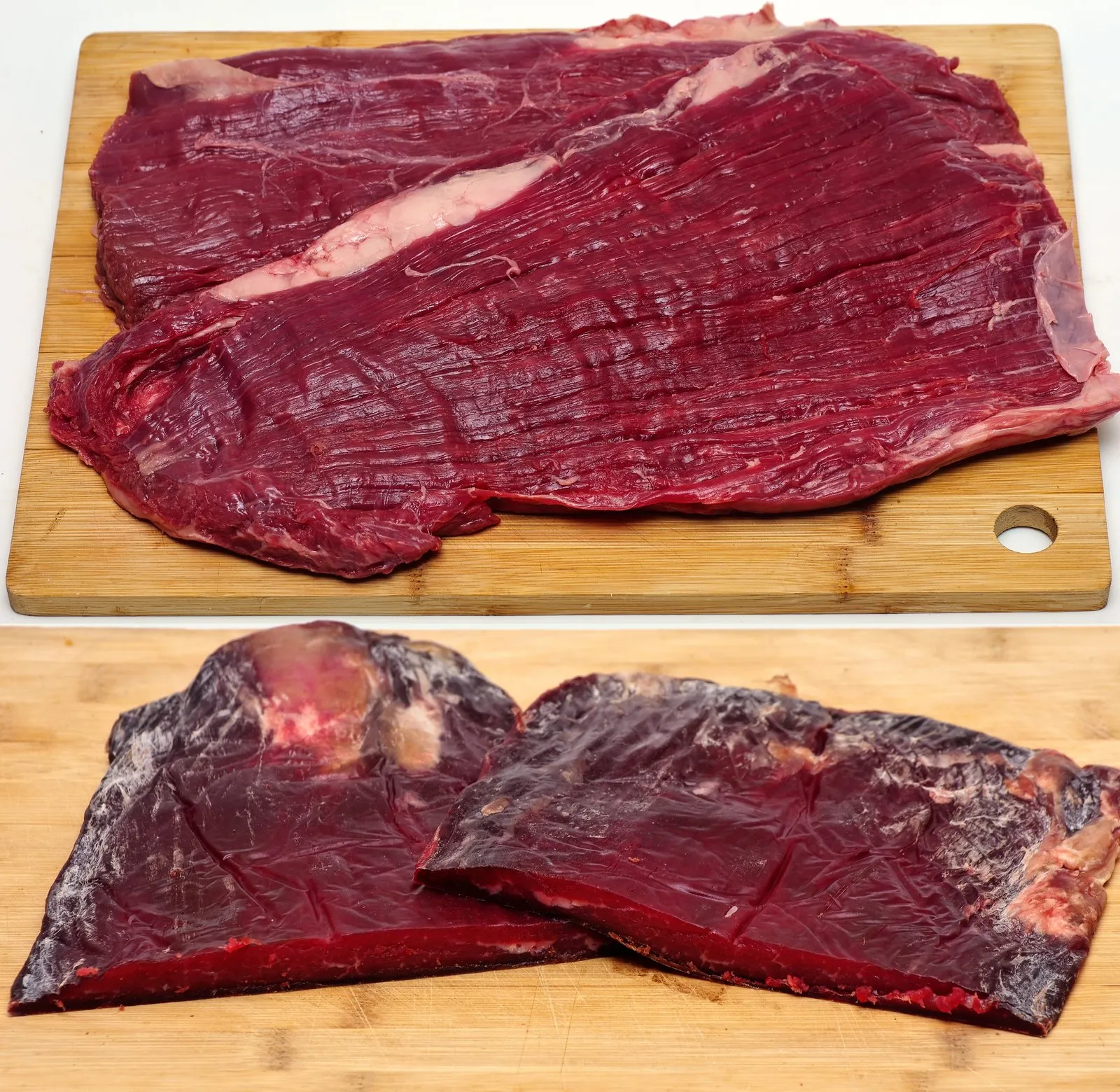 — view the full-size photo
Dry-aged beef cuts. The crust is trimmed before serving. The photo is not a Taste 1973 chamber.  — view the full-size photo
Rib steak already cut from a dry-aged piece. The dark edge is the zone that the trim removes or leaves, depending on the cut.
Photos: 1. Pannet (opens in a new tab) (CC BY-SA 4.0 (opens in a new tab)) · 2. StagiaireMGIMO (opens in a new tab) (CC BY-SA 4.0 (opens in a new tab))
Frequently asked questions
What is meat ageing?
How do dry and wet differ?
How much weight is lost in dry ageing?
Can meat be aged in a home refrigerator?
What does Diego Schattenhofer have to do with ageing?
Are the 122 days and the 60 days the same trial?
Also in the glossary
Nitrogen, liquid
Liquid nitrogen is nitrogen in its liquid state, which at one atmosphere boils at around −196 °C and freezes whatever it touches on contact.
Non-essential amino acids
Non-essential amino acids, those our body can synthesise by itself, play crucial roles both in our health and in the culinary world.
Omega-3 fatty acids
Omega-3 fatty acids are a type of essential polyunsaturated fat, meaning the human body cannot produce them on its own and they must be obtained through the diet.