Iberico ham: seal, breed and minimum time
- Term
- Jamón ibérico
- Tags
- Spain · Meat · Maturation
- Published
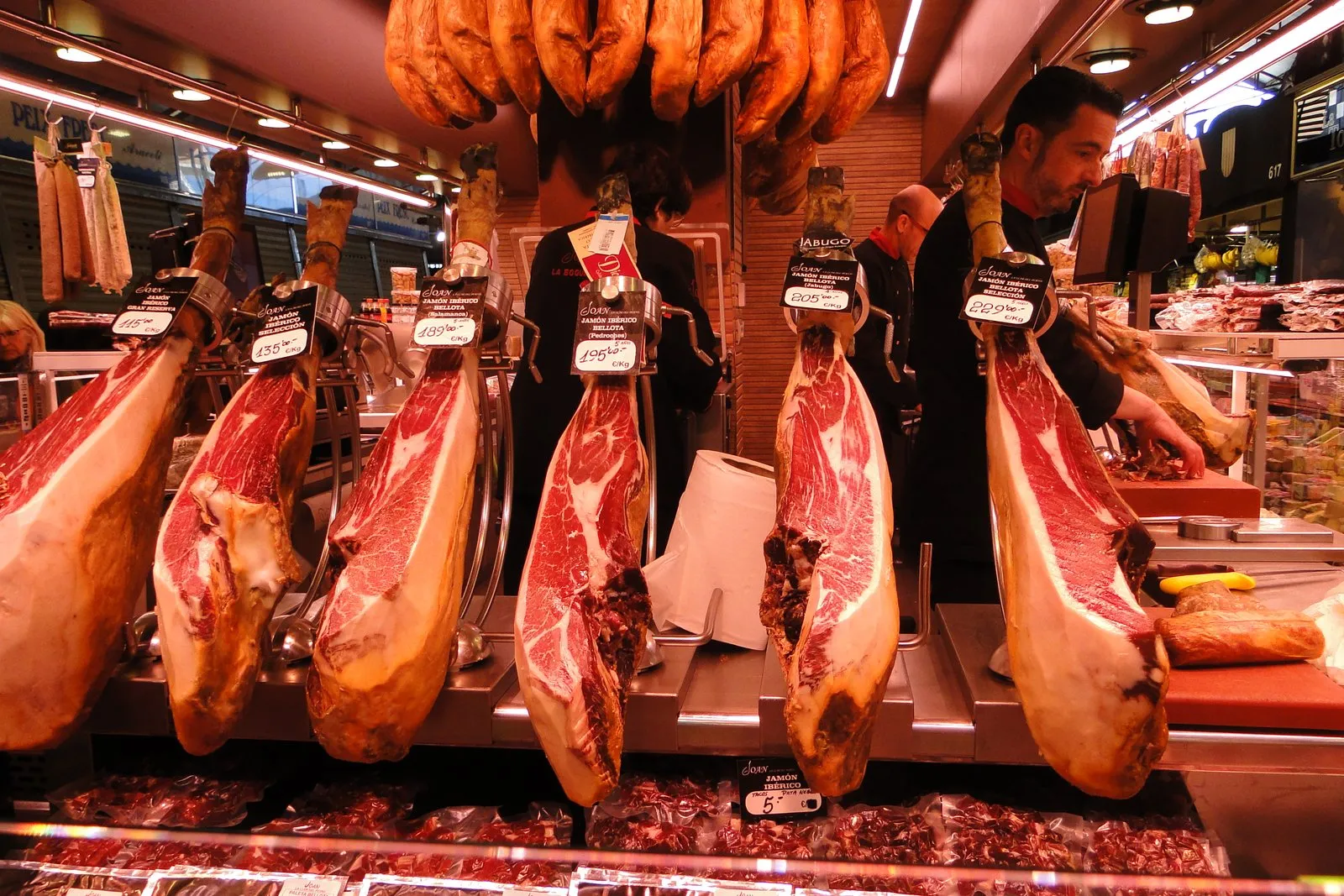
Iberico ham is the cured hind leg of the Iberian pig, with a sales denomination that obliges the label to state the feeding, the breed and the seal. It is not a menu adjective. It is a quality standard: Royal Decree 4/2014, of 10 January, which regulates Iberian meat, ham, shoulder ham and cured loin. Without those three words —piece, what the animal ate, breed percentage— the name remains a genus and the standard does not let it be sold that way.
The lead image shows hams hanging in the Boquería. The tapa shows the slice. The third photo was taken in Setúbal, in Portugal: it is good for recognising the whole piece and not good for attributing a Spanish designation of origin to it. The seal, which is what the standard asks to be looked at, cannot be guessed from the marbling.
The sales denomination
Article 3 composes the sales denomination with three designations, in this order, agreeing in gender. First the type of product: ham, shoulder ham (paleta) or cured loin (caña de lomo), if it is cured; or the name of the piece, if it is sold fresh. Then the feeding and management. “De bellota” (acorn-fed) is the animal slaughtered right after exclusively using acorn, grass and other resources of the dehesa, with no supplementary feed. “De cebo de campo” (field-fed) is the one that, though it may have eaten from the land, is fed with cereal and legume feed and reared outdoors, extensive or intensive, with the surface that Article 7 sets. “De cebo” (feed-fattened) is the one on feed in an intensive system, with the surface of Article 8.
The third designation is the breed. “100% Iberian” demands an animal with 100% Iberian genetic purity, whose parents also have 100% and are entered in the herd book. “Iberian”, without the one hundred per cent, demands at least 50% Iberian genetics. For 75% the standard asks for a 100% Iberian female and a male who is the son of a 100% Iberian mother and a 100% Duroc father. For 50% it asks for a 100% Iberian female and a 100% Duroc male. The breed certificate is issued by the herd-book association. The commercial brand cannot suggest another breed or another feed.
There are mentions that the standard reserves and mentions that it prohibits. “Pata negra” may accompany only acorn-fed 100% Iberian. “Dehesa” and “montanera” accompany only acorn-fed. Any drawing that evokes the acorn or the dehesa is likewise reserved for acorn-fed. “Recebo” and “ibérico puro” cannot be used. A menu that writes “pata negra” beside a white feed-fattened seal is using a phrase that the decree sets aside.
The four seals
At the slaughterhouse, Article 9 identifies hams and shoulder hams with a tamper-proof seal. The colour is the sales denomination:
| Seal | Sales denomination | Minimum age at slaughter |
|---|---|---|
| Black | Acorn-fed 100% Iberian | 14 months |
| Red | Acorn-fed Iberian | 14 months |
| Green | Field-fed Iberian | 12 months |
| White | Feed-fattened Iberian | 10 months |
The seal carries an individual number that is correlated with the carcass. They are assigned by the Asociación Interprofesional del Cerdo Ibérico (ASICI), which can review how they are fitted and keeps the count. A designation of origin or a protected geographical indication may put on its own seal if it respects these colours and these mentions. The seal stays on the piece in the shop and in the restaurant. No other is added that changes the colour or the mention.
The age in the table is not a menu whim. For acorn-fed, Article 6 sets 14 months. For field-fed, Article 7 sets 12 months. For feed-fattened, Article 8 sets 10 months. The minimum carcass weight is 115 kg, and 108 kg when the animal is 100% Iberian, in all three designations.
Acorn, field and feed
The acorn has a calendar. The animals enter the montanera between 1 October and 15 December, and are slaughtered between 15 December and 31 March. The average weight of the lot on entry is between 92 and 115 kg. The minimum weight gain during the montanera is 46 kg, over more than 60 days, on acorn and grass, with no supporting feed. Those figures are the legal minimum of the foraging, not a flavour score.
Field-fed asks, before slaughter, for a minimum stay of 60 days on the farms that Article 7 describes. An animal of more than 110 kg live weight must have, in that phase, at least 100 m² of free ground. Intensive feeding lowers that surface to 2 m² per animal of more than 110 kg, and lowers the minimum age to 10 months. Space is not a farm detail foreign to the plate: it is what separates the green seal from the white.
Minimum days of the piece
Article 12 counts the time from the day of entry into salting. To make it checkable, the piece carries an identification with the week of entry and the last two digits of the year.
In ham, the minimum depends on the weight of the cured piece. Under 7 kg, 600 days. At 7 kg or more, 730 days. On leaving the plant, a 100% Iberian ham may not go below 5.75 kg and an Iberian ham may not go below 7 kg. Those weights are of the piece already labelled, not of the live pig.
Shoulder ham has a single minimum: 365 days, whatever it weighs. On leaving, a 100% Iberian shoulder ham weighs at least 3.7 kg and an Iberian shoulder ham at least 4 kg. Cured loin closes the chapter with 70 days. Calling a shoulder ham a ham, or promising a loin cure with the days of a ham, mixes three products that the decree separates on purpose.
The process for ham and shoulder ham, in Article 11, is carried out on whole bone-in muscle pieces and passes through salting, washing, post-salting and curing-maturing. Loin passes through marinade, stuffing into casing and curing-maturing. The standard asks for maximum quality and traditional characteristics. The link with long flavour is in the entry on amino acids: proteolysis, glutamate, curing. The days that rule here are those of Article 12.
Four designations of origin
The MAPA list of specifications registers four iberico ham PDOs: Guijuelo, Jabugo, Dehesa de Extremadura and Los Pedroches. Each adds its specification —area, breed, management— on top of the state standard. They do not replace the colour seal: they can make it their own if the colour and the mention coincide. A piece can be Iberian by the standard and not belong to any of the four. A piece from the four is, besides, still black, red, green or white.
The protected designation of origin explains the European figure: all the stages in the area and a strong link with the environment. These four are that regime applied to a ham. They are not a ranking among themselves. The name that the menu must be able to sustain is that of the seal and, if there is one, that of the PDO. The rest is dehesa geography, which the specification of each draws and which a generic map of “Spanish iberico” does not replace.
In the kitchen
In the dining room the useful fact is short. The seal is looked at, not assumed. Black and red have gone through the montanera of Article 6; black adds the 100% breed and is the only one that may be called pata negra. Green has had field and feed, with a 60-day stay and 12 months of age. White is feed-fattened, with 10 months and 2 m². A slice with no seal in sight may be excellent and does not authorise inventing the colour.
The cut does not change the designation. A tapa in the photo is still the designation of the piece it came from. The bone, the caña and the shoulder ham are not interchanged to stretch a name: the shoulder ham has its 365 days and its weights, the ham has its own. The plating —with bread, with a wine, at room temperature so the fat is not mute— is cooking. The decree does not regulate it. What the decree does look at is that the name written beside that slice matches the seal the piece came with.
The maturing of which Article 12 speaks is salt curing, not the dry ageing of a fresh meat. Both use time and cold for another purpose. Fresh meat that rests in a chamber to tenderise has its own entry on meat ageing. The ham has already left the slaughterhouse identified and goes into salt. Confusing the 730 days of a ham of 7 kg or more with the weeks of a dry rib steak mixes two trades.
Related terms
- Protected designation of origin — the European figure of Guijuelo, Jabugo, Dehesa de Extremadura and Los Pedroches.
- Amino acids — the proteolysis of long curing and the flavour that glutamate leaves.
- Meat ageing — the rest of fresh meat, which is not the curing of ham.
- Water activity — the available water that salting and drying reduce.
- Fermentation — another route of transformation; the ham of this standard is not explained as a ferment.
Sources
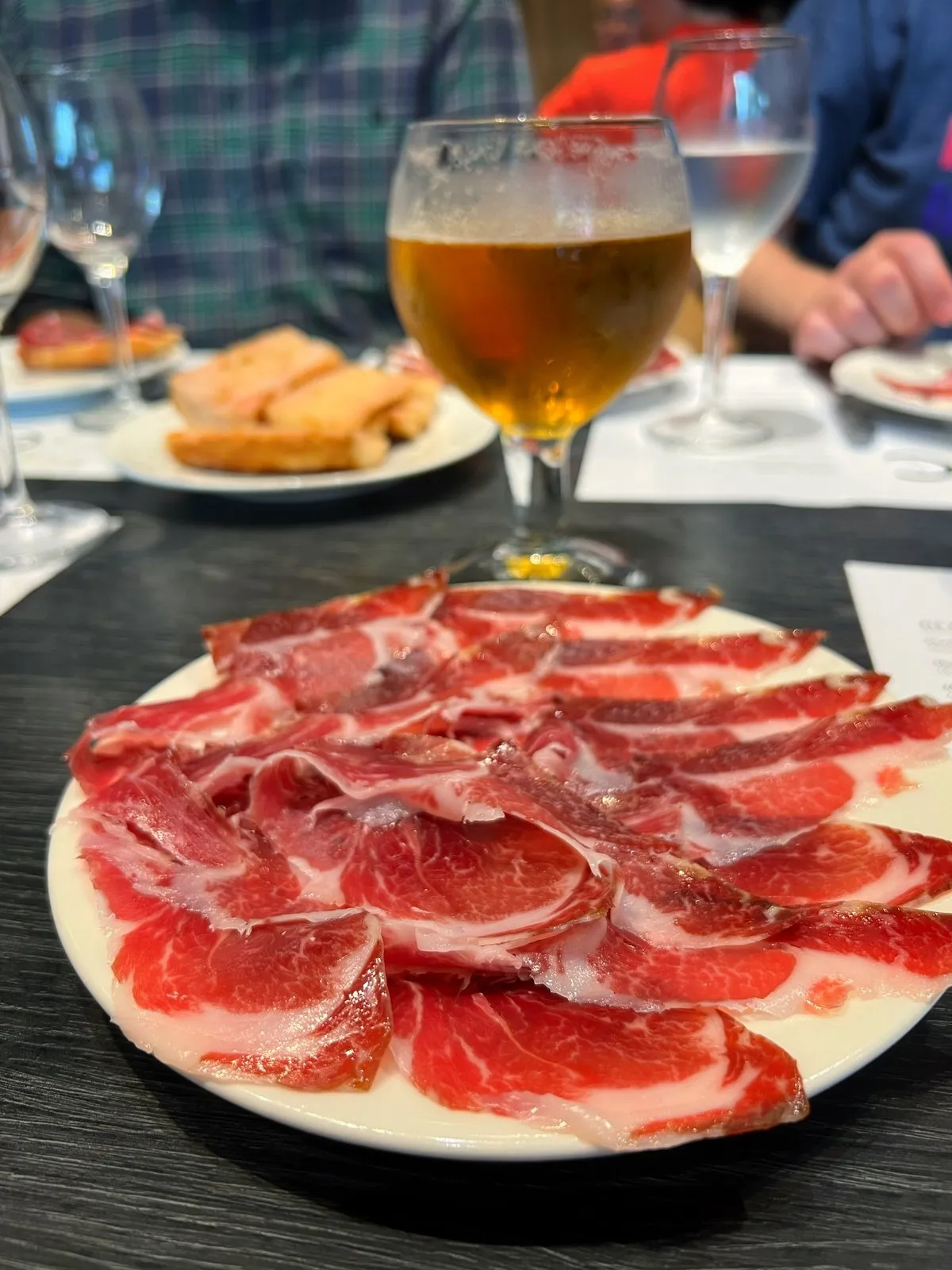 — view the full-size photo
Slices. The colour of the meat does not replace the seal: the standard asks for the colour of the seal, not of the marbling. 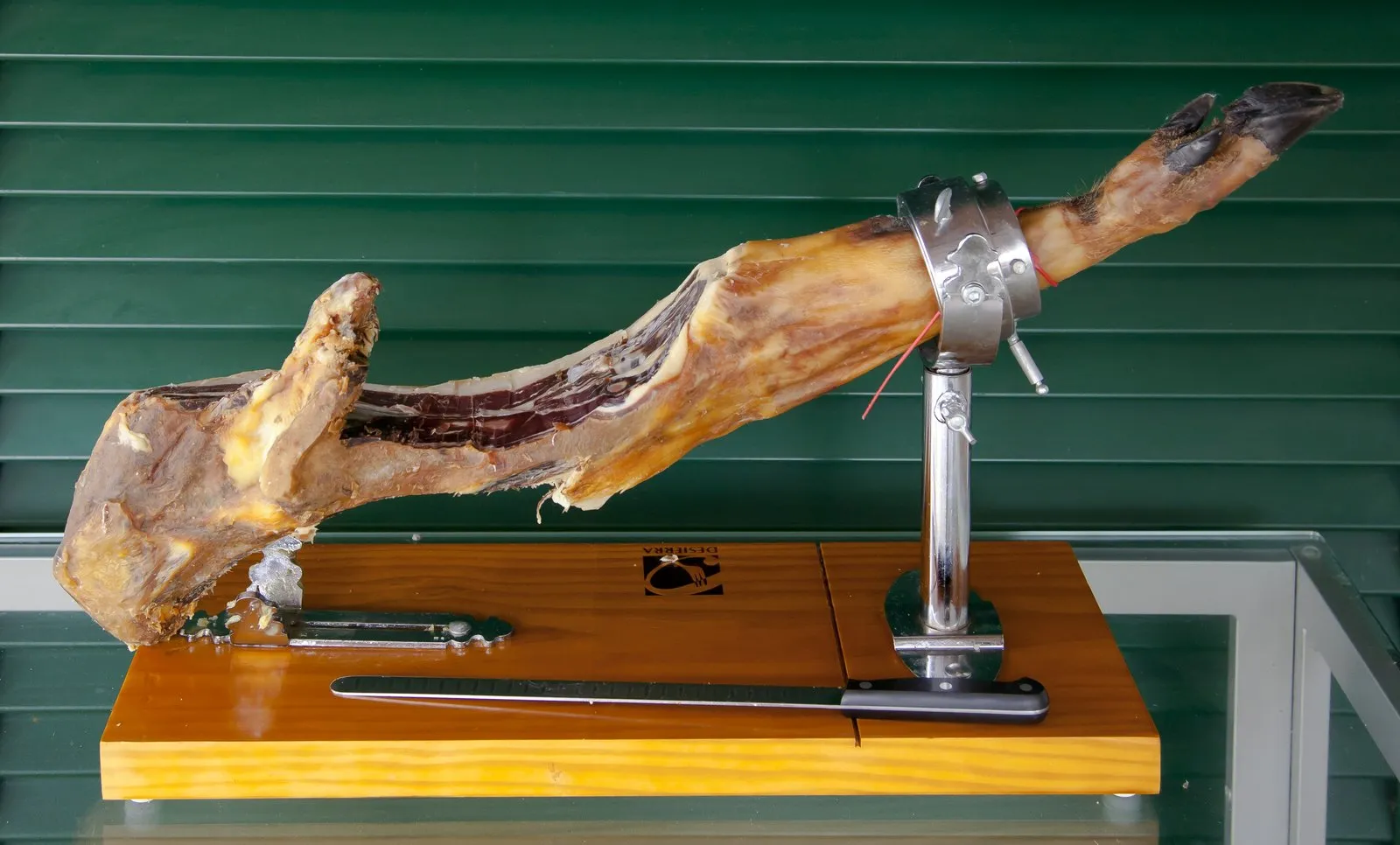 — view the full-size photo
Piece photographed in Setúbal. It shows the whole leg. Given the place of the photo, it is not a piece of Guijuelo, Jabugo, Dehesa de Extremadura or Los Pedroches.
Photos: 1. Elena.laps (opens in a new tab) (CC BY-SA 4.0 (opens in a new tab)) · 2. Diego Delso (opens in a new tab) (CC BY-SA 3.0 (opens in a new tab))
Frequently asked questions
What is iberico ham?
What does each colour of seal mean?
What is the minimum curing time of an iberico ham?
What does 100% Iberian mean?
Which designations of origin does iberico ham have?
Can pata negra be said of any iberico?
Also in the glossary
Kombu
Kombu is the brown seaweed Saccharina japonica, dried or rehydrated, from which dashi is made and from which glutamate took the name umami.
Lapas (Canarian limpets)
Limpets are molluscs of the genus Patella clinging to the rock; in the Canary Islands some are gathered subject to a size limit and a closed season, and the majorera cannot be taken.
Majorera goat
The Majorera goat is the native goat breed of Fuerteventura that the Official Catalogue has recognised since 2003, and the dairy base of Majorero cheese.