Majorera goat: the breed of Fuerteventura
- Term
- Majorera goat
- Tags
- Canary Islands · Meat
- Published
The Majorera goat is the native goat breed of Fuerteventura that the Official Catalogue has recognised since 2003, and the dairy base of Majorero cheese. It is not the old name of “all the Canarian goats”. It is a specific breed, with a morphological sheet, a herd book and a protected designation that asks for its milk. Anyone who searches for “Majorera goat” usually wants one of three things: how to recognise the animal, how many are registered, and what it has to do with the cheese. All three are answered from public sources.
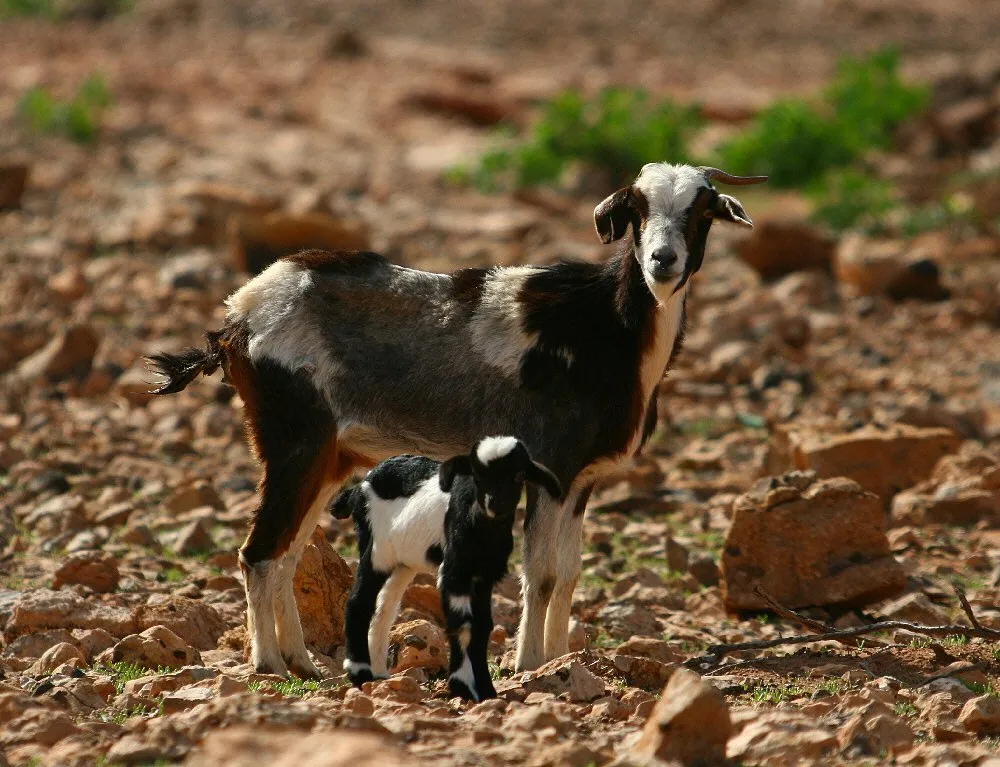
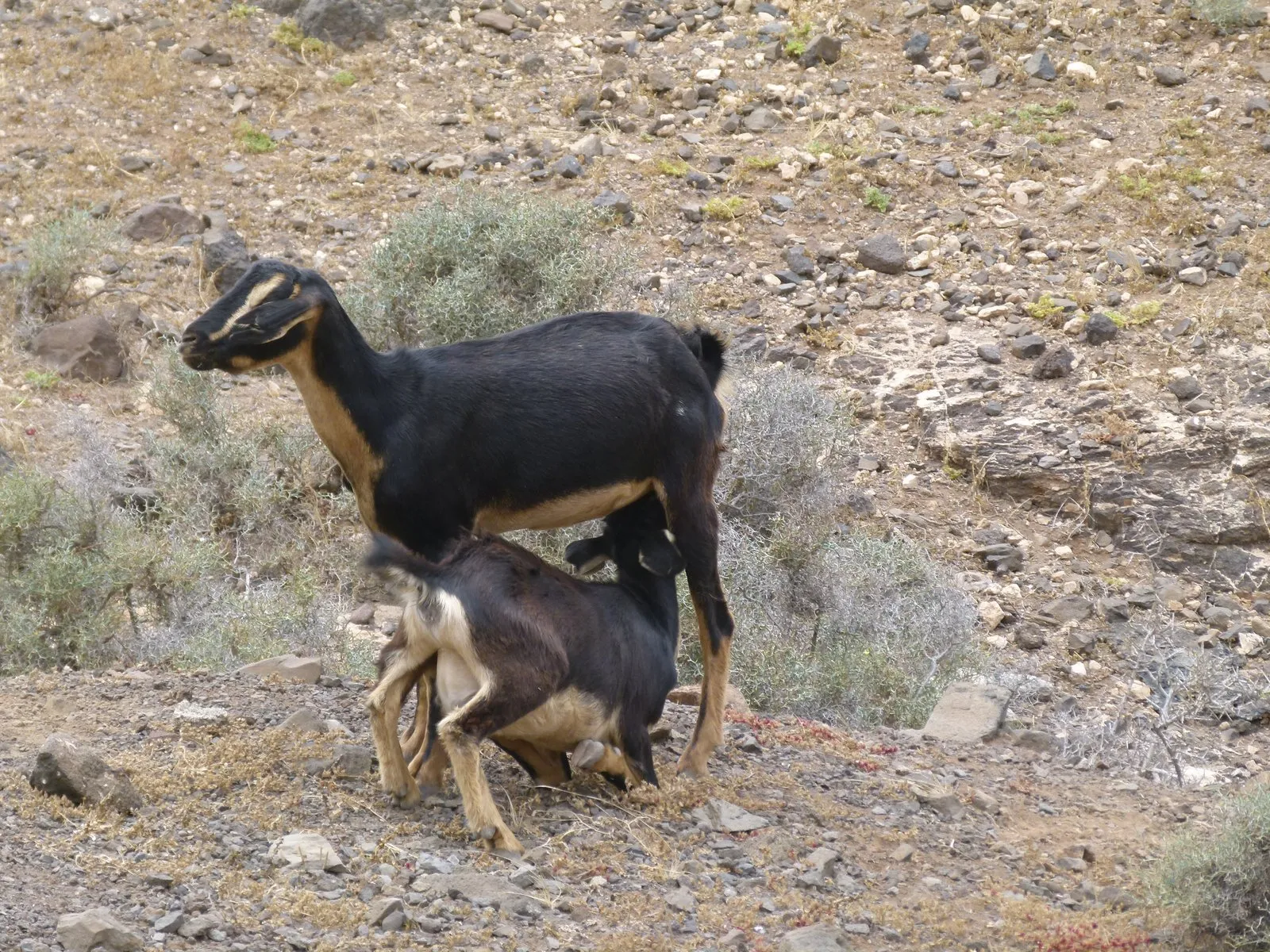
The lead image is a goat on a Fuerteventura farm. The source file calls it the island’s unofficial emblem. The caption does not say that animal is entered in the book: we do not have that fact. The gallery photograph was taken at El Cofete, in Jandía, and it stands as grazing landscape in the south of the island, with the same reservation.
Where the name comes from and when it enters the catalogue
The breeders’ federation links the name to Fuerteventura and to Maxorata, the pre-Hispanic name of the island. Majorera, in that account, is the goat of the Majorero island, not a loose adjective. The catalogue treats it as a breed, not as a nickname.
It entered the Official Catalogue with Order APA/2420/2003, of 28 August. That order suppresses the Agrupación Caprina Canaria — the figure that until then could be read as a single “Canarian goat” — and adds three breeds: Majorera, Palmera and Tinerfeña. The BOE published it on 5 September 2003. From then on, Majorera is a breed in its own right. The context of the other two is in Canarian goat.
The species is the domestic goat, Capra hircus. Calling it a breed does not make it another species. What the catalogue separates is the morphological pattern and the book, not the zoology of the species.
The federation dates the opening of the herd book to 2012. Since 2017, according to the same source, the book has been closed to males of incomplete genealogy. The federation’s page does not make clear whether the breed is endangered or in a promotion programme: it states both.
What it looks like, according to the catalogue
The Ministry’s morphological sheet describes an animal recognisable from far and from near. From far: a multi-coloured coat and pigmented mucous membranes, long ears, two horns in an arc that sometimes twist at the tip. From near: a large head, a neck that is fine and long, often with wattles, a deep chest, a wide rump, a high-set tail, limbs that are strong, long and fine. Bristly hair is frequent in the males. The udder is of great development, with fine skin and black or slate pigmentation, which is what one expects in an animal whose use, as stated by the federation, is dairy.
| Trait | What the MAPA publishes |
|---|---|
| Head and ears | Large head, long ears |
| Neck | Fine and long, often with wattles |
| Hair | Bristly hair frequent in males |
| Trunk | Deep chest, wide rump, high-set tail |
| Coat | Multi-coloured, with pigmented mucous membranes |
| Horns | 2, arched, sometimes twisted at the tip |
| Limbs | Strong, long and fine |
| Udder | Great development, fine skin, black or slate pigmentation |
| Withers height | 71 cm in males and 65 cm in females |
| Weight | 65 kg in males and 50 kg in females |
Those heights and those weights are the catalogue’s, not a kitchen weighing. They are worth leaving written next to any other figure in circulation, because they do not say the same thing. A male on the sheet weighs 65 kg. If a culinary working text speaks of 90 kg, it is speaking of another condition, and further down it is said which one, with its link. We do not mix the two into a single “breed average”.
The federation describes it as a dairy type, adapted to an arid climate, spread across the archipelago and with the largest census on Fuerteventura and Gran Canaria. Adaptation to the arid explains the landscape of the photographs — jable, coast, an open farm — better than any brochure adjective. It does not turn every goat in a photograph of Jandía into a registered animal.
For anyone comparing it with the other two breeds in the catalogue, the signs that do not need measuring are the long ear, the multi-coloured coat and the horn in an arc. The northern Tinerfeña is recognised by the long hair and the black or chestnut coat; the Palmera, by the red coat and the spiral horn. Those contrasts are developed in the overview entry. Here they are enough so that “Majorera” does not remain a demonym: it is a pattern. If the animal does not come close to that pattern, the island’s popular name does not enter it in the book.
The book, besides, is not a drawer that has been open from the start. The federation treats it as open in 2012 and, since 2017, closed to males whose genealogy is not complete. That changes what can be said of a young male on a farm: looking like the sheet is not the same as having a sire and a dam already registered. The practical effect, in the kitchen and in the dairy, is the same: “of the Majorera breed” is a condition of origin that someone has to be able to support with the book, not an impression from the photograph.
The udder of great development and the black or slate pigmentation matter more to the cheesemaker than to the roast cook, and that is why they live on this page beside the designation and not only beside the meat. An animal of dairy type is selected for milking. That a cook later matures carcases of that breed is a later use, the one Diego Schattenhofer has documented with the ICIA, not the use the federation puts first. To read the Majorera only as Canarian goat meat is to read it backwards.
How many are registered
The census we cite is the ARCA census at 31 December 2023, the same one the breeders’ federation reproduces. It is not a field estimate or a count of every goat on the island: it is the census of the book.
| Figure at 31 December 2023 | Number |
|---|---|
| Females | 13,940 |
| Males | 572 |
| Total animals | 14,512 |
| Farms | 78 |
| Scope of the census | Canary Islands |
78 farms for 14,512 animals give an idea of the size of the book, not of the size of the whole flock grazing outside it. Anyone who compares this census with old chroniclers’ phrases — tens of thousands of goats before the conquest — is comparing a current register with a historical quotation from another document, the cheese one, and they are not the same count. That quotation is explained in the entry for Majorero cheese, not here.
In the kitchen and in the cheese
The main use of the breed is milk. The 2026 single document for Majorero cheese asks for milk from goats of the Majorera breed, raw or pasteurised, and allows an occasional addition of up to 15 % Canarian sheep’s milk. Without Majorera there is no Majorero cheese with the designation. The percentage, the zone and the days of maturation are on the Majorero cheese page, where the specification is summarised.
Meat is the other use, the one Diego Schattenhofer has worked on with the ICIA within the study of the three native breeds, of which the Majorera is one.
In the kitchen, the usual mistake is to treat “Majorera” as a synonym of any goat on Fuerteventura, or as a synonym of Canarian goat. A goat on the island may be a herd-book Majorera, may look like one and not be registered, or may be another breed. The photograph does not decide it. The book decides it, and for the cheese the specification decides it as well: the milk has to be of the breed.
The second mistake is to use the weight of 65 kg, which is that of the male in the catalogue, as if it were the weight of an animal already chosen for maturation. The catalogue describes the breed. The maturation room describes a working criterion. They are different paragraphs.
In the Canary Islands
The rooting we mark is Fuerteventura, for the name and for the cheese, and Gran Canaria, because the federation places the largest census there, together with Fuerteventura. The same source says the breed is spread across the archipelago.
Maxorata remains an explanation of the name, not a second breed. Anyone who reads “goat of Maxorata” in an old text is looking at the antecedent the federation invokes, not at a different entry in the catalogue of 2003.
The island system — arid, of coast and of interior — is what the federation summarises as adaptation. We do not detail here a grazing calendar or a stocking rate: they are not in the sources we have used.
In the work of Diego Schattenhofer
The Majorera forms part of Diego Schattenhofer’s work with the three native breeds, not of a piece of research of its own. The article that summarises the MassCultura report says Diego Schattenhofer spent 3 years, with the ICIA, on the Palmera, the Majorera and the Tinerfeña, and that the kitchen working conditions were animals of about 3 years, 90 kg and at least 122 days of maturation. Those 90 kg do not replace the 65 kg of the male in the catalogue: they are the parameter of that study. The page is the research on the native goat.
The workshop of 6 July 2023 and the book of the Gobierno de Canarias are told separately, in the workshop chronicle and in La Magia de la Carne de Cabra Madurada.
Related terms
- Canarian goat — why that name is no longer a breed, and how the three are told apart.
- Majorero cheese — the designation that asks for milk of this breed, with up to 15 % Canarian sheep’s milk.
- History and tradition of the Canarian goat — the historical narrative, distinct from the catalogue sheet.
- The research on the native goat — the 3 years with the ICIA and the parameter of 90 kg.
- La Magia de la Carne de Cabra Madurada — the book of the Gobierno de Canarias.
- Sensory-analysis workshop of 2023 — the session of 6 July 2023.
Sources consulted
 — view the full-size photo
A goat at El Cofete, Jandía. The photograph documents the landscape, not the animal's entry in the herd book.
Photos: 1. Norbert Nagel (opens in a new tab) (CC BY-SA 3.0 (opens in a new tab))
Frequently asked questions
What is the Majorera goat?
Where does the name Majorera come from?
How tall is it, and how much does it weigh?
How many Majorera goats are there?
How is it related to Majorero cheese?
Does it figure in the work of Taste 1973?
Also in the glossary
Majorero cheese
Majorero cheese is a pressed-paste cheese with a protected designation of origin, made on Fuerteventura with milk from goats of the Majorera breed.
Meat ageing
Meat ageing is the cold rest that lets the muscle's enzymes work, in the air of a chamber or under vacuum in its own juice.
Nitrogen, liquid
Liquid nitrogen is nitrogen in its liquid state, which at one atmosphere boils at around −196 °C and freezes whatever it touches on contact.