Spherification: alginate, calcium and the liquid sphere
- Term
- Esferificación (spherification)
- Published
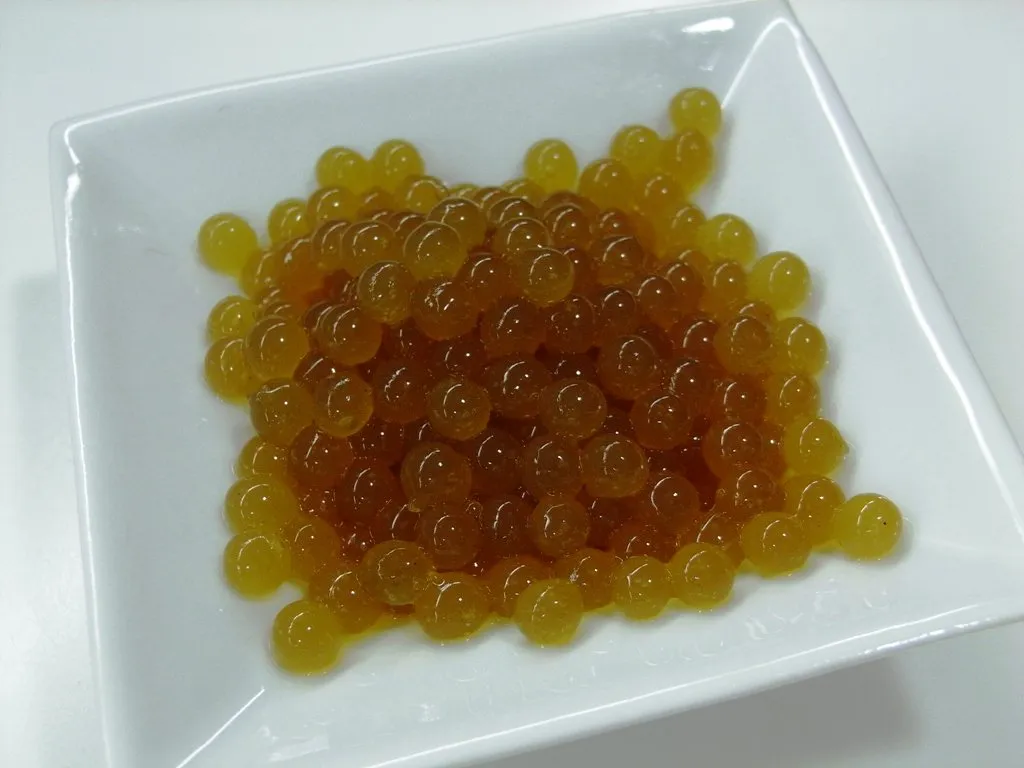
Spherification encloses a liquid in a thin skin of alginate gelled with calcium, so that the sphere bursts in the mouth. It is not a croquette, nor a pasta ravioli, nor a moulded gel. It is a membrane. The diner breaks it and finds the liquid that was inside: juice, tea, purée, reconstructed olive. What follows explains why calcium is needed, why there are two ways of ordering the two ingredients, and what not to ask of the technique.
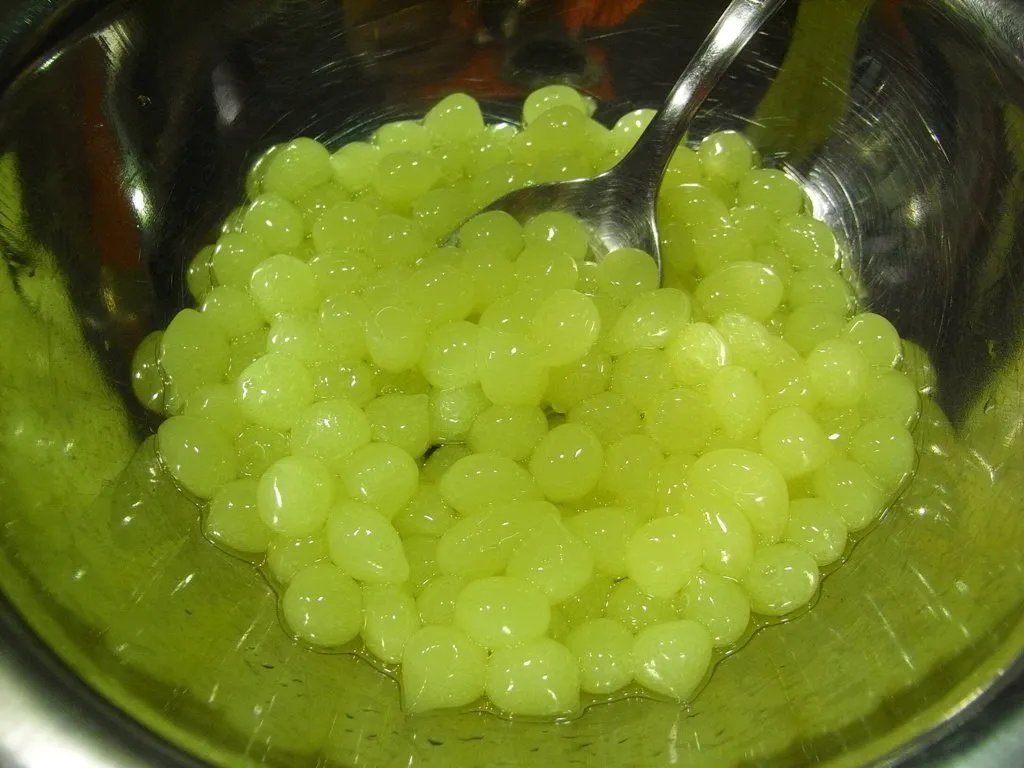
The lead image shows spheres of tea. The one in the gallery, spheres of apple juice. Both are by jlastras and show the result, not a quantity. These photos carry no supplier datasheet and no hand.
From a factory in 2003 to the reverse in 2005
Ferran Adrià tells it in a New Scientist interview. In 2003 he visited a factory, saw spheres in a glass and asked what they were. They told him about an alginate solution. He asked for alginate, bought calcium chloride at a pharmacy and, back in the workshop, mixed until he got the first sphere. He himself describes the immediate limit: as soon as alginate goes into an acidic or salty liquid, the reaction stops working. The catalogue of possible products, at first, was short.
The way out is told in the same account. If an alginate bath is prepared and yoghurt is poured in, the yoghurt reacts because it already contains calcium. That is reverse spherification. Then comes calcium gluconolactate, a salt that Adrià describes as lacking flavour, so that a liquid that does not bring calcium of its own, and cannot bear the taste of the chloride, can be calcified.
Chemistry World lays out the same dates from outside the kitchen: Adrià hits on the technique in 2003, and in 2005 the restaurant’s science department turns it around. Instead of drops with alginate over a calcium bath, liquids rich in calcium (or supplemented) over an alginate bath. The article recalls that the principle was not born in 2003. In the nineteen-forties it had already been patented to make artificial cherries. What changes at elBulli is the use: from an industrial solid to a haute cuisine sphere with the inside still liquid, and later to the method that allows dairy and products that already carry calcium.
The two statements are best kept apart. Alginate and calcium are chemistry that predates the restaurant. The liquid sphere as a dish, in the version the contemporary dining room recognises, enters with that workshop of 2003. The reverse, with 2005. Citing only one of the two dates leaves the history lame.
What happens in the drop
Sodium alginate is a thickener extracted from brown algae. In the presence of calcium ions it stops behaving like a thick liquid and builds a gel. Chemistry World sums it up: the drop, as it gels, is rounded by surface tension. No spherical mould is needed. The physics of the drop does the work if the bath and the density cooperate.
In the direct method the alginate is dissolved in the flavourful liquid and the bath is a calcium salt, the chloride in the account of 2003. As the drop falls, the calcium enters through the surface and the skin sets. The inside, if taken out in time, stays liquid. The problem the same article points out is that the membrane does not consider itself finished: it keeps thickening after the bath, until the sphere may end up solid. That is why the direct method is eaten straight away.
In the reverse method the order is changed. The calcium is in the product (yoghurt, or a liquid to which calcium gluconolactate or another calcium salt has been added) and the bath is alginate. The skin forms on the outside, at the contact, and the thickening is better controlled. Chemistry World notes the practical consequence: the reverse method lasts longer with the liquid inside. Olives, dairy and other products that the direct method rejected for their own calcium, or for their acidity, find their place there. The olive purée that the article recalls as an elBulli dish is the example cited again and again precisely because the olive, in the direct method, would not obey.
The percentage of alginate and the grams of chloride per litre depend on the manufacturer, not on a single legal dose: food regulation does not fix one. Those figures live in the product datasheet and in cookery-school notebooks. Whoever is going to carry out the technique needs the datasheet of the alginate on the shelf, not a round number from memory.
In the kitchen, beside other gels
The sphere does not replace the agar gel. Agar sets as a block when it cools and melts again only if given a lot of heat: it is a sheet, a noodle, a vegetable flan. Spherification sets only the boundary. Asking agar for a liquid skin, or asking alginate to hold up a hot block like agar, is changing tools in mid-sentence.
Xanthan does not make this skin either. It thickens and stabilises; on its own, it does not build the calcium gel. In a sphere it may appear in the liquid to give it body before the surface gels, but that is already formulation, not the definition. The map of these polysaccharides (agar, xanthan, gellan, carrageenans, pectin, and the alginate of this technique) is in hydrocolloids.
The failures that Adrià’s account leaves on record are still the starting ones. Acid and salt in the direct method. Calcium already present in the liquid, which triggers the gel inside before reaching the bath. Too much time in the direct method, until the liquid centre is lost. And the taste of calcium chloride when the salt is not rinsed off or when it is used where gluconolactate would bother less. None of those failures is fixed with a brand name. They are fixed by going back to the order of the two ingredients.
The generic name is spherification. If a brand sells the alginate or the calcium, it is an example of supply, not the name of the technique. The same goes for the bath, the syringe or the spoon: they are tools, not the concept.
What it is not
It is not an emulsion, nor a siphon foam, nor a low-temperature egg. It shares with those techniques the avant-garde cooking of the same years and does not share the mechanism. Here there is no gas, no egg white, no vacuum bag. There is a brown-algae polysaccharide and a calcium ion.
On the islands the technique is applied to local liquids (a mojo, a fish broth, a wine), and many are acidic or salty: the limit Adrià pointed out in 2003 matters here more than anywhere.
The drop rounds itself. Chemistry World attributes that to surface tension, not to a mould shaped like a sphere. The cook chooses the order of the two ingredients and the moment of lifting the piece out. If the alginate is in the liquid and the calcium in the bath, the skin keeps thickening afterwards and the liquid centre is lost if one waits. If the calcium is in the product and the alginate in the bath, setting stops when it is lifted out. Yoghurt served as the example because it already carries calcium. An acidic or salty liquid, in the first order, stops obeying: that is the limit the factory account leaves written, and it is the one that most often meets a mojo, a broth or a wine from the islands.
How to recognise it on the plate
A well-made sphere holds on the spoon, shines and gives way in one go. The liquid comes out clean, with no lumps of undissolved alginate and without the metallic bitterness of the chloride if that was the salt and it was not rinsed. A solid sphere, all gel, is usually a direct method that waited too long. One that falls apart before the mouth is usually a short skin: little contact, scarce calcium or alginate that never hydrated. These signs are read without scales. The scales are needed to repeat, and repetition depends on the batch of alginate, not on a universal figure.
Size changes the dining-room name and not the mechanism. The caviar of the photo (small spheres of tea or apple) is the same reaction as a large sphere served as a single mouthful. What changes is the contact time and the tool, syringe or spoon, not the alginate-calcium pair. Calling the small ones “caviar” is a metaphor of size, not a species of fish.
The reverse method allows preparing further ahead precisely because the skin does not keep eating the inside at the same rate. That made it useful in real service, where the direct method forces gelling almost in view. Chemistry World points to it as the advantage that is not minor: being able to stop the setting. In a restaurant kitchen, that advantage decides more than the poetry of the sphere.
Alginate hydrates better if dispersed vigorously and left to rest so it loses its air. The calcium bath of the direct method is kept cold in many workshops because that is how the drop is handled. None of that is in the regulation. It is in the craft that starts from the account of 2003 and of 2005, and each house refines it. What is not refined is the direction of the ingredients: either the alginate goes inside and the calcium outside, or the other way round. Reversing them by accident is the failure of whoever mixes the two methods in the same bowl. One last sign, visible in the photos: the spheres of tea and apple are small, regular and separate. If they stick to one another as they fall, the bath is overloaded with pieces or the skin is still soft. They are separated at the moment, not when they have already formed a cluster. That gesture, so much of the workshop, does not change the chemistry and does change the dish that reaches the table. The diner recognises the sphere by the burst in the mouth, not by the name of the technique written on the menu.
Related terms
- Agar-agar — the gel that sets as a block and melts far above the heat of the mouth, distinct from this skin.
- Xanthan — the thickener that does not form, on its own, the calcium membrane.
- Hydrocolloids — the umbrella of agar, xanthan, gellan, carrageenans and pectin, alongside the alginate of this technique.
- Amino acids — the flavour of the enclosed liquid, when that liquid owes its taste to glutamate or other compounds, not to the skin.
- Acidification — the practical limit: a liquid that is too acidic stops obeying alginate in the direct method.
Sources
 — view the full-size photo
Spheres of apple juice. The same idea as the tea ones in the lead image: a thin skin and liquid inside, with no doses written over them.
Photos: 1. jlastras (opens in a new tab) (CC BY 2.0 (opens in a new tab))
Frequently asked questions
What is spherification?
Who brought it to haute cuisine?
How does reverse spherification differ?
Why does alginate sometimes fail to gel?
Is calcium gluconolactate compulsory?
Is it the same as an agar gel?
Also in the glossary
Fermentation
Fermentation is the microbial transformation of a food: lactic in milk, alcoholic in must and acetic when wine turns to vinegar.
Gofio
Canarian gofio is the flour obtained on the islands by milling toasted cereals, with or without sea salt, covered by a PGI.
Hydrocolloids
Hydrocolloids are polysaccharides that, dispersed in water, thicken or gel a food: agar, xanthan, gellan, carrageenan and pectin.