Gofio: toasted, milled cereal of the Canary Islands
- Term
- Gofio
- Tags
- Canary Islands · Recipes
- Published
Canarian gofio is the flour obtained on the islands by milling toasted cereals, with or without sea salt, covered by a PGI. It smells of toast, stains the fingers and does not behave like the baker’s raw wheat flour. The process is written in a specification: grain, heat, milling, and the archipelago as the place where it happens and where it is packed.
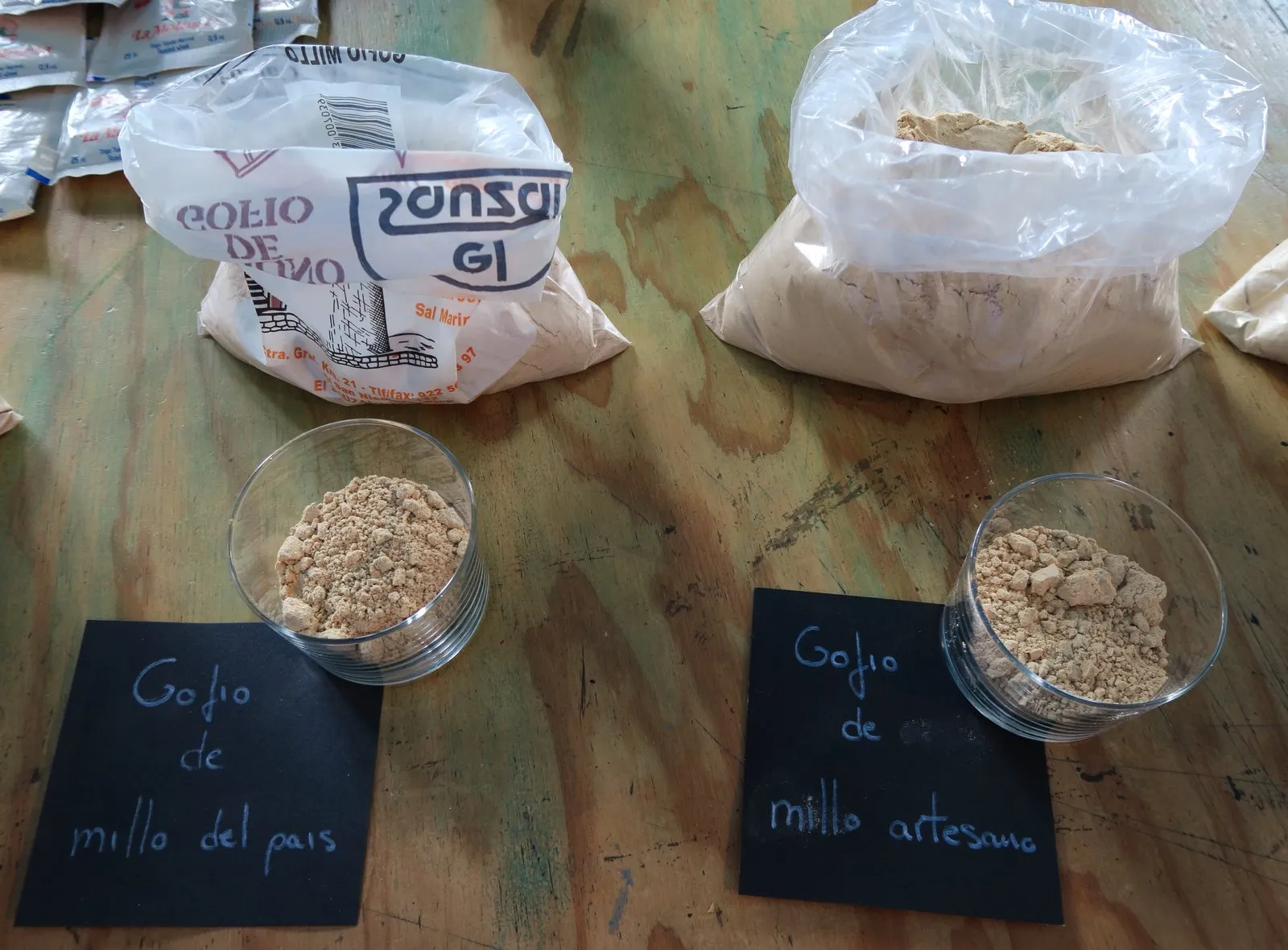
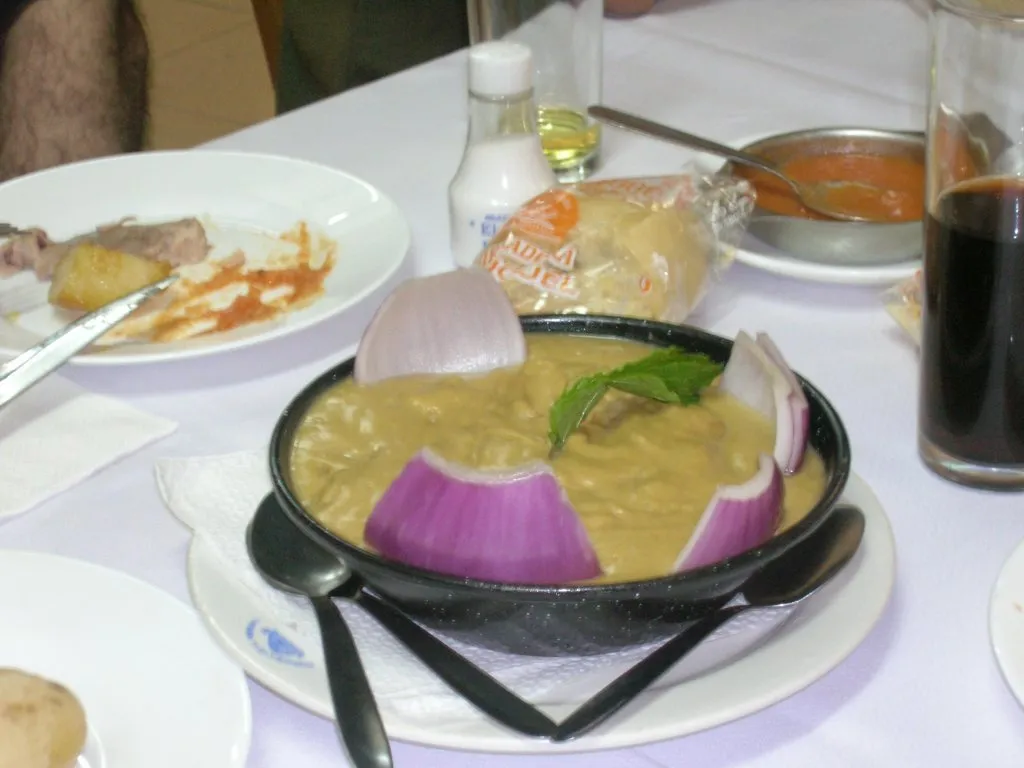
The lead image shows local maize gofio next to artisan maize gofio. The second photo is a gofio escaldado. The third, milk with gofio. All three are the same product at three moments: powder, paste with broth and glass. None is a calorie table.
What the specification admits
The specification of the “Gofio Canario” PGI, in the MAPA version dated 11 February 2014, defines it as the product obtained in the Canary archipelago by milling toasted cereals, with or without sea salt. Sometimes it is supplemented with pulses given the same treatment as the cereal.
The cereals in the specification are wheat, millo (maize), barley, rye, oats and rice. The pulses are broad bean, chickpea and soya. The salt, if it goes in, is sea salt. This is not an improvised supermarket list: it is the list the indication protects. A toasted powder of another grain, or toasted outside the islands, may be an honest flour and will not be Canarian gofio under the PGI.
The toasting has a ceiling. The temperature may not exceed 200 °C. The toasted grain must look uniform before being milled. It is then cooled, in sacks or in cooling boxes, to room temperature; the master miller decides when that rest has finished, and it can be sped up with air. Then comes the milling, which the specification calls the fundamental part. The miller stops it when the powder has the smoothness and the adhesiveness proper to gofio, and records the check before packing. The packing, because of the nature of the powder and the link with toasting and milling, must be done in the Canary Islands.
That is a PGI, not a designation of origin. The difference between the two categories (all the stages and a stricter link, versus one stage and a reputation) is in the entry on protected designation of origin. Gofio fits the second. Calling it a PDO is a labelling error, even if the pride in the name is the same.
Where the name comes from
The Canarian Institute of Agri-food Quality summarises the account the dossier itself uses. When the first Europeans arrived, they saw that the aboriginal people prepared a food from grains of barley and other cereals, lightly toasted and ground in hand stone mills. That product was called gofio or ahoren. Only the first word survived. The conquest changed the raw material: first wheat, then maize, and barley gradually fell behind without disappearing entirely. Mechanical mills came to the cleaning and the milling. The judgement of the toasting and the miller’s touch remain the craft.
There is no need to adorn that account with a date of conquest or a number of mills. The ICCA does not put them on that page, and the specification does not need them to define the powder. What it does fix is the continuity: toast and mill, with a hand that decides the end.
Escaldón, pella and the glass of milk
The powder on its own is rough. That is why the kitchen dissolves it. The RAE Tesoro defines escaldón as the paste formed by boiling water, stew broth or fish broth with gofio, to which other ingredients are usually added. The liquid has to arrive very hot: hence the name, related to scalding. On the coast the broth is usually fish; in the mid-altitudes, stew, cabbage, potatoes or meat. The photo of the bowl shows that paste, thick, with the spoon stuck in.
The University of La Laguna separates other forms that are best not all called escaldón. Kneaded with water (pella, pelota, kneaded gofio) it is the compact mouthful, the one eaten as one eats bread. With broth it is escaldón. With milk, sometimes with honey, it is another presentation, that of the glass in the third photo. With potatoes or with banana there are more variants in that same list. The practical criterion is the amount of liquid and the heat. Little water and kneaded: pella. Boiling broth and soft paste: escaldón. Milk in the glass: dissolved gofio, not a yoghurt.
None of these forms ferments the cereal. The milk may be milk, and if it were yoghurt it would already be something else, the lactic route of fermentation, not a property of gofio. The specification has no microbial stage. The grain is toasted, cooled and milled. Whoever looks for a Canarian ferment has wine and cheese. Gofio is the counterexample, and that is why it matters to say so clearly.
In the kitchen
The specification describes gofio by its process and its senses, not by a nutrition table: toasted powder, a colour that runs from ivory to reddish according to the grain and the degree of toasting (so the dossier describes it), a roasted aroma, and a use that runs from the handful to the paste.
At the table the same powder changes gesture. Kneaded with little water it is the pella, the compact mouthful. With very hot broth it is escaldón, the soft paste eaten with a spoon. With milk in the glass it is dissolved gofio, not a ferment. The specification does not separate those three forms with a recipe: it separates the product by the toasting, the milling and the packing in the archipelago. The master miller stops when the touch is already that of gofio, and that decision comes before the spoon.
When buying, the fact the PGI does give is the place and the craft. If the pack carries the indication, the toasting and the milling took place in the Canary Islands and someone decided the point by touch, not only by a timer. If it does not, it may still be gofio in household speech (the name predates the registration) and it cannot claim the category. Both truths fit: the word is old; the seal is a specification of 2014.
In cheese, gofio sometimes appears rubbed onto the rind, like paprika or oil, when the cheese specification allows it. That does not make gofio a cheese or the cheese a cereal PGI. They are two products that touch at the rind. Majorero has its own entry.
The escaldón in the photo carries no fixed recipe of onion, cheese or ribs. Those additions exist in households and change by island. The stable definition is that of the historical dictionary: gofio and very hot liquid. The rest is company.
In the Canary Islands
The rootedness belongs to the whole archipelago, which is the PGI’s area, not to a single capital. Tenerife, Gran Canaria, Lanzarote, Fuerteventura, La Palma, La Gomera and El Hierro come in because the specification draws the archipelago as the place of making and packing. Each mill has its preferred grain (maize in some houses, wheat in others, a mix in others) and the specification admits them all if the treatment is its own.
Gofio escaldado is among the emblematic dishes of Canarian cooking in the award text, in the same sentence as mojo, wrinkled potatoes and sancocho. The account is in the Consume Canario best restaurant award.
How it is bought and how it is said
On the pack, the fact that distinguishes everyday speech from the seal is the geographical indication. “Gofio” on its own can be the powder of a mill that toasts and grinds as it has always done, and the house has called it that since before 2014. “Canarian gofio” as a PGI adds the specification: area, cereals from the list, ceiling of 200 °C, cooling, the miller’s touch and packing on the islands. The two phrases do not tread on each other if they are not sold as if they were the same. The buyer who wants the seal looks for it in writing. The one who wants the mill on the corner asks about the grain and the toasting, which the specification also covers but which a bag without registration can tell honestly.
The local maize and the artisan maize of the lead image show that, within maize, there are already different ways of presenting it. The wheat, barley, rye, oats, rice and pulses of the specification widen the map without turning it into a drawer of raw flours. If the grain was not toasted, it is not gofio: it is flour or semolina, and it behaves differently in the escaldón, because it brings neither the roasted aroma nor the same thirst for liquid. That is the easiest failure in the pantry: substituting raw flour and expecting the same paste.
The travelling pella, the one kneaded to carry, and the table escaldón do not compete. One is eaten by hand, compact. The other is eaten with a spoon, hot. Both come from the same powder. Whoever has only seen the glass of milk misses half the recipe book, and whoever has only seen the fish escaldón misses breakfast. The product is one. The hungers it covers are several, and none requires a borrowed nutritional figure to be understood. Whoever tries it for the first time does well to start with little powder and a lot of hot liquid: gofio drinks water at once and, if it is left dry, it rasps. That gesture of adding broth a little at a time is a well-made escaldón, and it asks for neither scales nor table. It asks for the heat of the broth and the hand that stops when the paste no longer lets go of powder. The roasted aroma shows that the grain passed through the fire before the mill.
Related terms
- Protected designation of origin — the sibling category: gofio is a PGI, not a PDO, and the difference is explained there.
- Fermentation — the route of wine and cheese, which gofio does not follow.
- Majorero cheese — the cheese with a PDO that sometimes carries gofio on the rind, if its specification allows it.
- Water activity — why a dry, toasted powder does not ferment like a must.
- Baifo — another piece of the island recipe book, of meat, not of cereal.
Sources
 — view the full-size photo
Gofio escaldado: the powder worked into hot liquid until it forms a paste. It is not the pella, which is kneaded drier. 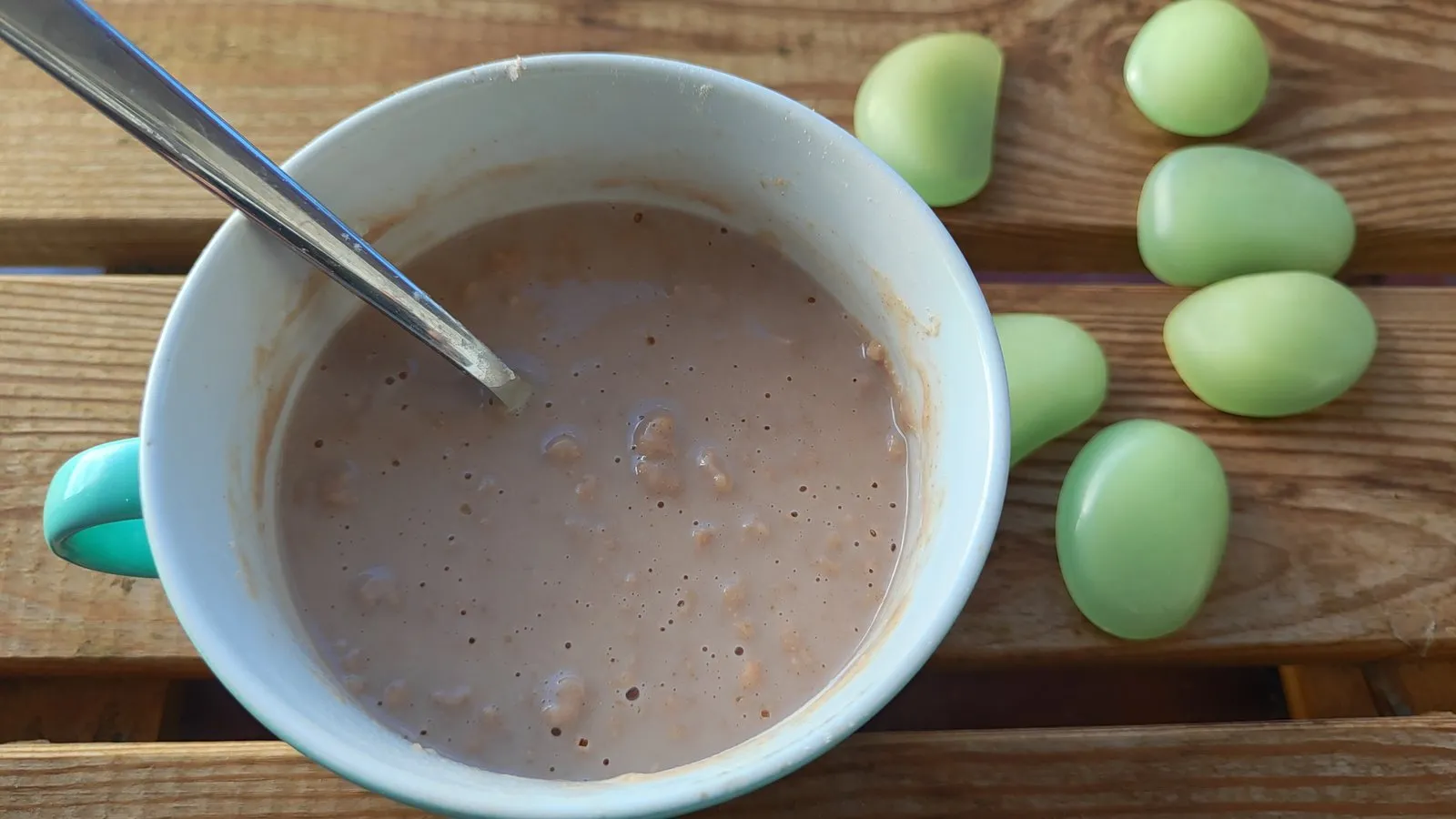 — view the full-size photo
Milk with gofio, another way of taking it dissolved. It is still the same toasted powder, not a dairy ferment.
Photos: 1. barraquito (opens in a new tab) (CC BY-SA 2.0 (opens in a new tab)) · 2. Mentxuwiki (opens in a new tab) (CC BY-SA 4.0 (opens in a new tab))
Frequently asked questions
What is gofio?
Is Canarian gofio a designation of origin?
At what temperature is it toasted?
Is gofio fermented?
What is escaldón?
How many calories does it have?
Also in the glossary
Hydrocolloids
Hydrocolloids are polysaccharides that, dispersed in water, thicken or gel a food: agar, xanthan, gellan, carrageenan and pectin.
Indication, geographical, protected (PGI)
A protected geographical indication is a European name that identifies a product from a specific place when at least one of its stages takes place there.
Jamón ibérico
Iberico ham is the cured hind leg of the Iberian pig, with a sales denomination that obliges the label to state the feeding, the breed and the seal.