Protected geographical indication (PGI): what the name requires
- Term
- Indication, geographical, protected (PGI)
- Tags
- Seals · Canary Islands · Spain
- Published
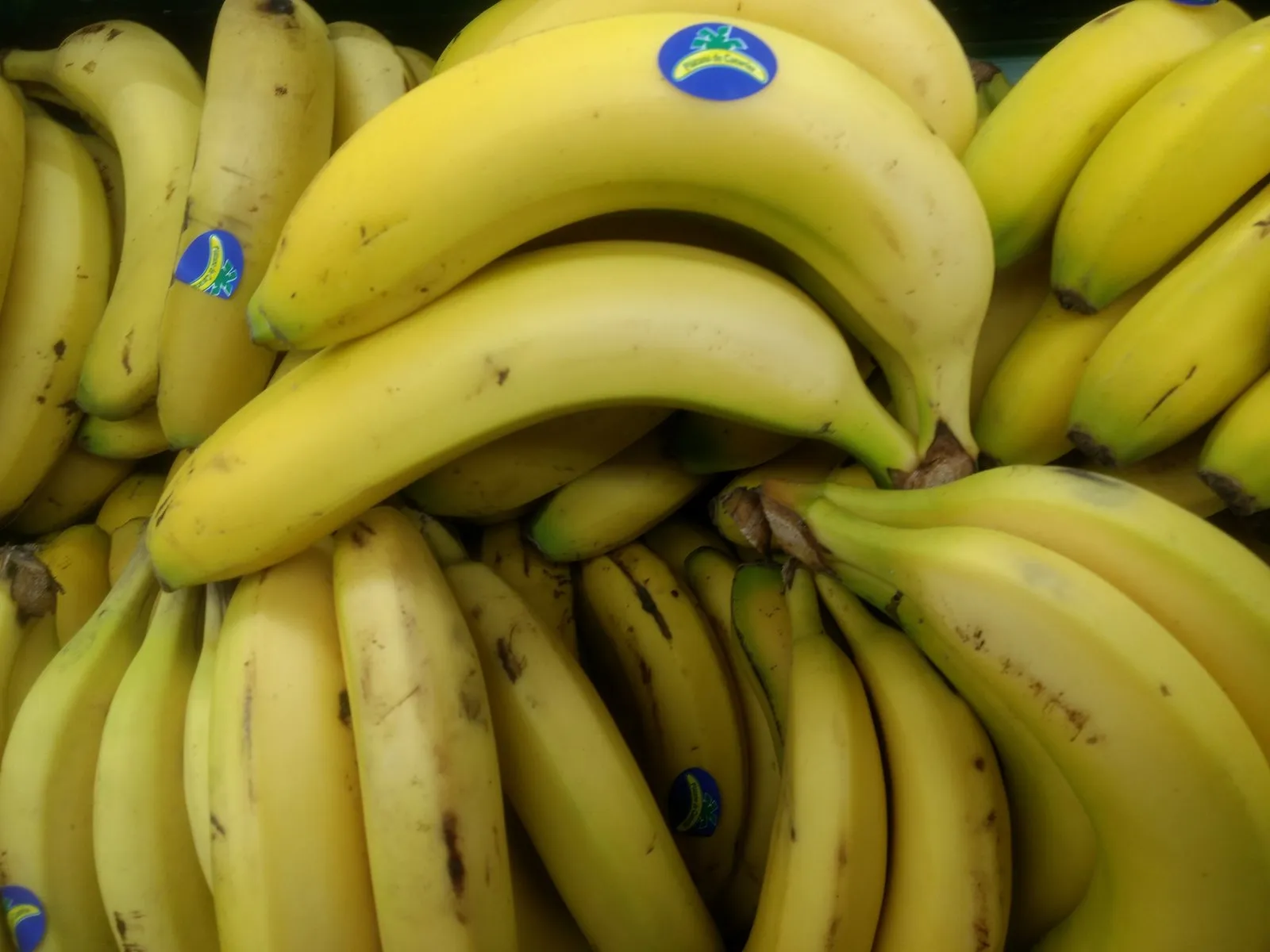
A protected geographical indication is a European name that identifies a product from a specific place when at least one of its stages takes place there. The sentence fits on a label and falls short unless the other figure, the designation of origin, is set beside it. Both protect a name. They do not ask for the same thing. Without that difference, gofio, bananas and majorero cheese look like three interchangeable seals. They are not.
The photos show bananas. They are not the logo of the indication, which is an institutional mark and is not reproduced here. The bunch is the product of one of the three agri-food PGIs that the MAPA list records in the Canary Islands. Gofio and avocado, which complete the trio, do not fit on the same plate.
What Article 46 requires
Regulation (EU) 2024/1143, of 11 April 2024 and applicable from 13 May 2024, calls a geographical indication, in paragraph 2 of its Article 46, a name that identifies an agricultural product under three conditions. It must originate in a specific place, region or country. Its quality, reputation or other specific characteristic must be essentially attributable to that geographical origin. And at least one of its production stages must take place in the defined area.
Paragraph 1 of the same article is the designation of origin. There the bar rises: the quality or characteristics are due fundamentally or exclusively to the environment, with its natural and human factors, and all the stages take place in the area. Both definitions have travelled in the same article since this regulation repealed Regulation (EU) No 1151/2012, of 21 November 2012. The correlation table of the new text pairs paragraph 2 with the old Article 5.2. Practice did not change overnight on 13 May 2024: what changed was the legal drawer where it was written.
The MAPA still explains the difference using the wording of the repealed regulation. That is useful for reading the label and not for citing the article number. The current number, for agricultural products, is 46. Wine has a chapter of its own within the same regulation. That is why a Canarian bottle with a designation of origin is not read with paragraph 2, nor with paragraph 1, word for word: it is read under the wine regime. In the MAPA wine list, the Canary Islands appear with 11 PDOs, and no wine PGI is added to what that list shows.
Three figures, three contracts
| Figure | What ties the name to the place | How many stages, in the area |
|---|---|---|
| PDO | Quality or characteristics due to the environment, fundamentally or exclusively | All |
| PGI | A quality, the reputation or another characteristic attributable to the origin | At least one |
| GI for spirit drinks | Own regime for spirit drinks, not Article 46.2 | Whatever its specification sets |
The third row avoids the same mistake already pointed out in the entry on protected designation of origin: sitting ronmiel at the table of cheeses. The ronmiel of the Canary Islands is a geographical indication for a spirit drink. The MAPA list of specifications records it in that class, registered in the EU on 13 February 2008. Its honey percentage and its strength belong to its specification, which will get an entry of its own. Here it is enough not to call it an agri-food PGI or a PDO.
Nor is a PGI the same as a food “from the Canary Islands” without registration. The geographical adjective is free until a specification reserves it. Once registered, using it on a product that does not comply is an infringement, not a menu style. A PGI is not a competition prize. It is a regime: an area, at least one stage, and a link that can be one of quality or of reputation.
The agri-food PGIs of the Canary Islands
The MAPA agri-food list records, for the Canary Islands, 3 PGIs and 6 PDOs. The protected geographical indications on that list are these:
- Gofio canario
- Aguacate de Canarias
- Plátano de Canarias
The six designations of origin on the same paper —cochineal, old potatoes, Tenerife honey, Flor de Guía cheese, majorero and palmero— are developed in the PDO entry. Majorero cheese is a PDO, not a PGI. Confusing the seal of the cheese with that of the banana is misreading the label, even though both are Canarian.
Gofio is the example whose specification is already in view. The MAPA version dated 11 February 2014 defines it as the product of milling toasted cereals in the archipelago, with or without sea salt. Toasting may not exceed 200 °C. Packing, because of the nature of the powder and the link with toasting and milling, must be done in the Canary Islands. That fits paragraph 2: the name is due to a way of making and to a place, and it does not require every grain to have grown on the island. Calling it a PDO would be climbing a step that the register has not climbed.
The Canary Islands banana takes the plate for the same reason: it is one of the three, it is recognised without a map, and the photo does not replace the specification. A banana plantation beside the road at Mogán shows the crop in Gran Canaria. It does not show the census of all the plots covered, nor does it turn into a PGI any banana that ripens at another latitude and is sold on the island.
The Canary Islands avocado closes the list of three. It is in the same ministerial PDF, next to gofio and the banana. Counting the archipelago’s PGIs and stopping at two leaves out a fruit that the list already covers.
These counts —3 agri-food PGIs, 6 agri-food PDOs, 11 wine PDOs— are those of the MAPA list. A new registration would move them. Paragraph 2 of Article 46 does not move with them.
When buying
The seal serves to read the label, not to guess the flavour. A gofio with a PGI has to meet the toasting, milling and packing of its specification. A banana with a PGI has to be the fruit that its specification covers, not a place name written next to a fruit of another origin. An avocado with the indication is the one in the register, not any avocado that has ripened on an estate on the island without that name.
The commonest abuse is the same as with the designation of origin: writing the seal next to a product that is merely local. If it is not on the list, the honest adjective is another: from Tenerife, from the mill, from the cooperative, from the estate. Those adjectives may be true and are not a PGI. Whoever pays for the protected name pays for the specification.
In the dining room, the short sentence is the one that separates. If the gofio carries the PGI, say PGI. If the cheese is majorero, say PDO and keep the PGI for the cereal or the fruit. If the ronmiel carries its spirit-drink indication, say that, not “one more PGI”. The 3, the 6 and the spirit drink are not added up in a single glass of prestige.
In the Canary Islands
The rooting of the regime is that of the archipelago the specifications draw, not that of a single capital. Tenerife, Gran Canaria, Lanzarote, Fuerteventura, La Palma, La Gomera and El Hierro are included because gofio, banana and avocado are defined over the whole or over the area that each specification fixes, and because the sister PDOs —honey, cheeses, potatoes, wines— cover specific islands that the other entry already lists. The photo of Mogán fixes one slope of banana plantations in Gran Canaria. It does not say that the whole island is the area, or that a plantation without the name is the PGI.
The difference from the PDO can be touched with the hand in two products that already have an entry. Gofio is toasted and milled under a PGI: one decisive stage and a way of making are enough for paragraph 2. Majorero requires the milk of the island’s goat and the rest of its specification under a PDO: paragraph 1. Both can be on the same table. They do not carry the same seal, and saying it wrongly is worse than forgetting an adjective.
Related terms
- Protected designation of origin — paragraph 1 of the same Article 46: all the stages and a stricter link.
- Gofio — the PGI with a 2014 specification, a ceiling of 200 °C and packing in the islands.
- Majorero cheese — a PDO, so the seal of the cheese is not mixed with that of the banana.
- Fermentation — the route of wine and cheese, which the seal does not replace.
- Canarian goat — the breed of the milk the majorero PDO requires, outside this list of PGIs.
Sources
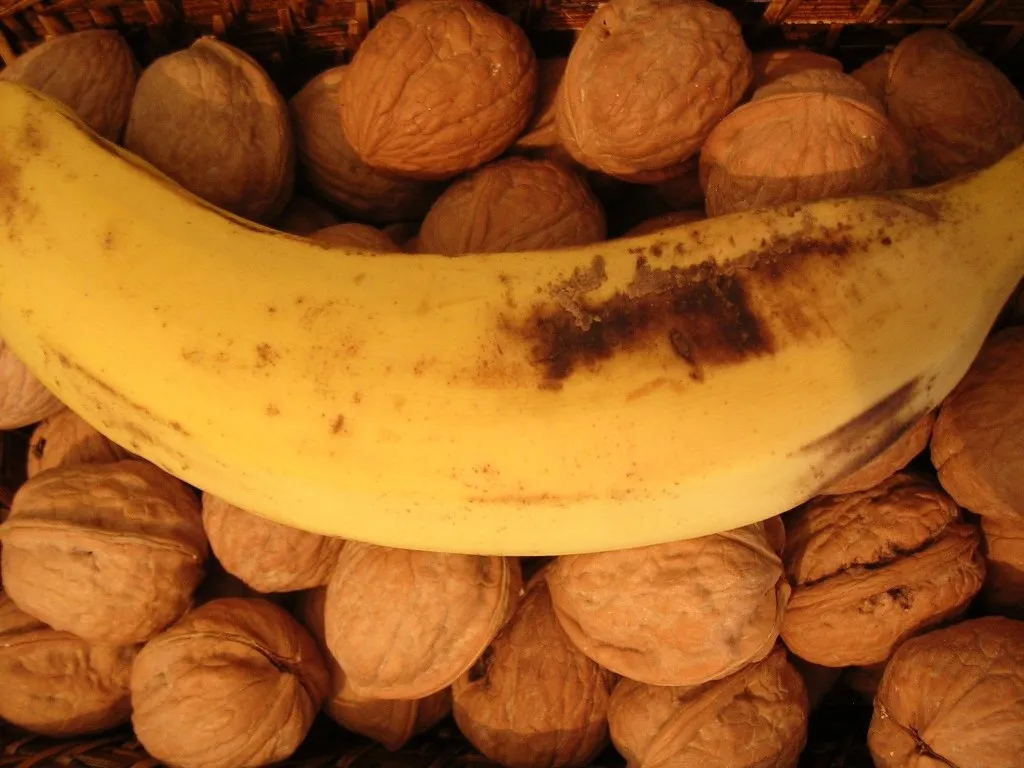 — view the full-size photo
Canarian banana and walnuts. The photo shows the fruit of one of the three agri-food PGIs, not the drawn seal. 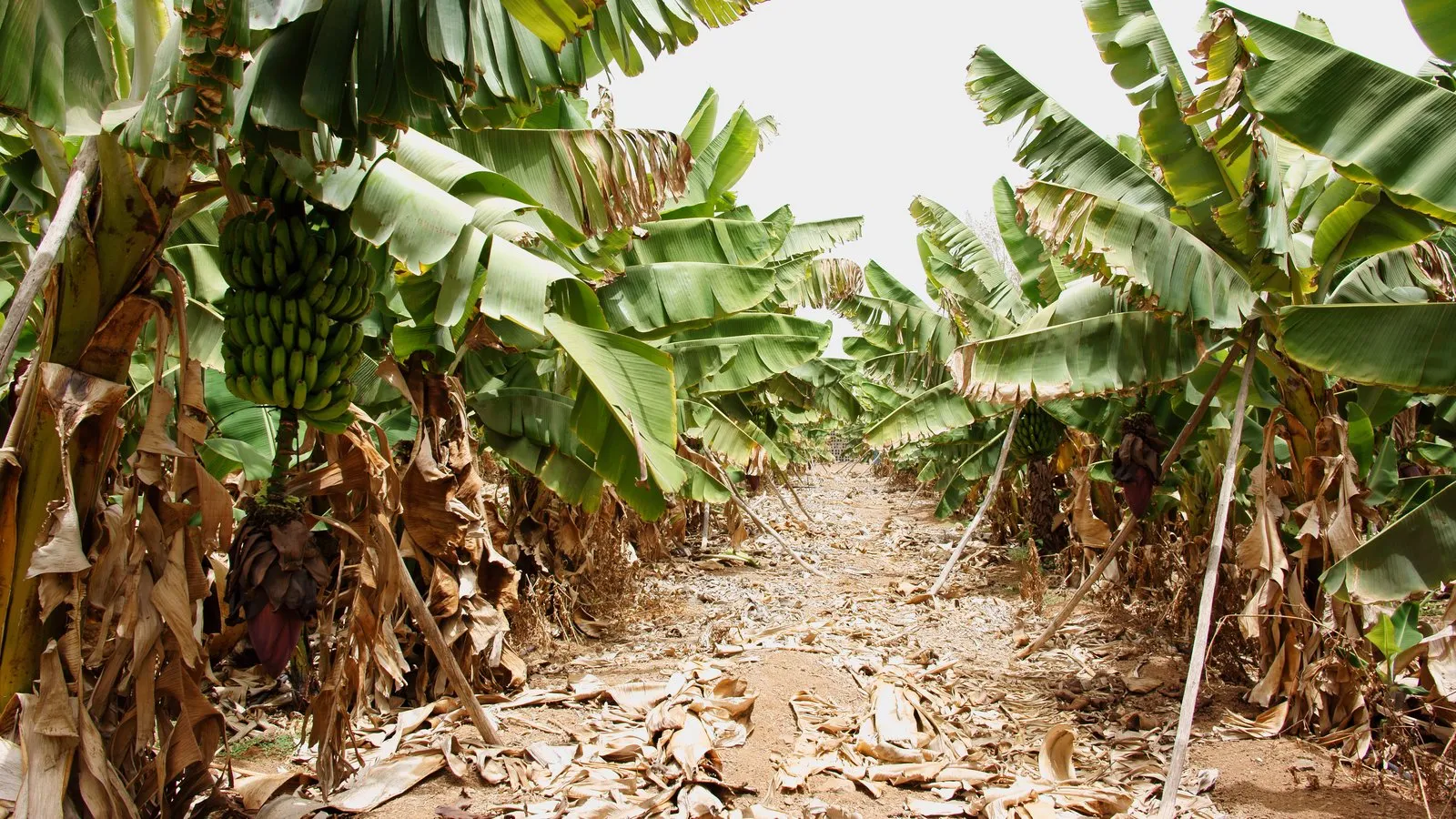 — view the full-size photo
Banana plantations between Puerto de Mogán and Veneguera. The crop is visible in the landscape; the PGI register is another matter, and it is checked in the list.
Photos: 1. racatumba (opens in a new tab) (CC BY 2.0 (opens in a new tab)) · 2. Jarek Prokop (opens in a new tab) (CC BY 3.0 (opens in a new tab))
Frequently asked questions
What is a protected geographical indication?
How does a PGI differ from a PDO?
How many agri-food PGIs are there in the Canary Islands?
Is the Canary Islands banana a PDO?
Is Canarian gofio a PGI?
Is the ronmiel of the Canary Islands a PGI?
Also in the glossary
Jamón ibérico
Iberico ham is the cured hind leg of the Iberian pig, with a sales denomination that obliges the label to state the feeding, the breed and the seal.
Kombu
Kombu is the brown seaweed Saccharina japonica, dried or rehydrated, from which dashi is made and from which glutamate took the name umami.
Lapas (Canarian limpets)
Limpets are molluscs of the genus Patella clinging to the rock; in the Canary Islands some are gathered subject to a size limit and a closed season, and the majorera cannot be taken.