Pollack: Information and Culinary Uses
- Term
- Pollack
- Tags
- Fish · Canary Islands
- Published
- Updated
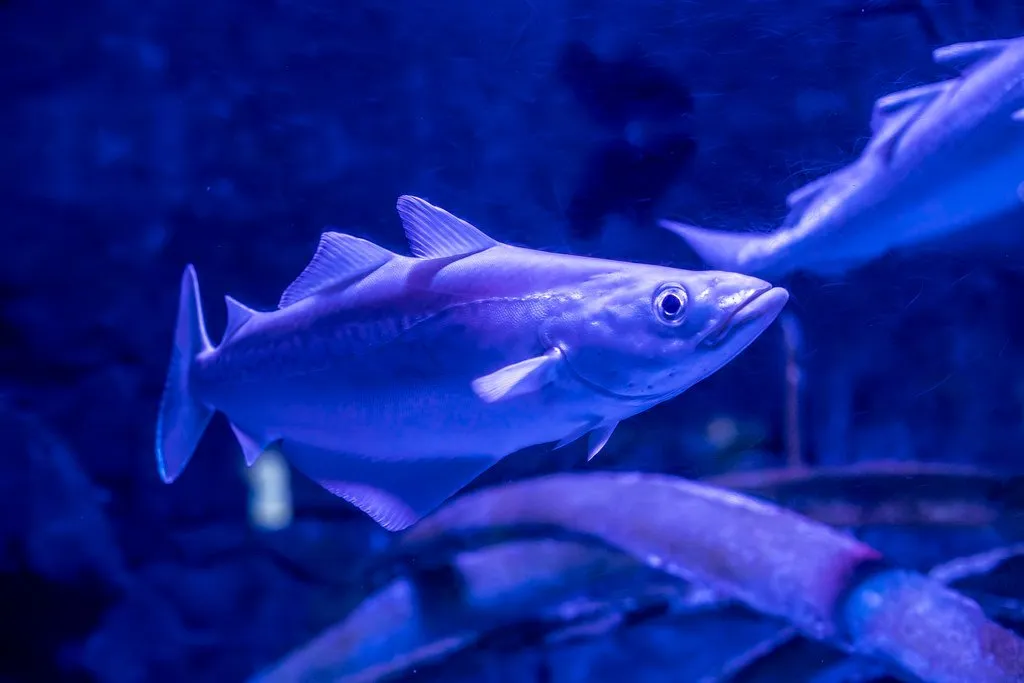
Definition: what is pollack?
Pollack is a fish highly prized in cooking for its versatility and mild flavour. It is the common name for several species of the same genus as cod. It differs from cod mainly in the absence of a barbel on its lower jaw. Pollack usually measures between 70 and 80 cm, with a grey belly and a back that ranges from greenish-grey to dark green. It lives in Atlantic waters, especially in the area that extends down to the Bay of Biscay.
This is how the RAE records it; in current taxonomy, pollack and cod are different genera —Pollachius and Gadus— within the same family, the gadids.
It’s worth saying from the outset, because it’s the most repeated confusion and the one no fishmonger’s label clears up: in the Canary Islands that same word does not name this fish. Here “abadejo” and “abade” —two names for the same fish depending on the province— designate an endemic grouper of the Macaronesian Atlantic, from another family. This is expanded on below.
What “abadejo” means and where the word comes from
The RAE’s Diccionario de la lengua española records two ichthyological senses: cod, the fish, and the common name applied to several fish of the same genus as cod. This is why the word is used as a commercial synonym in some fishmongers and as the name of a different species in others.
The same entry records three senses that have nothing to do with the sea: the goldcrest, a small bird, and two coleopteran insects, the carraleja (blister beetle) and the cantárida (Spanish fly). Anyone who searches for “abadejo meaning” and finds an insect hasn’t picked the wrong dictionary.
On the origin of the word, the RAE points to the union of “abad” (abbot) and the suffix “-ejo”. The dictionary doesn’t settle the etymology: it gives it as probable, and it should be cited as such.
Mainland pollack: Pollachius pollachius
The reference scientific name of the pollack sold on the Spanish mainland is Pollachius pollachius (Linnaeus, 1758), of the family Gadidae, the same as cod. It is a fish of the north-east Atlantic: it is distributed from Iceland, the Faroes and Norway down to the Bay of Biscay, and also in the southern Baltic Sea. It has never arrived alive at a Canarian market.
| Fact | Pollachius pollachius |
|---|---|
| Family | Gadidae |
| Maximum recorded length | 130 cm |
| Maximum recorded weight | 18.1 kg |
| Maximum reported age | 8 years |
| Sexual maturity | around 41 cm |
| Usual depth | 40–200 m (most often, 40–100 m) |
| Distribution | North-east Atlantic and southern Baltic |
Data from FishBase.
Size figures matter in the kitchen more than they might seem to: a specimen close to its maximum size gives thick loins that hold up on the griddle and in the oven without falling apart, while smaller commercial-size fish call for brief cooking times.
Pollack and cod: how they differ
They are two different species of the same family. The fastest tell at the counter is the barbel, the fleshy appendage that hangs from the lower jaw: cod has it and pollack does not. Then come size and habitat, where the gap is large.
| Fact | Pollack (Pollachius pollachius) | Atlantic cod (Gadus morhua) |
|---|---|---|
| Jaw barbel | Absent | Present |
| Maximum length | 130 cm | 200 cm |
| Maximum weight | 18.1 kg | 96 kg |
| Maximum age | 8 years | 25 years |
| Depth | 40–200 m | 0–600 m (most often, 150–200 m) |
Data from FishBase for both species.
Added to that gap is conservation status: FishBase lists Atlantic cod as “Vulnerable” on the IUCN Red List.
The confusion doesn’t end there. In the Spanish trade, two other species of the order Gadiformes circulate under the name “abadejo”, or salted alongside cod: coalfish or saithe (Pollachius virens), of the family Gadidae, and ling (Molva molva), of the family Lotidae. That’s why the commercial name isn’t enough to know what you’re buying: the scientific name on the label is.
Nutritional characteristics of pollack
Pollack is a lean fish, meaning it has a low fat content. Below is a detailed table of its nutritional values per 100 grams:
| Nutrient | Amount |
|---|---|
| Energy | 76 kcal |
| Carbohydrates | 0 g |
| Protein | 17.4 g |
| Fat | 0.75 g |
| Fibre | 0 g |
| Saturated fatty acids | 0.13 g |
| Monounsaturated fatty acids | 0.08 g |
| Polyunsaturated fatty acids | 0.5 g |
| Cholesterol | 50 mg |
| Calcium | 16 mg |
| Iron | 0.3 mg |
| Zinc | 0.4 mg |
| Vitamin A | 0 µg |
| Vitamin C | 0 g |
| Folic acid | 12 µg |
| Sodium | 300 mg |
| Sugars | 0 g |
This data is purely for guidance and should not be used for medical purposes. The people responsible for this website accept no liability.
With less than one gram of fat per 100, the unsaturated fraction counts for little in absolute terms: pollack is not a notable source of omega-3 fatty acids, which are found mainly in oily fish. Its interest lies in its protein and its lightness.
In the kitchen
It is sold whole, in steaks, in fillets or in pieces, fresh, frozen and salted, and is commonly used as a more affordable alternative to cod, including in preparations traditionally made with it. That is its most frequent role on the à la carte menu and at the fishmonger’s.
Its white, mild-flavoured flesh takes to almost any treatment, and it’s precisely that mild flavour that allows it to be paired with characterful ingredients without one masking the other. Being a lean fish —less than one gram of fat per 100, according to the table above— the margin between perfectly cooked and dry is narrow: in practice, what matters is heat control, with brief cooking on the griddle and in the oven and, in a stew, adding the fish at the end, once everything else is done.
If working with the salted piece, the technical reference is the same as for any salting: what governs preservation is not the salt you can see, but the water activity (a_w) that salt leaves available.
Popular pollack recipes
Pollack is a versatile fish that can be prepared in various ways. Here are some popular recipes:
| Recipe | Type of dish | Time | Serving temperature |
|---|---|---|---|
| Griddled pollack with tomato and garlic salad | Fish, vegetables | 30 min | Hot |
| Griddled pollack, tomato and garlic salad and Galician-style potatoes | Fish, single dish | 45 min | Hot |
| Griddled pollack with pasta and wok-fried vegetables | Fish, vegetables, single dish | 50 min | Hot |
| Pollack in white wine | Fish | 50 min | Hot |
In the Canary Islands: “abade” and “abadejo” name a different fish
This is the point where a glossary written from Tenerife has something that fishmonger’s labels don’t tell you. On the islands, the common name does not designate the same species as on the mainland: it is applied to fish of the genus Mycteroperca, that is, to groupers, not gadids. Pellagofio also documents a split by province in the two non-native species sold as abade: they are called “abade” in Las Palmas and “abadejo” —perhaps hispanicising the Portuguese word badejo— in Santa Cruz de Tenerife. That same source names the endemic species “abade de Canarias” (Canarian abade).
The species that gives the Canarian abade its name is Mycteroperca fusca (Lowe, 1838), of the family Serranidae, endemic to Macaronesia: it lives exclusively in the Azores, Madeira, the Salvage Islands, the Canary Islands and Cape Verde. There is no close kinship with cod or with mainland pollack; what they share is the Spanish name, inherited for historical reasons of trade and translation.
| Fact | Abade, Mycteroperca fusca |
|---|---|
| Family | Serranidae (groupers) |
| Distribution | Endemic to Macaronesia: Azores, Madeira, Salvage Islands, Canary Islands and Cape Verde |
| Length | 70 cm on average, up to 80 cm; males are larger than females |
| Habitat | Solitary, near the rocky seabed, down to 200 m |
| Water temperature | 10–26 °C |
| Behaviour | Territorial; may confront other males |
| Reproduction | Sequential hermaphrodite (born female and may become male); oviparous, spawns in open water |
Data from the Government of the Canary Islands’ CanariWiki, except for the Macaronesian distribution (Pellagofio).
This deep-rootedness also has administrative backing. The regulations on minimum catch sizes in Canarian waters set the minimum catch size at 35 cm for the species it identifies as “Gitano” (Mycteroperca fusca), based on Royal Decree 560/1995, of 7 April. It’s worth citing this with the precision the official source uses: in Canarian fisheries literature the name “abade gitano” is used for Mycteroperca rubra, a different species, so the nickname “gitano” doesn’t always point to the same fish depending on who uses it.
The other side of that deep-rootedness is its status. The population of the endemic abade is overexploited in the archipelago and its presence at fish auctions and markets is increasingly scarce. In its place, relatives of African and Mediterranean origin circulate, imported from the fishing grounds of the Sahara, Mauritania and Senegal: the “abade gitano” (Mycteroperca rubra) and the “falso abadejo” (Epinephelus costae), also called the goldblotch grouper, a serranid averaging 80 cm and up to 140 cm that inhabits rocky and muddy bottoms down to 200 m between Spain and Nigeria, the Mediterranean and the Black Sea.
For anyone buying fish in the Canary Islands, the practical consequence is simple: “abade” on the sign doesn’t guarantee the endemic abade, and the size of the specimen and its origin say more than the name.
None of the institutional sources consulted —ICIA, the Government of the Canary Islands, CSIC, IEO, fishermen’s guilds— record any specific traditional preparation of the Canarian abade: no documented festive dish, no local salting technique, no associated quality label. What is documented is the above: the species, its size regulation and its commercial substitution. We would rather write it this way than invent a tradition for it.
Related terms and further reading
- Gastronomic products of the Canary Islands — the list of Canarian produce where pollack appears alongside parrotfish and wreckfish.
- Fish maturation in Tenerife — the house’s research on the maturation of Canarian rock fish: it works with grouper, wreckfish and wahoo, not abade.
- Los Cristianos Fish Fair — the annual showcase for local fish from the south of Tenerife.
- Water activity (a_w) — the parameter that explains why salting preserves fish.
- Omega-3 fatty acids — the fat abundant in oily fish and scarce in lean fish such as pollack.
- Sensory appreciation — how a mild flavour like this fish’s is described and judged.
Sources consulted
- RAE · Diccionario de la lengua española: “abadejo”
- RAE · Tesoro de los diccionarios históricos: “abadejo”
- FishBase · Pollachius pollachius
- FishBase · Gadus morhua
- Pellagofio · “Los pata negra del mar: meros, abades y chernes”
- CanariWiki, Gobierno de Canarias · “Abade”
- CanariWiki, Gobierno de Canarias · “Abadejo”
- Gobierno de Canarias, Consejería de Pesca · Tallas mínimas, normativa nacional
- Congelados Dil · “¿Es lo mismo bacalao y abadejo?”
- Cata la lata · “Diferencias entre el bacalao y el abadejo”
- Cocina Delirante · “Abadejo, una alternativa económica al bacalao”
 — view the full-size photo
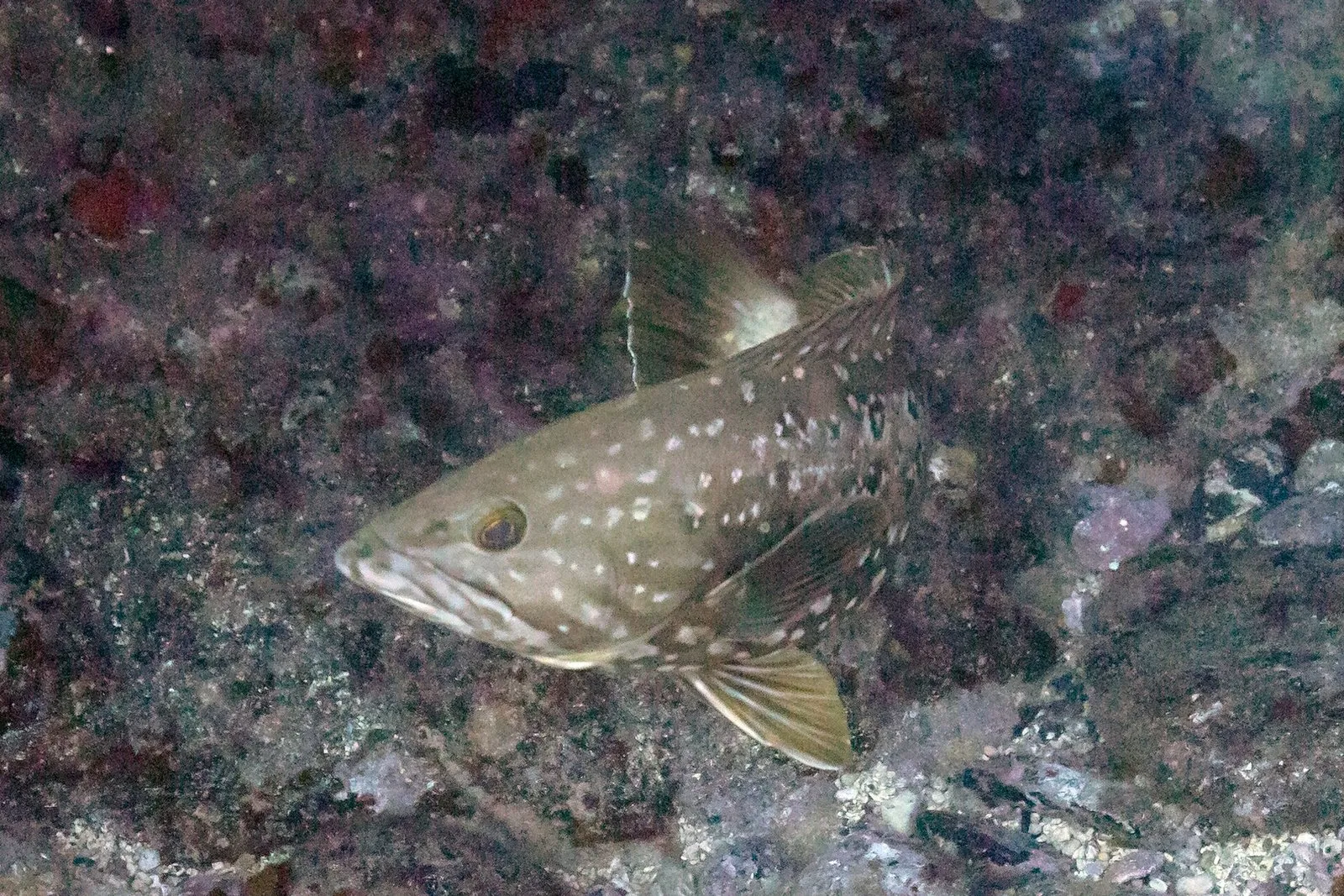
The endemic abade (Mycteroperca fusca), photographed in the Teno-Rasca marine strip, on the coast of Tenerife. 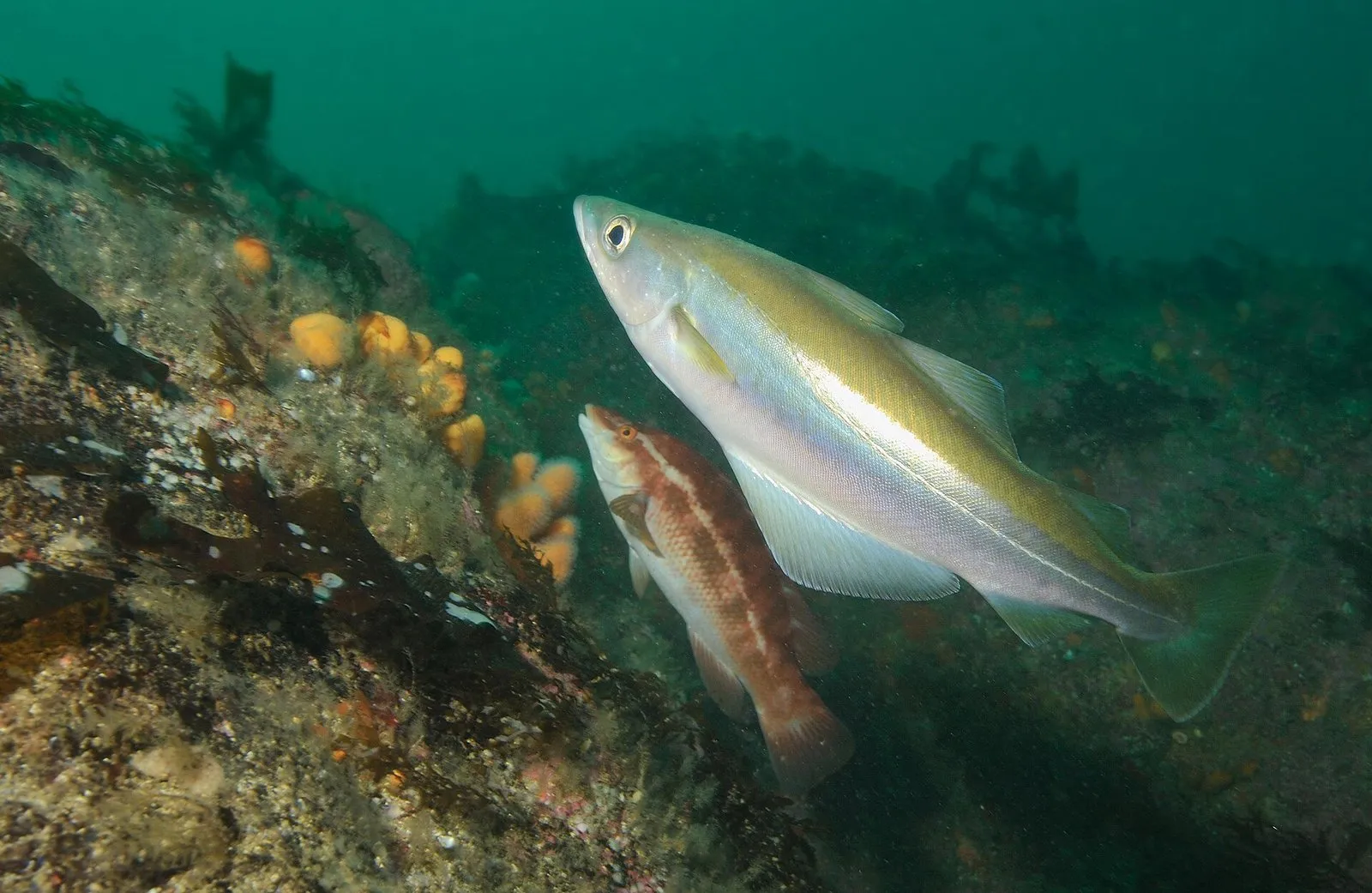 — view the full-size photo
Mainland pollack (Pollachius pollachius), the fish named as such by the RAE and FishBase. 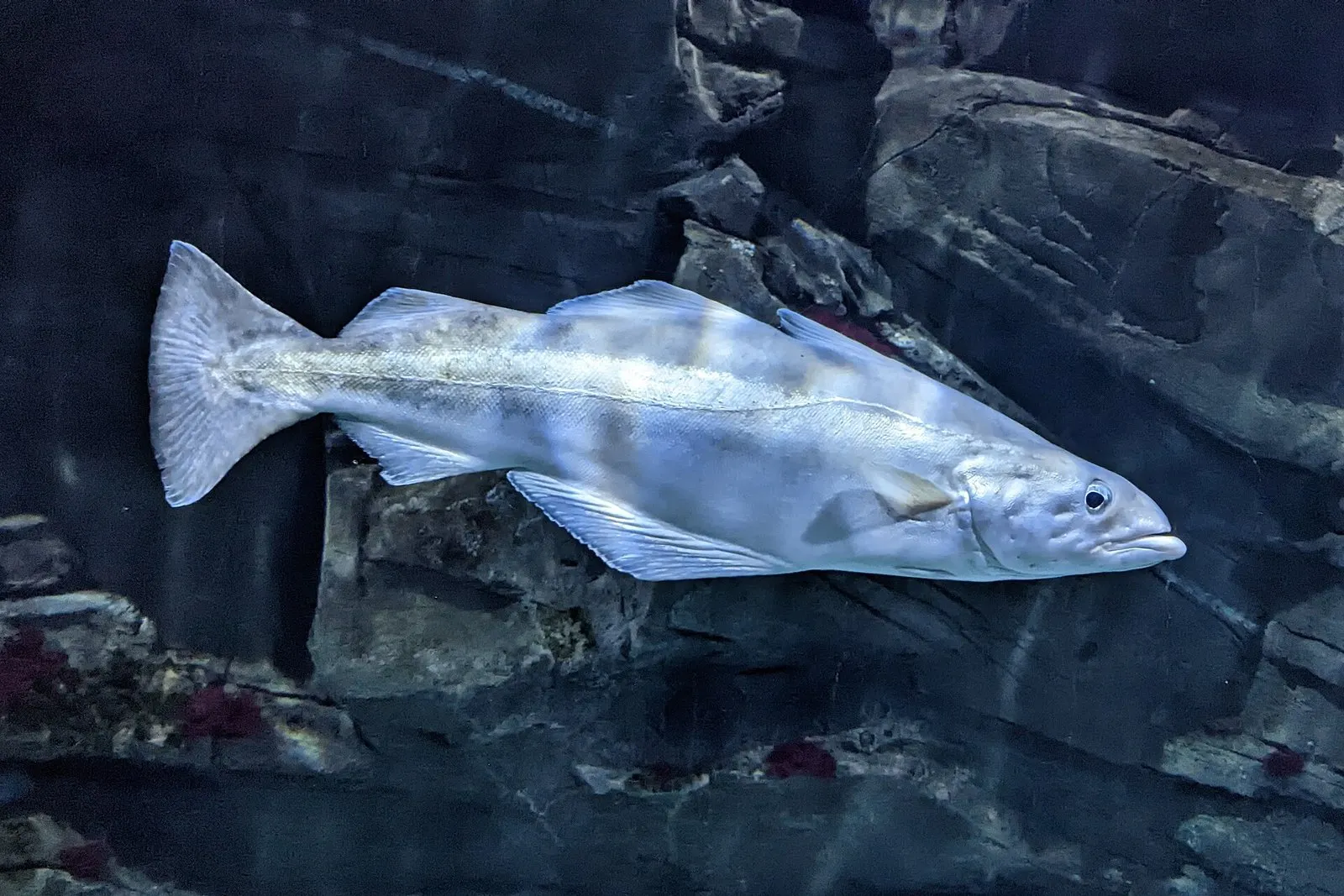 — view the full-size photo
Photos: 1. Diego Delso (opens in a new tab) (CC BY-SA 4.0 (opens in a new tab)) · 2. Olivier Dugornay (Ifremer) (opens in a new tab) (CC BY 4.0 (opens in a new tab)) · 3. Wilhelm Thomas Fiege (opens in a new tab) (CC BY-SA 4.0 (opens in a new tab))
Frequently asked questions
What is the difference between pollack and cod?
What does "abadejo" mean and where does the word come from?
Where is pollack found?
Is the "abadejo" of the Canary Islands the same fish as mainland pollack?
Why is abade scarce at Canarian fishmongers?
What nutritional benefits does pollack have?
How can pollack be cooked?
Is pollack suitable for low-fat diets?
Also in the glossary
Sensory appreciation
Sensory appreciation in gastronomy is a fascinating field that delves into how our senses interact with food, turning every bite into a unique experience.
Water activity (a_w)
Water activity (a_w) is a crucial concept in food science that refers to the amount of free water available to take part in chemical reactions and microbial growth in food.
Xanthan gum
Xanthan gum is a natural polysaccharide used as a thickening and stabilising agent in food.