Sous-vide: the bag, the bath and the centre of the piece
- Term
- Sous-vide (vacuum cooking)
- Tags
- Techniques · Avant-garde cuisine · Equipment
- Published
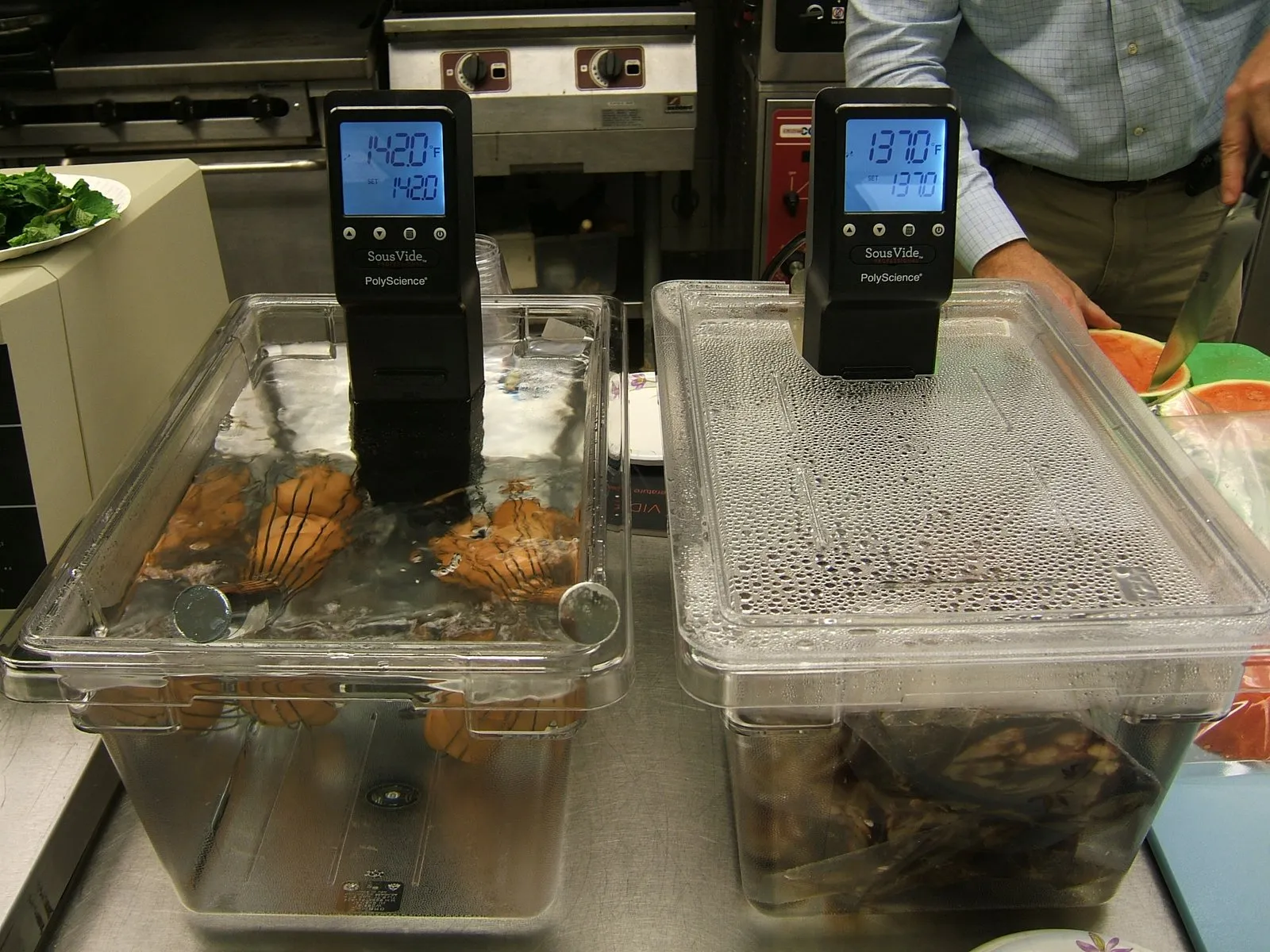
Sous-vide is cooking in a sealed vacuum bag, submerged in a water bath at a controlled temperature. The food does not touch the water. The bag does. The temperature of the bath is the one chosen for the centre of the piece, and the machine holds it. The craft name of the machine is immersion circulator. Roner, and the brand readable in the photograph, are examples of a purchase, not the technique.
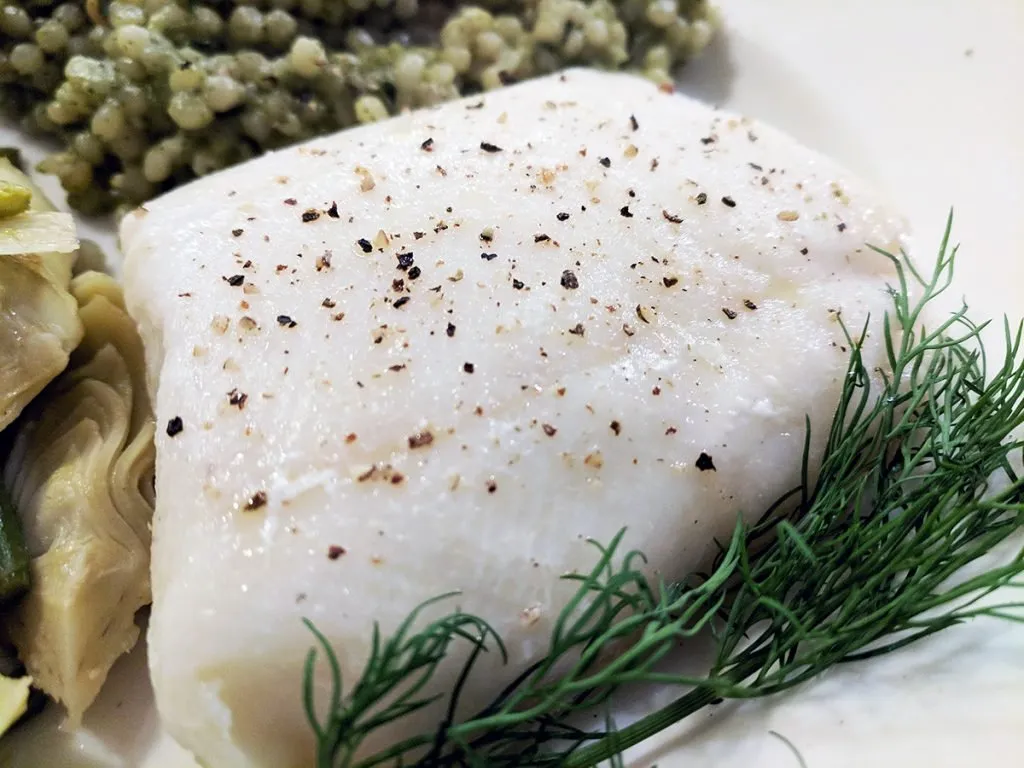
The photographs show the equipment, not a plated dish. The lead image is circulators clipped to the tanks. The bag holds vacuum-packed cod. The third is the chamber sealer, closed. The vacuum and the bath are the two gestures. None of the three machines is named sous-vide as if the iron were the recipe.
The bag and the bath
The bag takes the air out and seals. The vacuum presses the plastic to the food, so that the water of the bath heats the surface without a layer of air to insulate it. The food is not washed in the water and does not release its juice into the bath: the juice stays in the bag. That is why a meat cooked this way arrives juicy if the chosen temperature has not squeezed the water out of the muscle, and arrives dry if the bath was too high or too long for that piece.
The circulator moves the water and holds it at the chosen degree. Without movement, the bath would have colder zones beside the bag and hotter zones beside the element. The circulator exists so that the temperature programmed is the one surrounding the piece. A pot on the fire, without control, boils or falls short: it is not this bath.
The sealer in the gallery is the previous step. There are chamber sealers and external-extraction sealers. Both seek the same end: air out, seal closed. A badly sealed bag lets water in or loses the vacuum, and the cooking ceases to be even. The craft checks the seal before releasing the bag into the tank.
Douglas E. Baldwin published in 2012 a review of this cooking in the International Journal of Gastronomy and Food Science. There is the frame: bag, fixed temperature, time thought for the centre. The practical guide by the same author brings that frame down to minutes and to one pathogen. It is not a thickness table reduced to a single number. Thickness changes the time the centre takes to arrive. What does not change is the idea: holding is counted at the coldest point.
Time and temperature
The practical guide, with the FSIS recommendation of 6.5 decimal reductions of Salmonella in beef, writes that at 60 °C the coldest point must remain for at least 35.6 minutes, because at that temperature one decimal reduction takes 5.48 minutes. The product of those two figures is the holding time. The time runs when the centre is already at the temperature of the bath, not from the moment the bag enters the water.
That distinction is the one most often skipped. A cold, thick bag, put into the bath, takes time to have the centre at the chosen temperature. Those minutes of coming up are not the holding time. Adding them as if they were leaves the centre short. A thin piece arrives sooner. A thick piece arrives later. That is why a thickness table exists in the guide, and why it does not fit whole in a paragraph: each thickness has its own rise. What does fit is the rule. First the centre reaches the temperature. Then the holding clock starts.
The example is beef and Salmonella, with the reduction figure the FSIS recommends in that case. It is not a universal figure for every pathogen, every animal and every temperature. Lowering the bath lengthens the holding needed for the same reduction. Raising it shortens the holding and changes the doneness of the meat. Choosing that degree is choosing a point and, with it, a clock. The clock of another degree is another clock.
Safety is not the only criterion of the pass. A vegetable in a bag seeks texture, not a Salmonella table. A fish seeks a precise point, and its holding is not that of beef. The error is to use the beef number for everything, or to use none when the piece is meat and the bath is long. The guide is there for the case it calculates. The rest of the foods need their own reference, not a shortcut.
In the work with goat
The work with matured goat meat includes, among its methods, a low-temperature cooking: sous-vide at 56 °C for 4 hours to preserve juiciness. It is a juiciness method for that meat, not a pasteurisation calculation: the holding time that secures safety depends on the species, the thickness and the temperature, and it is calculated apart, as in Baldwin’s guide for beef. The immersion circulator serves both baths, but one does not replace the other.
Meat ageing is the earlier rest, in cold-room chill, not the bath. A piece can age and then enter the bag. They are steps in sequence, not synonyms. Liquid nitrogen is the extreme cold on the other side, the one that freezes on contact. Spherification makes a skin of alginate. Transglutaminase links proteins. None of the three replaces the bath or the sealing of the bag.
Related terms
- Liquid nitrogen — cryogenic cold, not a cooking bath.
- Meat ageing — the rest in the cold room, before or apart from the bag.
- Spherification — another avant-garde technique, of gel, not of bath temperature.
- Transglutaminase — an enzyme that joins proteins, not a circulator.
Sources
 — view the full-size photo
The bag closes the food and separates it from the water. The vacuum presses the plastic to the piece so the heat arrives evenly. 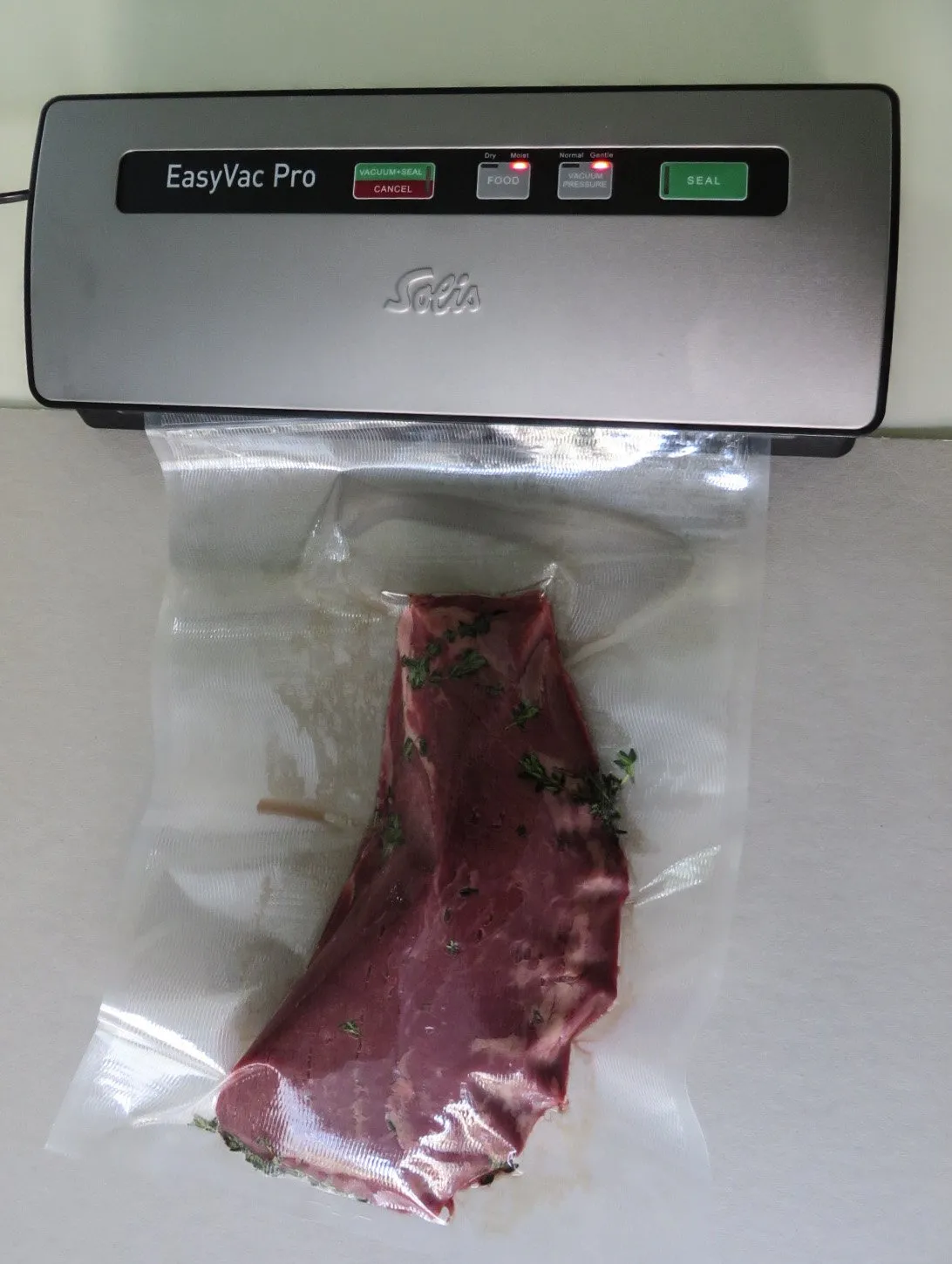 — view the full-size photo
The sealer makes the vacuum and seals. Without that closure, the bath is not a vacuum cooking.
Photos: 1. sousvideguy.com (opens in a new tab) (CC BY 2.0 (opens in a new tab)) · 2. BBCLCD (opens in a new tab) (CC BY 3.0 (opens in a new tab))
Frequently asked questions
What is sous-vide?
Does the time start when the bag goes in?
What equipment is needed?
Are the hours in the goat text the pasteurisation table?
Is it the same as freezing with nitrogen?
Also in the glossary
Transglutaminase
Transglutaminase is an enzyme that joins food proteins by linking glutamine and lysine, and in the European Union it is treated as a food enzyme.
Umami
Umami is the taste of glutamate, distinct from sweet, sour, salty and bitter, which Kikunae Ikeda isolated from kombu in 1908.
Vieja
Vieja is the parrotfish Sparisoma cretense, a species of the eastern Atlantic and the Mediterranean, and one of the fish of Canarian cooking.