Umami: the taste of glutamate
- Term
- Umami
- Tags
- Tasting · Food science · Compounds
- Published
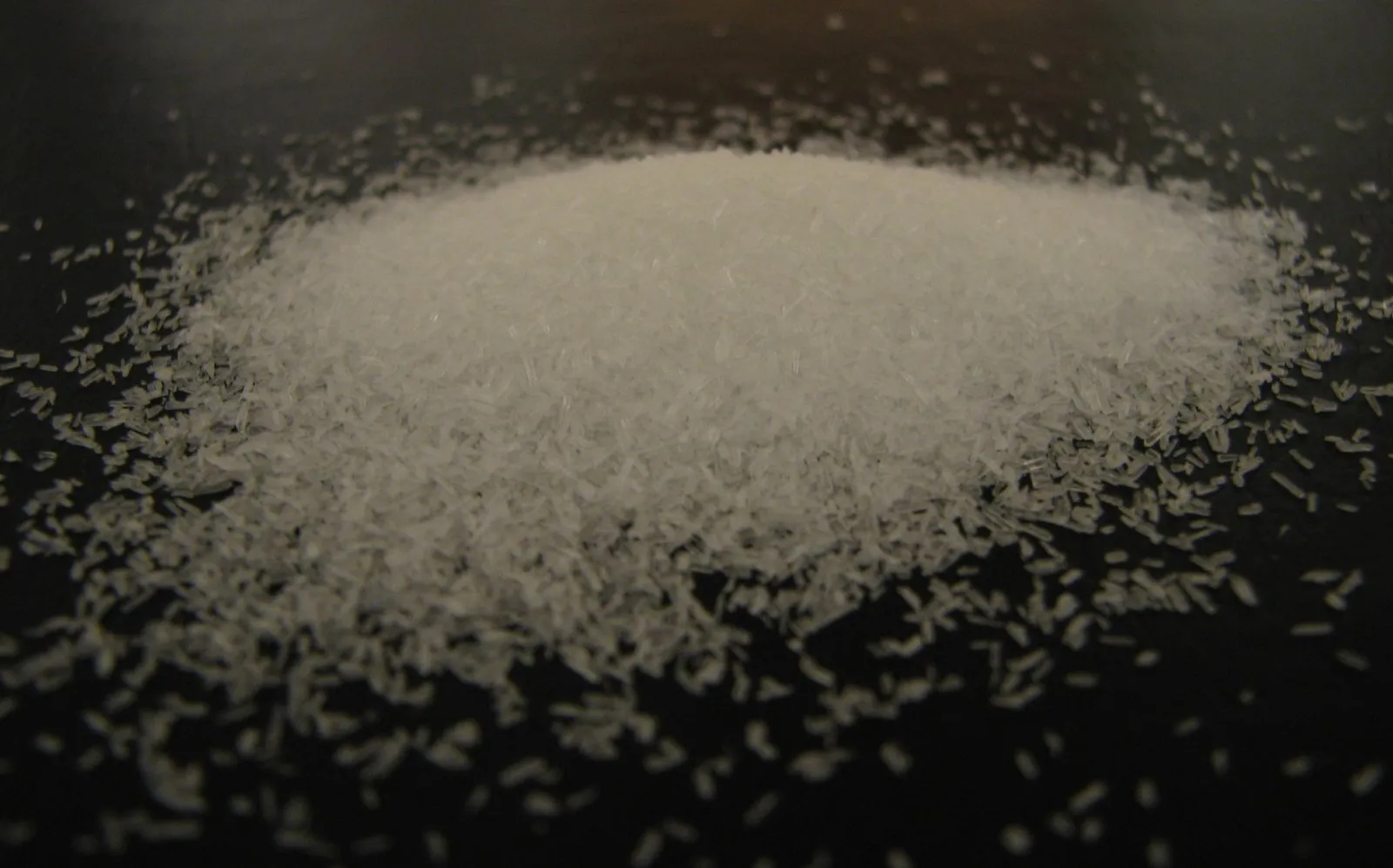
Umami is the taste of glutamate, distinct from sweet, sour, salty and bitter, which Kikunae Ikeda isolated from kombu in 1908. It is not a menu adjective and it is not a powder one is obliged to use. It is the name of a taste the food already carries when glutamate is free, and that taste becomes much clearer if a nucleotide sits beside it.
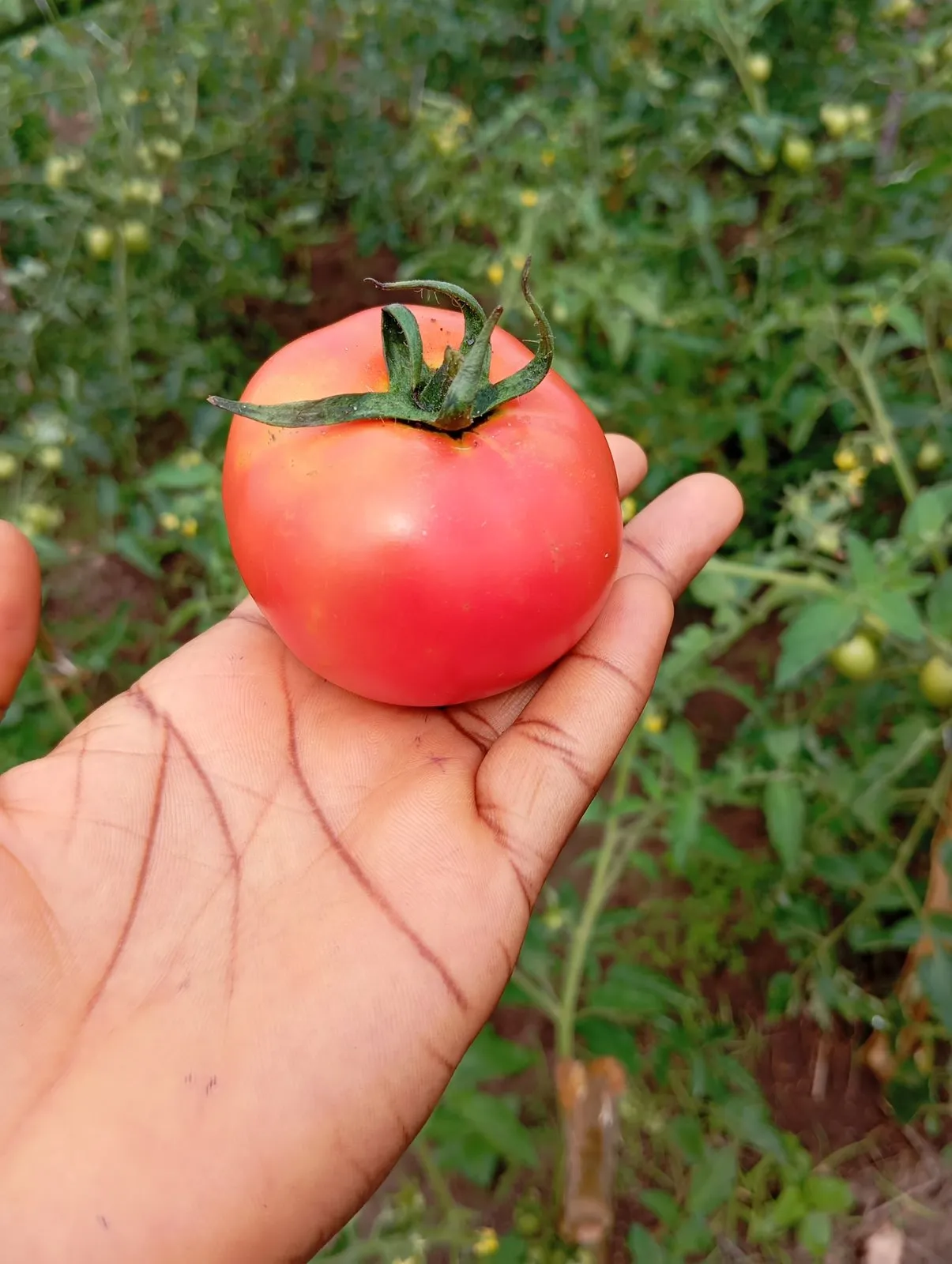
The plate shows the crystallised salt, the seasoning format. The gallery shows two foods whose free glutamate Kurihara’s paper measures: a ripe tomato and a wheel of Parmesan. The seaweed the finding came from has its own page.
The taste and the name
Kikunae Ikeda, a professor at the Tokyo Imperial University, closed with dried kombu the work that gave umami its name. He identified the salt of glutamic acid as the component of that taste and called it umami. The Japan Patent Office tells the invention side: from the taste of the seaweed he obtained a method for crystallising monosodium glutamate and leaving it as a seasoning. Commercial production was taken up by Saburosuke Suzuki. The finding and the jar share the year and they are not the same gesture. One describes the stock. The other manufactures a powder.
The nuance that matters in the kitchen is the one Kurihara stresses when he reconstructs the experiment. Glutamic acid, tasted as an acid, tastes sour and then flat. The salt — sodium, potassium or calcium — is what gives umami. In food, at a pH close to neutral, glutamate is almost all present as a salt. That is why a dashi, a tomato or a cheese can carry the taste without anyone having opened a jar: the tissue already holds it.
Glutamate is an amino acid. In kombu it sits in the seaweed and the water draws it out. Calling umami any pleasant taste empties the word. In sensory appreciation it names a basic taste, beside the other four, not a compliment.
The three substances
Ikeda also looked at dried bonito. His student Shintaro Kodama identified inosinate in 1913, the salt of inosine monophosphate, as the umami of those flakes. Decades later it was seen that guanylate, the salt of guanosine monophosphate, gives umami and that it is the main component of shiitake. Inosinate goes with animal foods. Guanylate goes with mushrooms and other plants. Glutamate is in both kingdoms.
Kurihara gathers the figures the literature had measured. Kombu enters the list of examples, along with green tea, potato, Chinese cabbage, soya, sardine, prawn and clam. The two concentrations the table records are those of ripe tomato and of Parmesan. Long-cured ham is not in that paragraph: its glutamate is that of proteolysis, and the page on Iberico ham tells it.
| Food | What it contributes | Kurihara's figure |
|---|---|---|
| Ripe tomato | Free glutamate | 140 mg/100 g |
| Parmesan | Free glutamate | 1200 mg/100 g |
Kombu stock alone, the same text says, does not give a strong umami. If dried bonito or dried sardine is added, bringing inosinate, the taste shoots up. That synergy was identified by Akira Kuninaka and examined systematically by Shizuko Yamaguchi. In European cooking the equivalent gesture is another one: meat or poultry, which have inosinate, with a vegetable that has free glutamate, or with cheese. The Japanese name is not required for the mechanism to occur. What is required is not believing that the powder is the only door.
Kurihara closes the path with the place of umami among the tastes: the work of physiology and of receptors left it as a fifth basic taste, besides sweet, sour, salty and bitter. That does not turn every reduction into a dashi. It turns the word into a tasting tool, with a molecule behind it.
In the kitchen
The craft is in joining the two halves, or in letting one of them suffice. A short kombu stock, the blade out before it turns bitter, is already umami. A very ripe tomato in a sofrito is too, and more so if a meat stock or a mature cheese sits beside it. The Parmesan in the gallery is the extreme case of the table: a great deal of free glutamate, little left to spell out. An island cheese with a long cure, such as majorero cheese, plays in the same family, with another figure and another rind.
The jar of monosodium glutamate is the salt Ikeda crystallised. It serves when the dish does not bring enough glutamate of its own and the taste is wanted without a long base. It does not replace inosinate: the synergy asks for both pieces. A powder labelled only as an enhancer may be glutamate, a nucleotide or the blend. The pack is read. The name of the taste is not the brand on the sachet.
In a tasting, “umami” is earned if one can point to where it comes from: seaweed, tomato, cheese, mushroom, dried fish, meat. If it only decorates a sentence, it is surplus. The opposite mistake is to reserve the word for the powder and never taste the tomato. Both are called the same thing because the molecule is the same.
In Diego’s work
The article on the science of meat maturation uses this word for matured meat: during maturation the glutamates increase, and that increase is the umami of the mouthful. It is not a dashi. It is the same taste by another route, that of proteolysis, which is also the route of long ham and of meat ageing.
Related terms
- Amino acids — glutamate is one of them, and here it is free, not inside the protein.
- Kombu — the seaweed from which Ikeda drew the taste, and the dashi that yields it to the water.
- Sensory appreciation — umami as a tasting term, not as a loose adjective.
- Iberico ham — the long cure and the glutamate that proteolysis leaves.
- Meat ageing — the other larder where time releases the same taste.
Sources
 — view the full-size photo
Ripe tomato. Kurihara notes 140 mg of free glutamate per 100 g in this fruit, and points to it as the source of its umami. 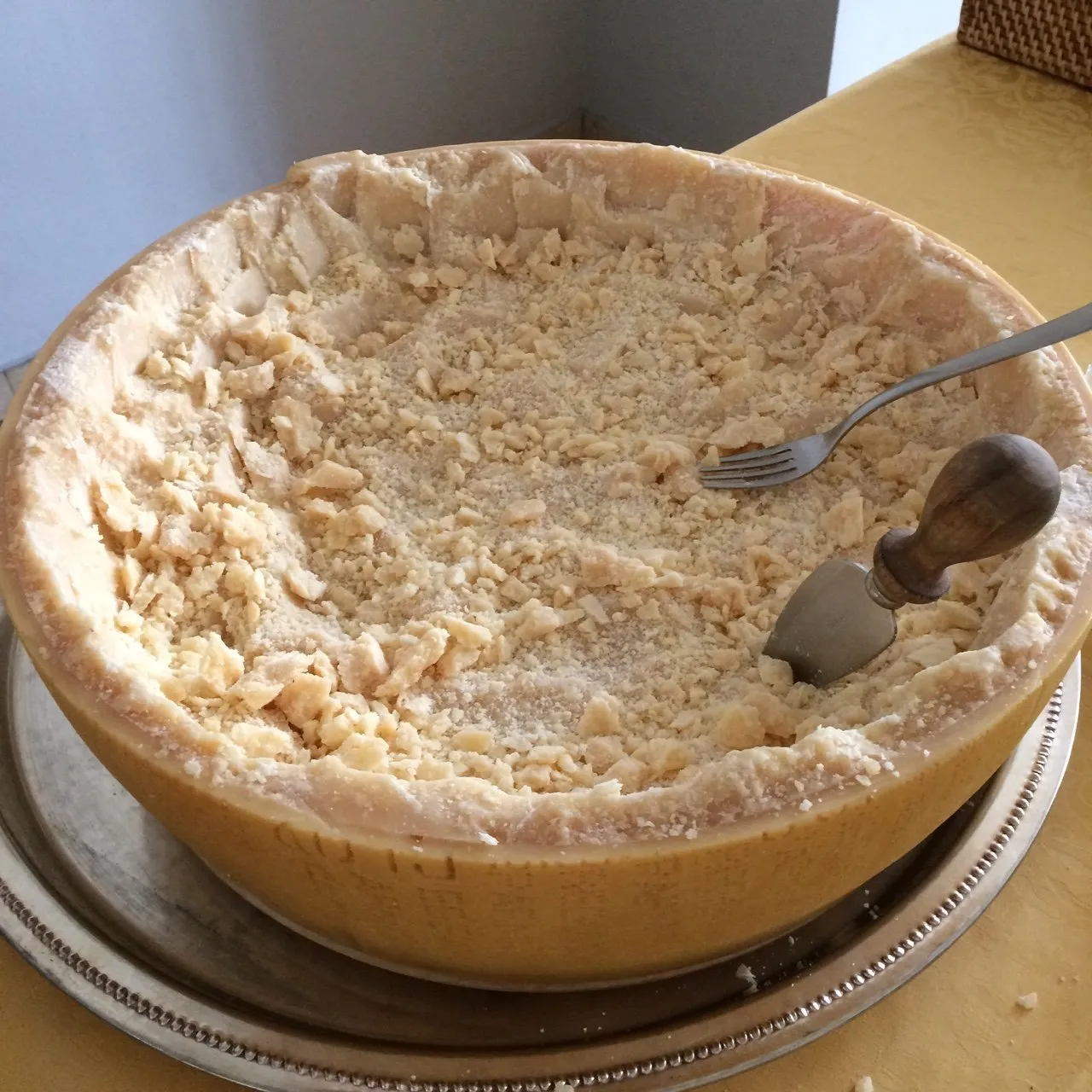 — view the full-size photo
A Parmesan wheel in mid-use. In the same paper, Parmesan is listed at 1200 mg of free glutamate per 100 g.
Photos: 1. D'GreenPen (opens in a new tab) (CC BY-SA 4.0 (opens in a new tab)) · 2. Melissa Highton (opens in a new tab) (CC BY-SA 4.0 (opens in a new tab))
Frequently asked questions
What is umami?
Who named umami, and in which year?
What is inosinate?
What is guanylate?
Which foods have umami?
Are umami and monosodium glutamate the same thing?
Also in the glossary
Vieja
Vieja is the parrotfish Sparisoma cretense, a species of the eastern Atlantic and the Mediterranean, and one of the fish of Canarian cooking.
Wagyu
Wagyu is the meat of four Japanese breeds and of their crosses with one another, graded by the JMGA with a yield grade and a quality grade.
Water activity (a_w)
Water activity (a_w) is a crucial concept in food science that refers to the amount of free water available to take part in chemical reactions and microbial growth in food.