Wagyu: the Japanese breeds and the carcass grade
- Term
- Wagyu
- Tags
- Meat · Maturation
- Published
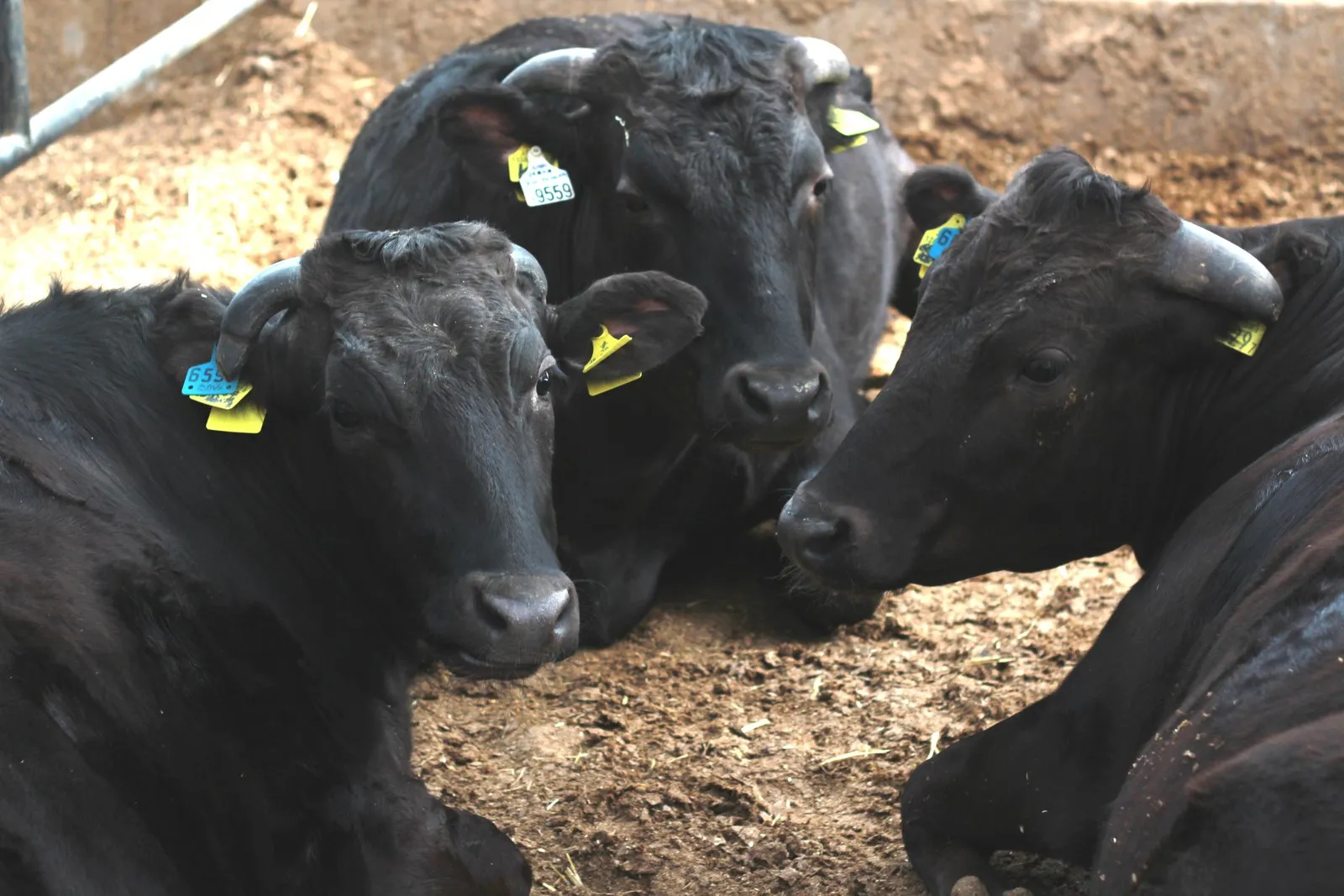
Wagyu is the meat of four Japanese breeds and of their crosses with one another, graded by the JMGA with a yield grade and a quality grade. It is not “the cow of Japan” as a block. The Ministry of Agriculture, in its notebook on wagyu, limits it to Japanese Black, Japanese Brown, Japanese Polled and Japanese Shorthorn, plus the crosses among those four. Outside that, the word cannot be used. An animal of another breed, even if it has lived its whole life in Japan, is domestic beef. It is not wagyu.
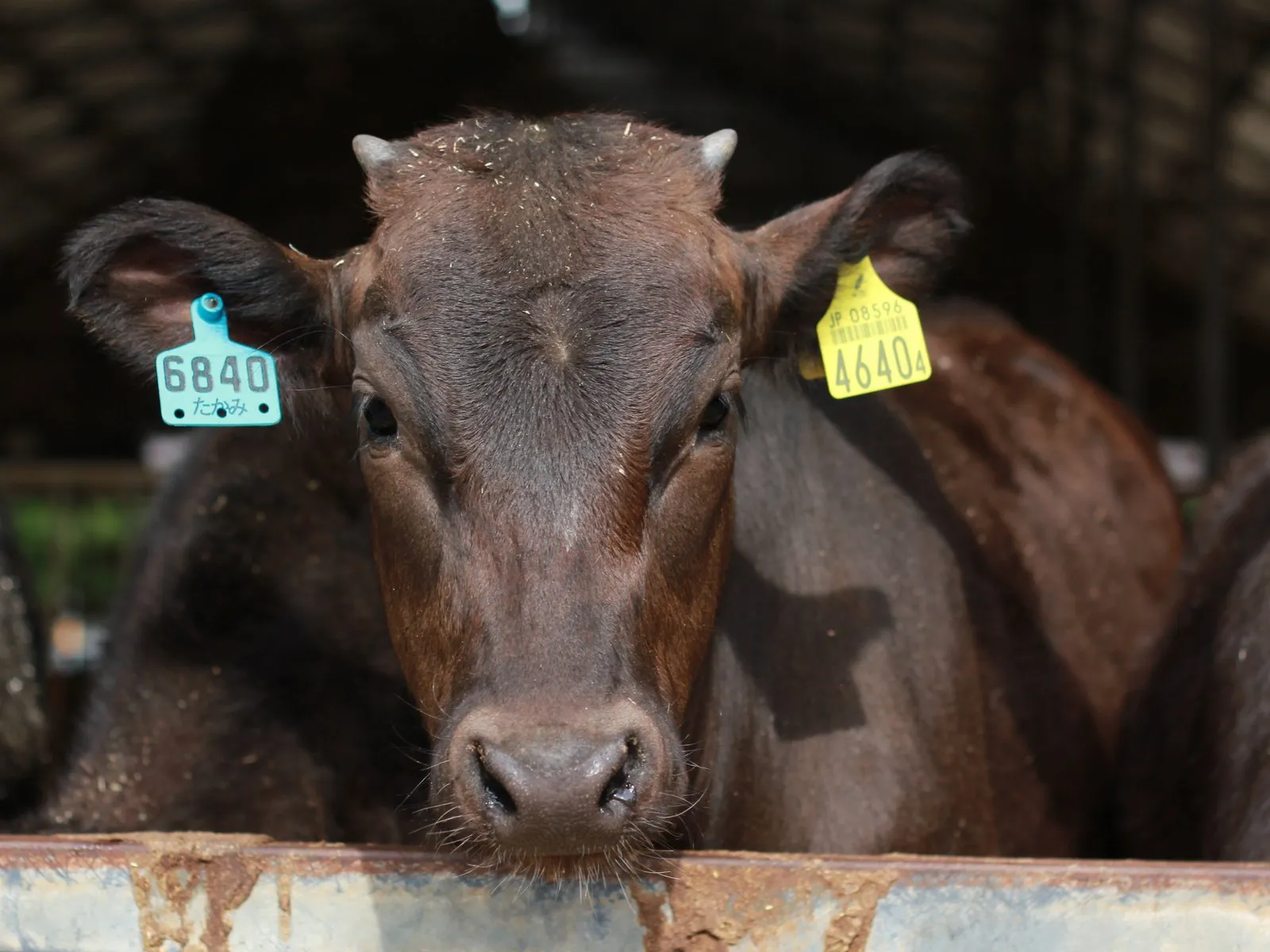
The plate and the second photograph are Tajima cattle on farms in northern Hyogo, the lineage from which Kobe can come if the carcass passes. The third photograph is the veining in slices, as it was sold in a Tokyo department store. None of the three is a grade certificate.
Four breeds
Japanese Black is the one the same ministry notebook points to as more than 90 % of the wagyu fattened in the country. Brown, Shorthorn and Polled complete the group. A cross between two of them can still be called wagyu, with the cross declared. A cross with Holstein cannot. The breed name and the name of a regional seal are not interchangeable: Tajima, the cattle in the photographs, is a lineage of Japanese Black raised in Hyogo. Kobe is what a part of that meat becomes after slaughter.
The carcass is not judged on the hoof. It is judged cold, opened between the sixth and the seventh rib, where the loin, the cover fat and the fat between muscles can be seen. The Japan Meat Grading Association fixes that. The scale applies to the beef carcasses that enter its standard, with the exception of the veal carcass, which stays outside.
The JMGA cut
There are two marks and they are written together. Yield is A, B or C. Quality runs from five down to one. Quality is not only the marbling: it is the worst result among four items, the veining, the colour and brightness of the meat, the firmness and the grain, and the colour and quality of the fat. A very high veining with poor fat does not keep the veining’s mark.
Yield comes from a formula the association publishes. The thresholds of that formula are these:
| Yield | Threshold |
|---|---|
| A | 72 or above |
| B | from 69 and below 72 |
| C | below 69 |
Marbling is compared with the Beef Marbling Standard, the BMS, from one to twelve. The association distributes those numbers across the five quality grades like this:
| Quality from veining | BMS |
|---|---|
| 5 | 8 to 12 |
| 4 | 5 to 7 |
| 3 | 3 to 4 |
| 2 | 2 |
| 1 | 1 |
That row is only the veining. The quality grade of the carcass can fall if colour, firmness or fat score worse.
Kobe is a seal
The association that promotes Kobe beef defines the seal from Tajima beef, not from any wagyu. The animal is a female or a castrated male, of Tajima seed produced in Hyogo, raised and fattened in Hyogo, slaughtered in Hyogo, with more than 28 months and fewer than 60. Of that Tajima beef, Kobe requires yield A or B, quality of 4 or higher, BMS of 6 or higher, and a carcass weight that for the cow runs from 270 kg to 499.9 kg and for the castrated male from 300 kg to 499.9 kg. If the carcass has damage, the association itself looks at it.
The ministry registered “Kobe beef”, “Kobe niku” and “Kobe gyu” as a geographical indication on 22 December 2015, with the number 3 of that register. The production zone is Hyogo prefecture. The register text asks for the same carcass — yield, quality and BMS — from Tajima. It is a Japanese geographical seal, not a European designation, and it is not the name of the breed.
That is why a menu that says “wagyu from Kobe” has to be able to say both things: the breed and the cross, which is the wagyu, and the seal, which is the Kobe. The veining, alone, is neither of the two.
In the kitchen
The grade describes the carcass at the abattoir. In the kitchen it describes how much intramuscular fat there is and, with it, how much fire is needed. A slice like that of the third photograph, already sold extremely thin, is cooked in seconds: the fat melts and the centre does not ask for an oven. A thick cut of a low BMS is treated like other beef, with the time of a lean piece. The name wagyu does not shorten the cooking by itself. The veining shortens it.
Meat ageing is another axis. A carcass can be graded and, afterwards, age in a chamber. BMS does not measure the days in the chamber. It measures the fat on the rib cut. The umami of a matured meat comes from the glutamates that time releases, and it can occur in this breed and in another. It is not the marbling, even if on the plate they arrive together.
Iberico ham is also sold with a quality code, the seal tag, which is neither a price nor a loose breed. It serves as a comparison of method: a seal is read, it is not guessed from the shine of the display. Amino acids explain the glutamate of that cure. Here glutamate is not the JMGA’s criterion.
Related terms
- Meat ageing — time in the chamber, which BMS does not measure.
- Umami — the taste of glutamate, distinct from the veining.
- Iberico ham — another quality code for meat, with another rule.
- Amino acids — the chemical family of the glutamate that maturation releases.
- Sensory appreciation — how the mouthful is named without confusing breed, grade and seal.
Sources
 — view the full-size photo
Another Tajima animal in northern Hyogo. The ear tag identifies the animal. It does not state the carcass grade and it does not authorise the word Kobe. 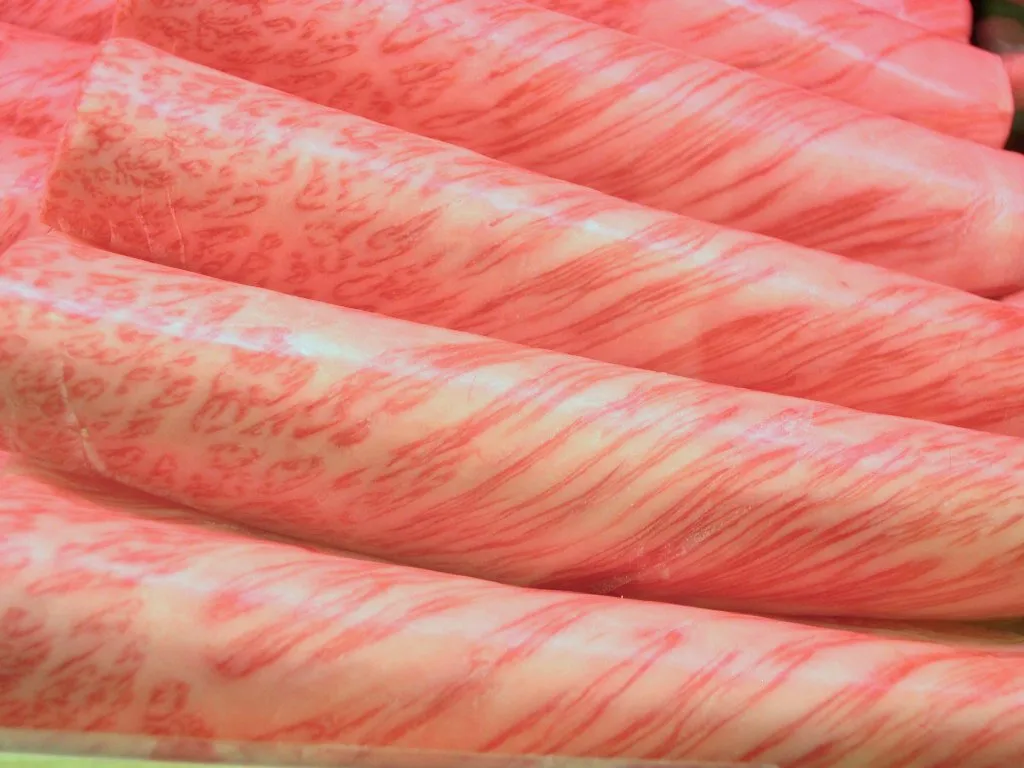 — view the full-size photo
Thinly veined slices, sold as wagyu in a Tokyo department store. The image carries no BMS number: the number is awarded on the carcass, not at the counter.
Photos: 1. Japanexperterna (opens in a new tab) (CC BY-SA 3.0 (opens in a new tab)) · 2. Schellack (opens in a new tab) (Public domain)
Frequently asked questions
What is wagyu?
What is BMS?
What do the letter A and the number on a carcass mean?
Are Kobe and wagyu the same thing?
Are Tajima cattle already Kobe beef?
Is the marbling eaten raw in thin slices?
Also in the glossary
Water activity (a_w)
Water activity (a_w) is a crucial concept in food science that refers to the amount of free water available to take part in chemical reactions and microbial growth in food.
Xanthan gum
Xanthan gum is a natural polysaccharide used as a thickening and stabilising agent in food.
Yerba mate
Yerba mate is the dried and lightly toasted leaf of Ilex paraguariensis, the infusion that in Argentina the Food Code defines and the INYM regulates.