Transglutaminase: the enzyme that links proteins
- Term
- Transglutaminase
- Tags
- Enzymes · Additives · Avant-garde cuisine · Meat
- Published
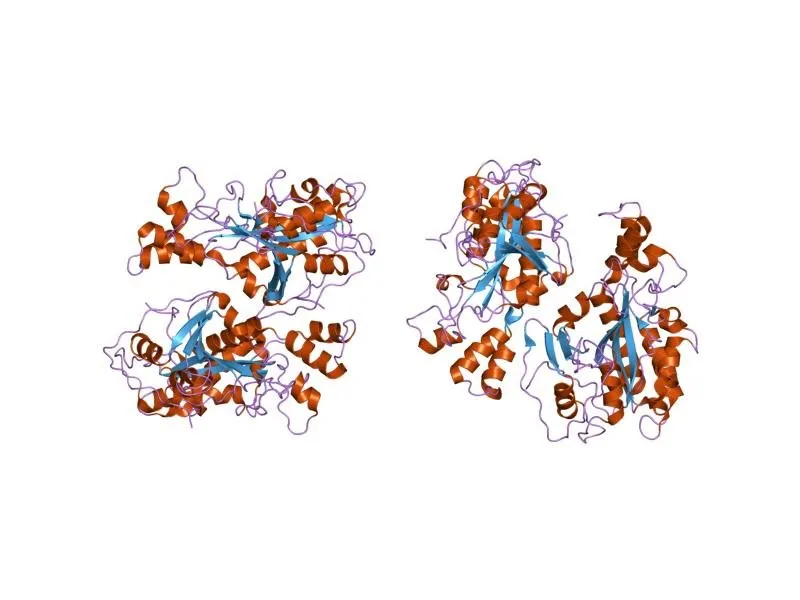
Transglutaminase is an enzyme that joins food proteins by linking glutamine and lysine, and in the European Union it is treated as a food enzyme. It is not a hardware glue and not an additive with an E number. It is a protein that acts as a catalyst: it takes the amide group of a glutamine bound to a peptide and links it to the amino group of a lysine bound to another chain. The result is a bond between proteins that, in meat, is felt as a piece that does not come apart.
The photographs are not the jar. The lead image is a ribbon model of the protein, from the structure archive. The second is the crystal structure of the microbial enzyme. The third is slices of raw beef, the substrate, with the photographer’s watermark still visible. The preparation dusted in a kitchen appears in none of the three.
The enzyme
The IUBMB catalogues it with the number EC 2.3.2.13. The systematic name is protein-glutamine:amine γ-glutamyltransferase. It is also called, simply, transglutaminase. The γ-carboxamide groups of peptide-bound glutamines act as acyl donors. The amino groups of lysines bound to protein or to peptide act as acceptors. The bond that remains is the one that gives cohesion.
That mechanism explains the use without a glue metaphor. A gel is not added. Two surfaces rich in protein are brought together and the enzyme is left to make the bridge. Amylase works on starch. This one works on protein. Mixing them leads to throwing the meat enzyme onto a purée, where there is not lysine and glutamine to join in the same way, or to expecting amylase to stick two fillets.
Amino acids are the pieces of those chains. Glutamine and lysine are two of them. The enzyme does not create them. It finds them already in the protein of the food and uses them as donor and acceptor. That is why the substrate in the photograph is meat, not a white powder: without protein there is no bridge.
The EFSA opinion of 2024 examines the protein-glutamine γ-glutamyltransferase from Streptomyces mobaraensis, strain AE-BTG, not genetically modified. It concludes that it raises no safety concern under the intended conditions of use. The sentence has a limit beside it: it does not rule out the risk of an allergic reaction, because known allergen sources were used in manufacture. No safety concern under the intended use is not the same as no allergen in the process. An allergic diner is not left outside that caution.
In meat and in other foods
The enzyme is used, among other processes, in modified meat and fish, in cheese and in meat analogues. Modified means pieces brought together, portions made of bound trimmings, not a meat that changes species. A loin that looks whole can be several trimmings joined. The craft that uses it knows this, and the person who eats it should be able to know it from the labelling that applies, not from the smooth look of the cut.
In meat and fish, the total organic solids of the enzyme remain in the food. It is not a processing aid that the process removes with a wash and treats as absent. It stays. In most processed foods the panel considered that the enzyme is inactivated: sausages, canned goods. In some it can stay active: cheese, plant analogues, depending on the process. A cheese is not a canned good. The heat and the time of each preparation decide whether the enzyme continues or is switched off.
There is no dose in grams per kilo here. The opinion does not write it as a kitchen instruction. The manufacturer of the preparation gives its own. The mechanism and the European frame are what can be stated. The grams of a particular jar are not.
There is also no health benefit to state. Joining two proteins is not a health argument. It is an argument of texture and of using the trimming. Meat ageing tenderises through other enzymes, in the cold and over days. This one links. A piece can age and, in another step, be bound. It is not the same verb.
Sous-vide cooks in a bag what the enzyme has joined, or cooks an intact piece. The enzyme does not set the temperature of the bath. If the bound piece enters the bag raw, it comes out cooked only if the bath and the time cook it. The glutamine and lysine bridge does not pasteurise.
The European framework
Before 2009, food enzymes that were not additives were unregulated, or they were regulated as processing aids, under the law of each State. On 20 January 2009 Regulation (EC) No 1332/2008 entered into force, and it also covers enzymes used as processing aids. From that date the frame is common: the food enzyme, even if it acts as a processing aid and is not presented as a flavour ingredient, enters the regulation.
As long as the Union list does not exist, the placing on the market and the use of food enzymes, and of foods produced with them, are governed by national legislation. That is the state the EFSA itself describes on its page on food enzymes. There is not, yet, a single list that closes the use in every State under the same conditions. Someone who produces in a country looks at the rule of that country as well as at the regulation.
That is why it is not given an E number as if it were already on the list of colour or preservation additives. The E number is another drawer. This is the drawer of enzymes. Calling it an E additive brings forward a list that the European page says does not yet exist, and it hides the national regime that does apply.
Related terms
- Amino acids — glutamine and lysine, the two pieces the enzyme links.
- Amylase — another enzyme, that of starch, not that of protein.
- Meat ageing — enzymes that tenderise, not those that bind.
- Sous-vide (vacuum cooking) — the bath that cooks; it does not bind on its own.
Sources
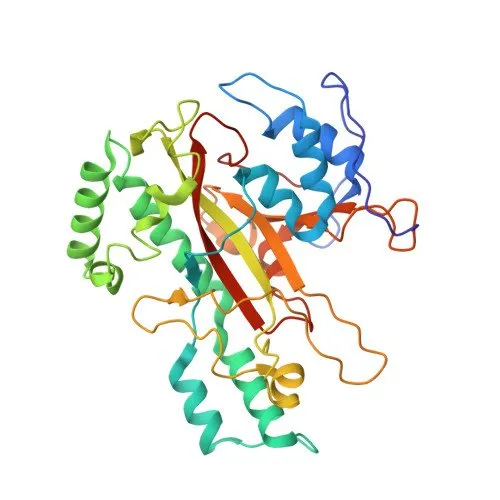 — view the full-size photo
Crystal structure of the microbial enzyme. It is a model, not the preparation weighed in a kitchen. 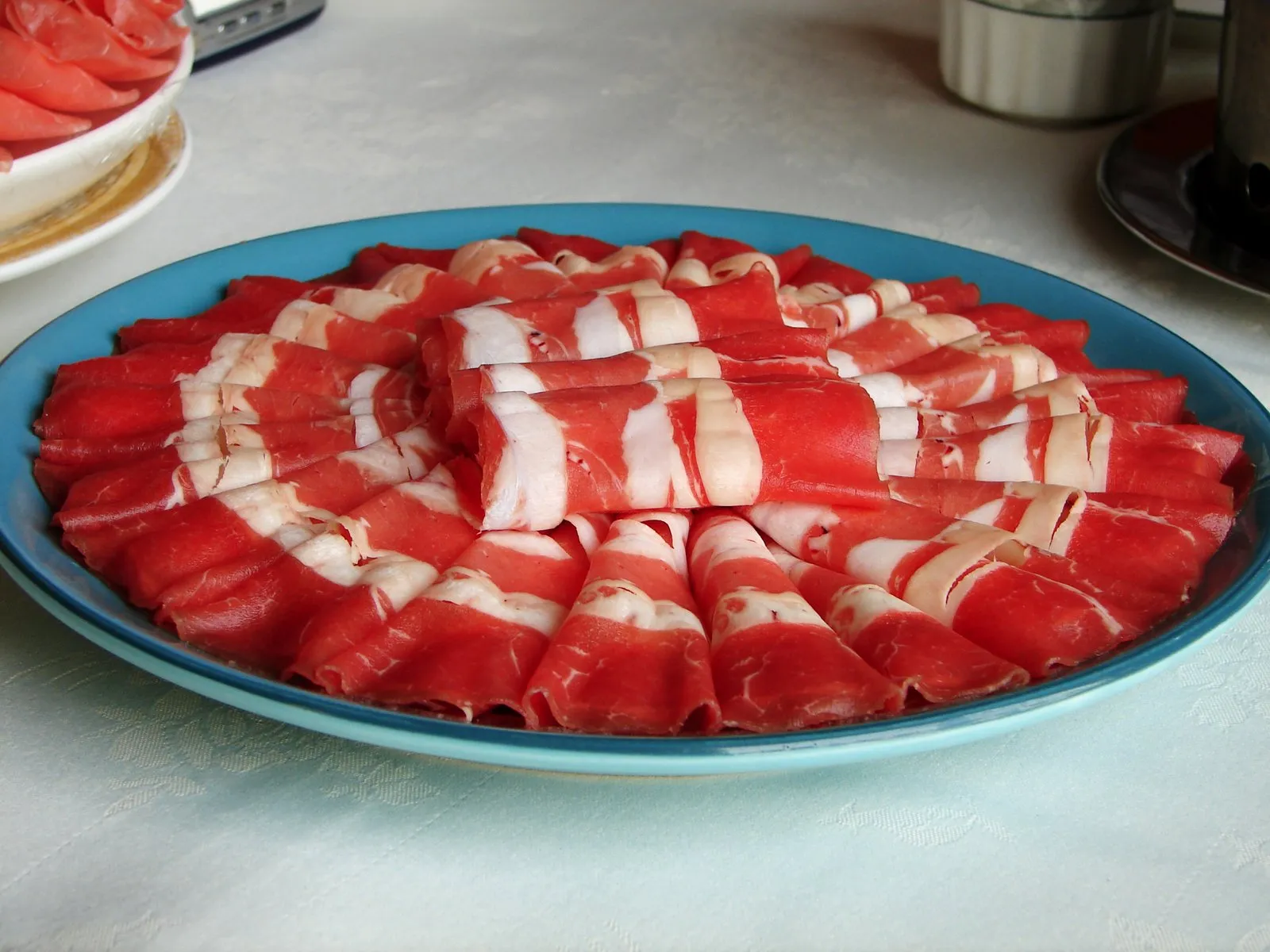 — view the full-size photo
Raw beef: the substrate, not the jar of the enzyme. The photographer's watermark remains in the shot.
Photos: 1. Autor desconocido (opens in a new tab) (Public domain) · 2. J. Samuel Burner (opens in a new tab) (CC BY 2.0 (opens in a new tab))
Frequently asked questions
What is transglutaminase?
Is it an additive with an E number?
Does it stay active in the dish?
Does the European opinion find it safe?
Does it stick any meat at any temperature?
Also in the glossary
Umami
Umami is the taste of glutamate, distinct from sweet, sour, salty and bitter, which Kikunae Ikeda isolated from kombu in 1908.
Vieja
Vieja is the parrotfish Sparisoma cretense, a species of the eastern Atlantic and the Mediterranean, and one of the fish of Canarian cooking.
Wagyu
Wagyu is the meat of four Japanese breeds and of their crosses with one another, graded by the JMGA with a yield grade and a quality grade.