Aguardiente: A Cultural Spirit
- Term
- Aguardiente
- Tags
- Drinks · Spirits · Canary Islands
- Published
- Updated
What aguardiente is
The definition of aguardiente as a broad category of distilled alcoholic beverages covers an impressive diversity of products around the world, each with unique characteristics that reflect the raw materials available, the production techniques and the cultural preferences of their regions of origin. The word “aguardiente”, from the Latin aqua ardens, literally means “burning water”, a poetic description that alludes to its potency and to the warmth often felt when drinking it.
The Diccionario de la lengua española settles it with a much drier formula: “a spirit drink obtained by distillation from wine, fruit or other substances”. Under that same entry, the Real Academia also lists a family of sub-entries — aguardiente de caña (cane), de guindas (morello cherry), de orujo (pomace), de Cazalla, anisado (aniseed), compuesto (compound) — which already hints at what happens in practice: “aguardiente” does not name a single drink, but a process and everything that comes out of it.
“Agua ardiente” or “aguardiente”: how it is spelled
In current Spanish it is written as a single word: “aguardiente”. The separate form, “agua ardiente”, is the etymological one — from the Latin aqua ardens, “burning water” — it explains the name and is still alive in speech, but it is not the current spelling: the dictionary carries a single entry, the fused word.
The name describes two things at once: the burn it produces when drunk and how easily the liquid catches fire. That second sense is not a metaphor, and it is the source of the fire techniques explained further below.
How it is made: fermentation and distillation
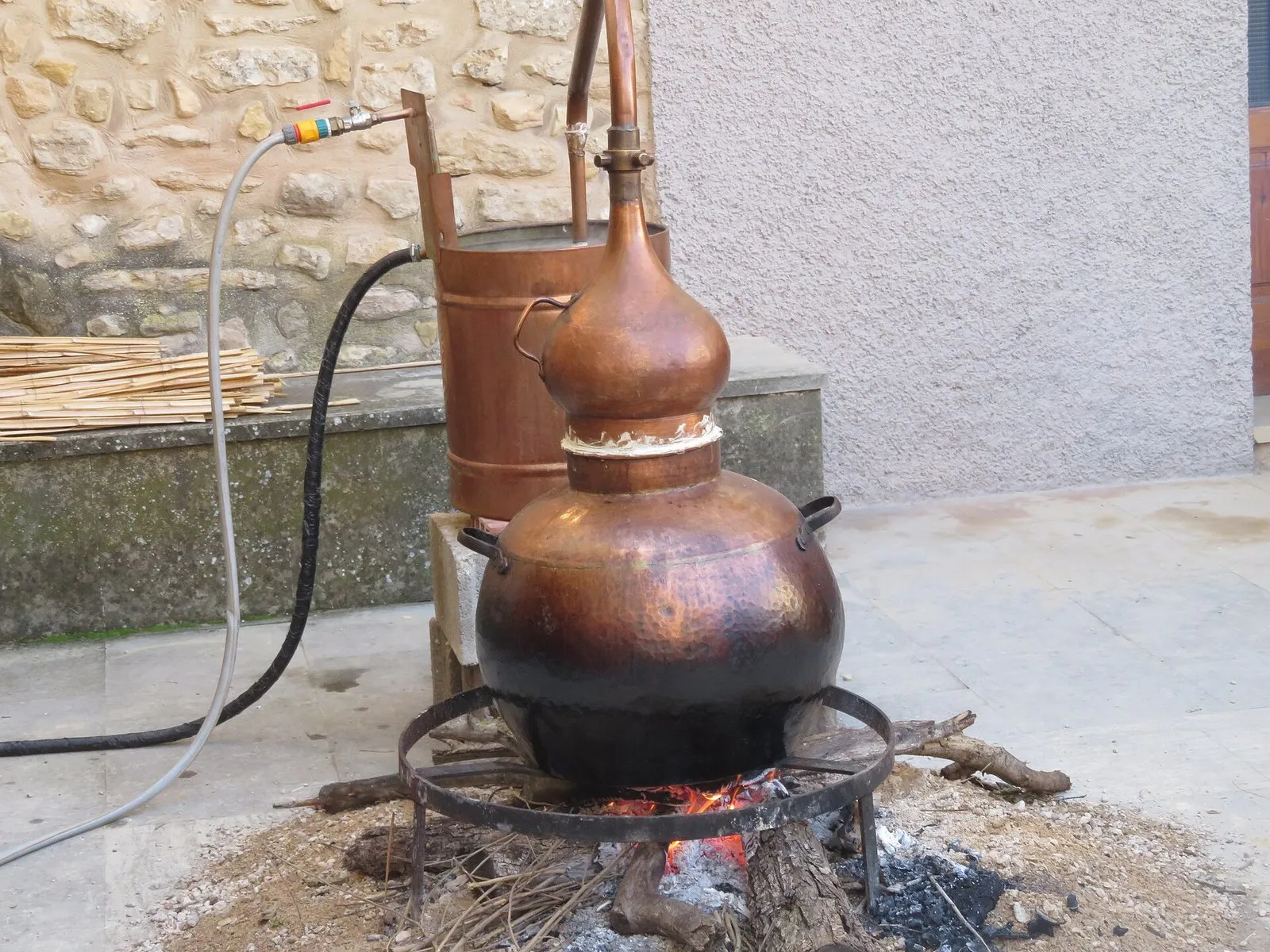
Aguardiente is produced through a process with two essential stages: fermentation and distillation. During fermentation, the sugars present in the raw materials are converted into alcohol and carbon dioxide by the action of yeasts. This stage can vary considerably depending on the type of raw material used and specific cultural practices. Sugar sources for fermentation can include, but are not limited to, sugar cane, fruit, cereals, tubers or even honey.
Distillation follows fermentation and serves to increase the alcohol concentration of the resulting liquid. Through this process, the volatile components of the fermented liquid are separated, allowing the alcohol and other desirable compounds to concentrate while impurities and unwanted components are removed. The product of distillation is a clear, potent liquid, which can be consumed directly or subjected to further processes such as ageing.
How strong it is: what the law says
The alcohol content of aguardiente can vary widely, generally between 40 % and 60 % alcohol by volume, although both milder and stronger versions exist. This high alcohol content not only intensifies the drink’s effects, but also preserves the distinctive flavours and aromas of the raw materials.
That range is commercial, not legal. What the law fixes is the floor: Regulation (EU) 2019/787 sets a general minimum alcoholic strength by volume of 15 % vol for spirit drinks, with a single exception, advocaat, which drops to 14 % vol. From there, each category tightens the rule on its own: pomace aguardiente cannot go below 37.5 % vol and is banned from having alcohol or flavourings added.
| Reference | Alcohol content | Regulation or source |
|---|---|---|
| Minimum for any spirit drink in the EU | 15 % vol (14 % vol for advocaat) | Regulation (EU) 2019/787 |
| Pomace aguardiente | 37.5 % vol minimum | Regulation (EU) 2019/787 |
| Practical threshold for flambéing | 40 % vol | Bartalent Lab |
| Cane aguardiente for Ronmiel de Canarias | 54-80 % vol (80-95.9 % vol if distilled) | PGI Ronmiel de Canarias (BOE) |
| Finished Ronmiel de Canarias | 20-30 % vol | PGI Ronmiel de Canarias (BOE) |
Varieties: one name, many drinks
Variations in raw material and production methods give rise to a wide range of aguardientes with very varied flavour profiles and alcohol contents. In Latin America, for example, aguardiente is typically associated with drinks derived from sugar cane, while in Europe the term can refer to a variety of spirits made from fruit such as grapes, apples or cherries. In Asia, aguardientes are produced from rice and other cereals, each with its own unique techniques and traditions.
The best-known aguardientes vary by region and include Cachaça from Brazil, Pisco from Peru and Chile, Orujo from Spain and Grappa from Italy. Each has unique characteristics derived from its production method and origin, and each is protected by its own national regulation. These represent only a fraction of the world’s diversity of aguardientes, reflecting the rich cultural tradition of distilling spirit drinks.
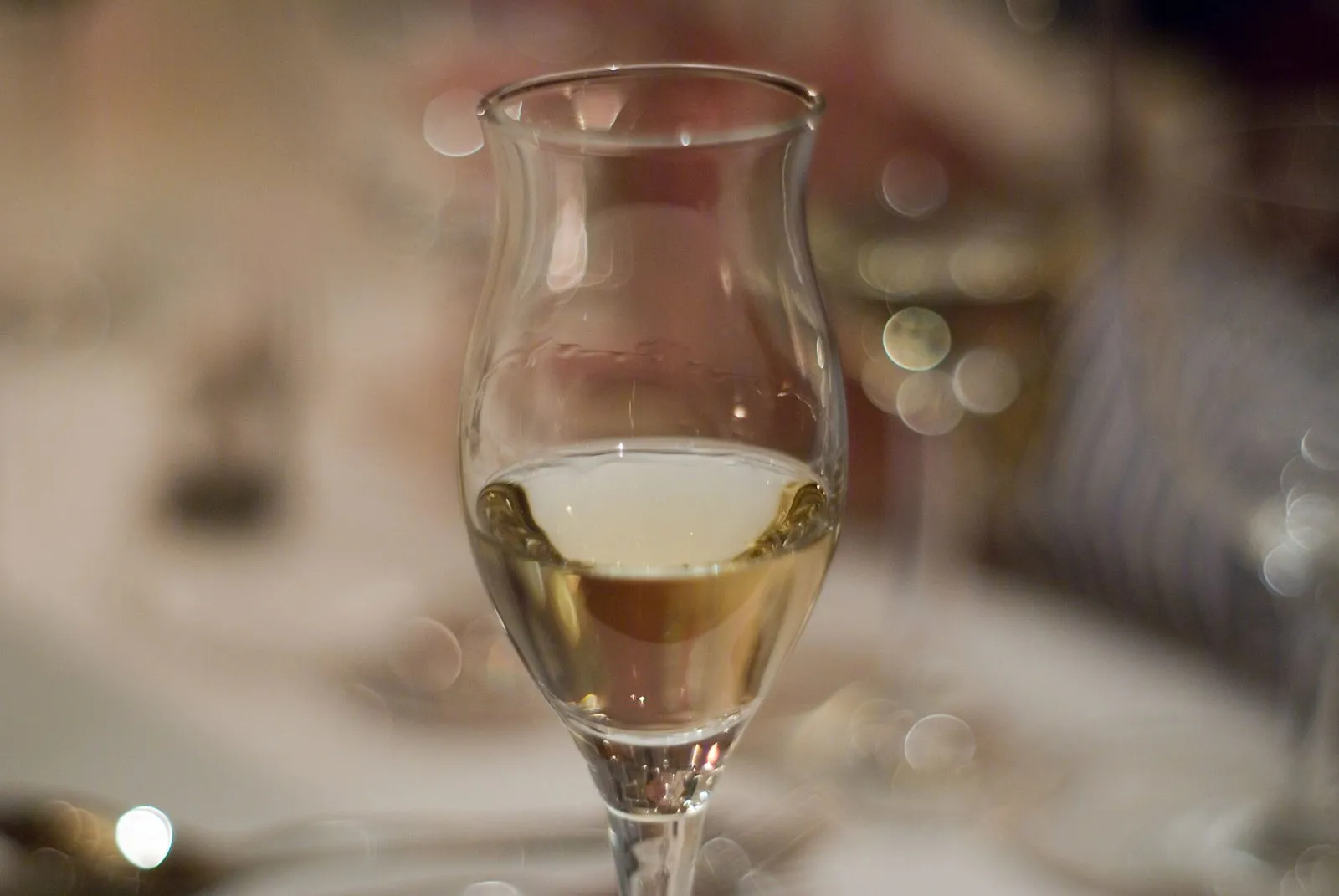
Within Spain there is a case the dictionary itself names: aguardiente de Cazalla, in Seville, an aniseed spirit obtained by distilling matalahúga (aniseed) and documented in the town since 1611. Cazalla had its own designation of origin and regulatory council until 1970; today it no longer holds that quality designation, although the name lives on as a category.
In the kitchen: flambéing and burning
Aguardiente enters professional kitchens less as a drink than as a controlled fuel. Flambéing needs a spirit of at least 40 % vol; below that threshold the flame will not catch. The technical recommendation is to warm the alcohol before pouring it over the dish, and then to bring the flame close: it catches more easily that way.
The best-known version of that technique is an after-dinner one: the Galician queimada, made with pomace aguardiente, sugar, lemon peel — or orange — and coffee beans, burnt while an incantation is recited. The incantation is not medieval: it was written by Mariano Marcos Abalo in the sixties.
Alcohol, energy and risk
How much energy it provides
Ethanol provides 29 kJ per gram, around 6.9-7 kcal/g according to the Atwater system used by the FAO. An aguardiente of 40 % vol contains around 31.6 g of ethanol per 100 ml — the density of ethanol is about 0.789 g/ml — which gives around 220 kcal per 100 ml. This is an approximate calculation based on the FAO figure, not a food composition table value.
Methanol: the real risk of badly made distillation
Methanol must never be present in a drink intended for human consumption: permanent blindness is a common consequence and many of those affected fall into a coma and die within 48 hours. Its worst feature is the delay. The symptoms — abdominal pain, nausea, vomiting, dizziness, breathing difficulty and blurred vision — appear between 12 and 48 hours after drinking, by which point the damage is already done.
This is not a theoretical danger. In Spain, in 1963, at least 51 people died and 9 were left blind by a batch of spirit drinks adulterated with 70,000 litres of methanol, in a case involving the businessman Rogelio Aguiar, from Ourense. The risk is concentrated in poorly controlled home distillation; hence the recommendation to buy alcohol only from trusted establishments.
In the Canary Islands: cane, sugar mills and Ronmiel
It is worth saying plainly: there is no designation of origin or geographical indication called “aguardiente” in the Canary Islands, nor a hundred per cent Canarian table aguardiente with its own seal. The term’s roots in the islands are real, but indirect, and come by two routes: the history of sugar cane and a protected product that uses aguardiente as its base.
The first route starts very early. In the sixteenth century the Canary Islands came to have at least 35 sugar mills, spread across four islands, and it was from the islands that the first cane cuttings to reach America came: the ones Columbus loaded on his second voyage, in 1493, and which were planted in La Española. By 1520 the sugar mills of Santo Domingo were already working with roller machinery perfected earlier in the islands: the archipelago was the technological bridge for sugar — and, therefore, for its distillate — between Europe and America.
The second route is still alive. Ronmiel de Canarias is the official Canarian product closest to aguardiente: it is not a pure aguardiente, but a liqueur that blends rum, cane or cane-molasses aguardiente — or their distillates — with drinking water, sugars, plant extracts and bee honey. It has been a Protected Geographical Indication since Order APA/3941/2006, and its production area is the entire archipelago.
| Ronmiel de Canarias | What its specification requires |
|---|---|
| Quality designation | PGI, Order APA/3941/2006 (BOE no. 309, 27 December 2006) |
| Production area | The whole Canary archipelago |
| Alcohol base | Rum, cane or cane-molasses aguardiente, or their distillates |
| Starting aguardiente | 54-80 % vol (80-95.9 % vol if distilled) |
| Bee honey | 2 % by volume, minimum |
| Sugars | 200 g/l minimum |
| Final strength | 20-30 % vol |
| Annual production | ≈1.5 million litres, of which ≈46,000 are exported |
Ronmiel began as a home and tavern drink, first made in Canarian households and later adopted by rum-making companies, which kept its traditional character. There is documented evidence of that industry: the Destilería San Bartolomé, in Tejina (Tenerife), started in 1948 producing brown sugar and cane syrup (miel de caña), and later rum.
Aguardiente as a cultural fact
Aguardiente, a distilled alcoholic drink made from the fermentation of sugars derived from various natural sources, has significant cultural importance in various parts of the world. This importance shows itself in different ways, spanning social, economic, historical and symbolic aspects in the societies where it is produced and consumed.
History and tradition
The production of aguardiente goes back centuries, being one of the earliest distilled alcoholic drinks known to humanity. In each region, aguardiente is made from different raw materials, which gives it unique characteristics. This diversity is deeply connected to local history and tradition: in many communities, distillation techniques have been passed down from generation to generation, becoming an integral part of the region’s cultural identity.
Celebrations and rituals
Aguardiente takes centre stage in a wide range of festivities and ceremonies, from harvest celebrations to weddings and religious rituals. Its consumption on these occasions symbolises union, joy and gratitude, serving as a link between the earthly and the spiritual. In some contexts, aguardiente is used in offerings and rituals to honour ancestors or ask favours of deities. The Galician queimada, with its sixties incantation, is the most recent example of how one of these rites is made.
Economic and social impact
Beyond its symbolic value, aguardiente production has a significant economic impact in many regions. For some rural communities, distillation is a primary source of income, fostering local economic development and the preservation of traditional techniques. Socially, aguardiente encourages community cohesion: production and consumption venues, such as bars and local festivals, become meeting places where bonds are strengthened and a sense of belonging is fostered.
Conservation of biodiversity
In some regions, aguardiente production contributes to the conservation of biodiversity. The use of local fruit and other ingredients promotes the conservation of native varieties and the upkeep of natural ecosystems.
Contemporary challenges
Despite its rich cultural heritage, the production and consumption of aguardiente face challenges in the modern era, such as competition from mass-produced drinks and concerns about alcohol abuse. However, there is growing interest in rescuing and valuing traditional distillation practices, recognising their cultural and economic importance.
Aguardiente is, ultimately, more than a drink: it is a cultural element that encapsulates the history, traditions and values of the communities that produce and consume it. Its role in society reflects the complexity of human relationships with the natural world and cultural heritage.
Related terms
- Acidification — the other destination for fermented sugars: the acid route, which shares its starting point with aguardiente.
- Aromatics — what distillation concentrates, and what it loses along the way.
- Sensory appreciation — how a spirit is tasted, and why its strength shapes what the nose perceives.
- Gastronomic products of the Canary Islands — the Canarian larder that Ronmiel belongs to.
- Gastronomic and wine journey through the volcanic heart of the Canary Islands — the volcanic wines, the neighbour with a designation of origin that aguardiente lacks.
Sources consulted
- Real Academia Española, Diccionario de la lengua española: “aguardiente”
- Real Academia Española, Tesoro de los diccionarios históricos de la lengua española: “aguardiente”
- Etimologías de Chile: “aguardiente”
- Regulation (EU) 2019/787 of the European Parliament and of the Council, on spirit drinks (PDF)
- Order APA/3941/2006, regulation of the Ronmiel de Canarias PGI (BOE no. 309, 27-12-2006)
- Government of the Canary Islands, Canary Institute for Agri-food Quality: Ronmiel de Canarias
- Junta de Andalucía: quality designations for spirit drinks
- La Voz del Sur: “La alquimia de Cazalla”
- El Progreso: “El ritual de la queimada gallega”
- Bartalent Lab: “Domina la técnica del flambeado”
- FAO: Food energy – methods of analysis and conversion factors (2003, PDF)
- Agencia SINC: “Metanol, el veneno que se esconde en el fondo de una copa”
- Canarias7: “Tres ingenios de azúcar de Gran Canaria optan a ser Patrimonio Mundial”
- mgar.net: “Canarias: Historia y Navegación — Introducción del azúcar”
- Wikipedia: Aguardiente · Cachaça · Pisco · Orujo · Grappa

Frequently asked questions
What is aguardiente?
Is aguardiente written as one word or two ("agua ardiente")?
What does the word "aguardiente" mean?
What is the alcohol content of aguardiente?
Is aguardiente the same as orujo (pomace spirit)?
Is there an aguardiente of its own in the Canary Islands?
Is home-distilled or illicit aguardiente dangerous?
How many calories does aguardiente have?
Also in the glossary
Al dente
"Al dente" is an Italian expression that translates literally as "to the tooth".
Albumin
Explore albumin's essential role in the kitchen, from improving texture to creating unique sensory experiences.
Alfalfa
Alfalfa, known scientifically as Medicago sativa, is a leguminous plant widely used in both animal feed and human food.