Aspic, Savoury Gelatine in Professional Cooking
- Term
- Aspic
- Tags
- Techniques · Gelling agents
- Published
- Updated
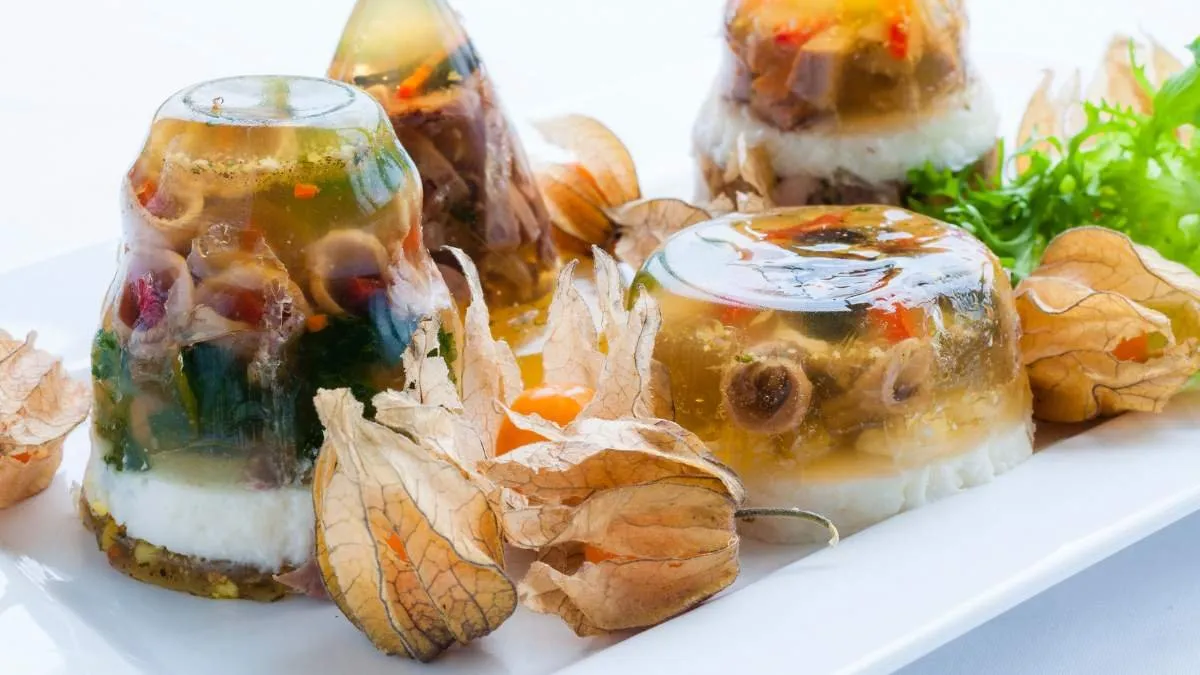
Aspic is a savoury gelatine made with meat or fish stock, clarified and set through the prolonged cooking of collagen-rich bones. This gel is used to encase other ingredients such as meats, seafood, vegetables or eggs, creating visually appealing dishes with a distinctive texture.
What aspic is and where the name comes from
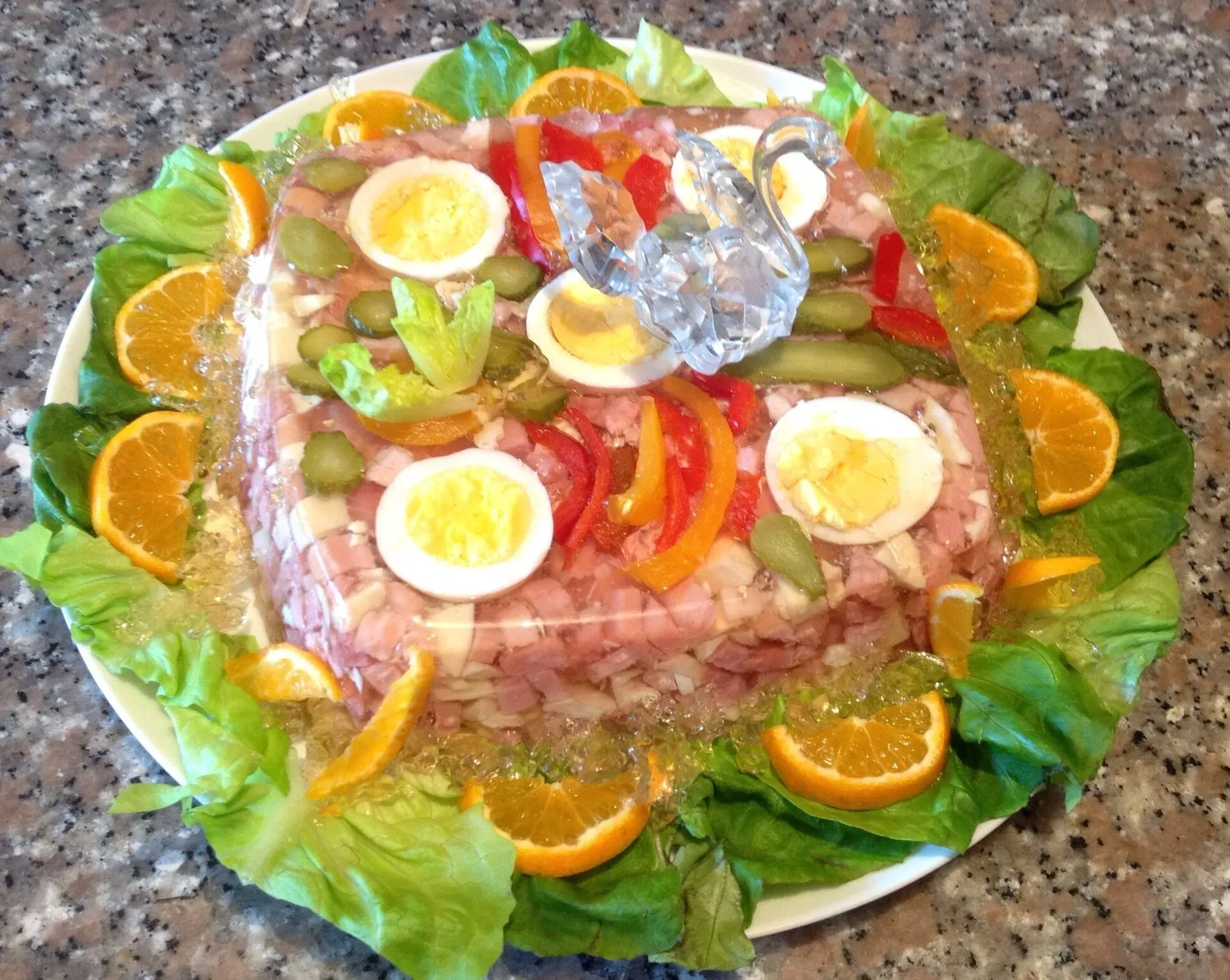
The nuance most often confused is this: an aspic isn’t the gel, it’s the piece. Gelatine is the substance; aspic is the moulded, seasoned preparation that results from using it, arriving at the table as a single block with the ingredients suspended inside: ham, foie gras, seafood, vegetables and, in its sweet versions, fruit.
The entry in Larousse’s Dictionnaire de français settles it with the dryness of the trade: “entrée froide composée d’éléments divers (filets de volaille, de poisson, légumes, etc.), enrobés de gelée”, a cold starter made up of various elements — poultry and fish fillets, vegetables — coated in gelatine. A cold dish in which the gel envelops, rather than accompanies.
On the word’s origin it’s worth being cautious. In French, “aspic” also names a European viper and a variety of lavender, aspic lavandin. The sources consulted confirm no etymological link between those meanings and the dish, beyond the term coming from Latin.
History: from the Viandier to gelatine salads
The origin of the technique is medieval: cooks discovered that a sufficiently thickened meat stock turned into gelatine on cooling. The oldest known written record appears in the Viandier attributed to Taillevent, towards the end of the fourteenth century — English-language sources date it to 1375 — although the more beautiful image is five centuries earlier: in the ninth century, the Arab poet Ibrahim ibn al-Mahdi described a jellied Iraqi carp, comparing it to “like ruby on the platter, set in a pearl”, a ruby on the platter set in a pearl.
Codification arrives with French haute cuisine. Marie-Antoine Carême (1784-1833) created the chaud-froid sauce and, in the early nineteenth century, systematised the various aspic preparations, which move from a larder resource to a repertoire piece. Then industry steps in: commercial boxed gelatine begins to be sold in the 1870s, though the first versions still required additional cooking with egg whites.
| Date | Milestone |
|---|---|
| Ninth century | Ibrahim ibn al-Mahdi describes a jellied Iraqi carp: "a ruby on the platter, set in a pearl" |
| Middle Ages | Cooks discover that a thickened meat stock gels on cooling |
| Late fourteenth century (1375) | Oldest known written recipe, in Taillevent's Viandier |
| 1410-1430 | The German Sülze appears documented in the papers of the counts of Katzenelnbogen |
| Early nineteenth century | Carême creates the chaud-froid sauce and systematises aspic preparations |
| 1870s | The first boxed gelatine is sold commercially, still requiring cooking with egg whites |
| 1890-1920 | Commercial success of packaged gelatines; by around 1920, a third of the salads in recipe books published in the US contain gelatine |
| 1950s | Meat aspic becomes a regular dish at American home dinners |
The outcome is surprising: by around 1920, a third of the salads recorded in recipe books published in the United States contained gelatine, and in the fifties meat aspic was a common dish at American home dinners.
The culinary importance of aspic
The use of aspic in cooking not only adds an aesthetic element but also serves to preserve food, since the gelatine acts as a barrier that prevents contact with air and, therefore, the proliferation of bacteria. Historically, it has been a popular technique in French and Eastern European cuisine.
That preserving function is documented: before domestic refrigeration, the layer of gelatine “keeps out air and bacteria, keeping the cooked meat or other ingredients fresh for longer”. It’s the same barrier principle that governs other concepts in food science, such as water activity. Today, with a cold room, aspic holds its ground on other merits: the sharpness with which it presents an ingredient suspended in a transparent block.
The science of the gel: collagen, Bloom strength and temperature
Gelatine is partially hydrolysed collagen and, dry, is almost pure protein: between 98 % and 99 %. Its main amino acids are glycine (26-34 %), proline (10-18 %) and hydroxyproline (7-15 %), which together account for around half the total. Industry obtains it from pig skins and bones, cattle bones and skins, and tendons, coming from tanneries and abattoirs.
The traditional method skips that industrial process. Boiling bones and collagen-rich cuts — pig trotters, calf’s feet — for five to eight hours produces a stock that sets on cooling by itself, without a gram of commercial gelatine. That’s what the opening definition means by “the prolonged cooking of collagen-rich bones”.
| Parameter | Value |
|---|---|
| Protein by dry weight | 98-99 % |
| Main amino acids | Glycine 26-34 %, proline 10-18 %, hydroxyproline 7-15 % (≈50 % of the total) |
| Setting temperature | 18 °C or below |
| Onset of melting | From 27 °C |
| Complete melting | Around 37 °C, below body temperature |
| Gel strength | 90-300 Bloom in commercial gelatines |
| Loss of gelling power | Above 100 °C, or near that temperature for a long time |
| Water absorption | 5-10 times its own weight |
| Traditional cooking of bones and collagen | 5-8 hours |
The gel is thermoreversible: it sets when cold and returns to liquid on heating. And the margin is narrow. That gelatine starts melting from 27 °C and disappears completely around 37 °C — below body temperature — is what makes an aspic melt in the mouth, and it’s also why it must be served on a chilled plate and never left waiting on the pass. There’s also a heat ceiling: gelatine loses gelling power above 100 °C or near that point for a long time, so the stock must never boil vigorously once it’s been added.
Bloom strength is the unit it’s bought by: it measures the gel’s strength, and commercial gelatines range between 90 and 300. The higher the Bloom, the less product needed for the same set: a recipe’s proportion is only reliable if the leaf or powder being used is known. Gelatine also absorbs between five and ten times its weight in water to form the gel: hence it’s always soaked before dissolving.
Producing it industrially is a long process: the bones are treated with acid to remove the minerals, then with lime for five to ten weeks, the pH is adjusted, the gelatine is extracted at a concentration of 6-10 %, filtered, concentrated, sterilised at 145 °C, cooled, extruded into granules and dried.
Ingredients and preparation
Main ingredients
- Gelatine (of animal origin, such as pork or beef)
- Broth or stock (can be meat, chicken, fish, etc.)
- Seasoning (salt, pepper, herbs, spices)
Basic steps
- Prepare the gelatine: hydrate the gelatine in cold water.
- Heat the stock: bring the stock to a hot temperature without letting it boil.
- Incorporate the gelatine: dissolve the hydrated gelatine in the hot stock.
- Season: add salt, pepper and other spices to taste.
- Pour and refrigerate: place the liquid in moulds together with the desired ingredients and refrigerate until it sets (several hours or overnight).
Between the second and third steps, the classic repertoire inserts one that marks the difference between a home aspic and a restaurant one: clarification. The base stock is clarified with egg whites before being left to set, so that the albumin coagulates and carries with it, as it rises, the suspended particles. It’s seasoned before use — once set there’s no fixing it — and served on chilled plates so it doesn’t melt. Without clarification there’s no transparency.
Variations of aspic
There are several variations of aspic depending on the ingredients and flavours:
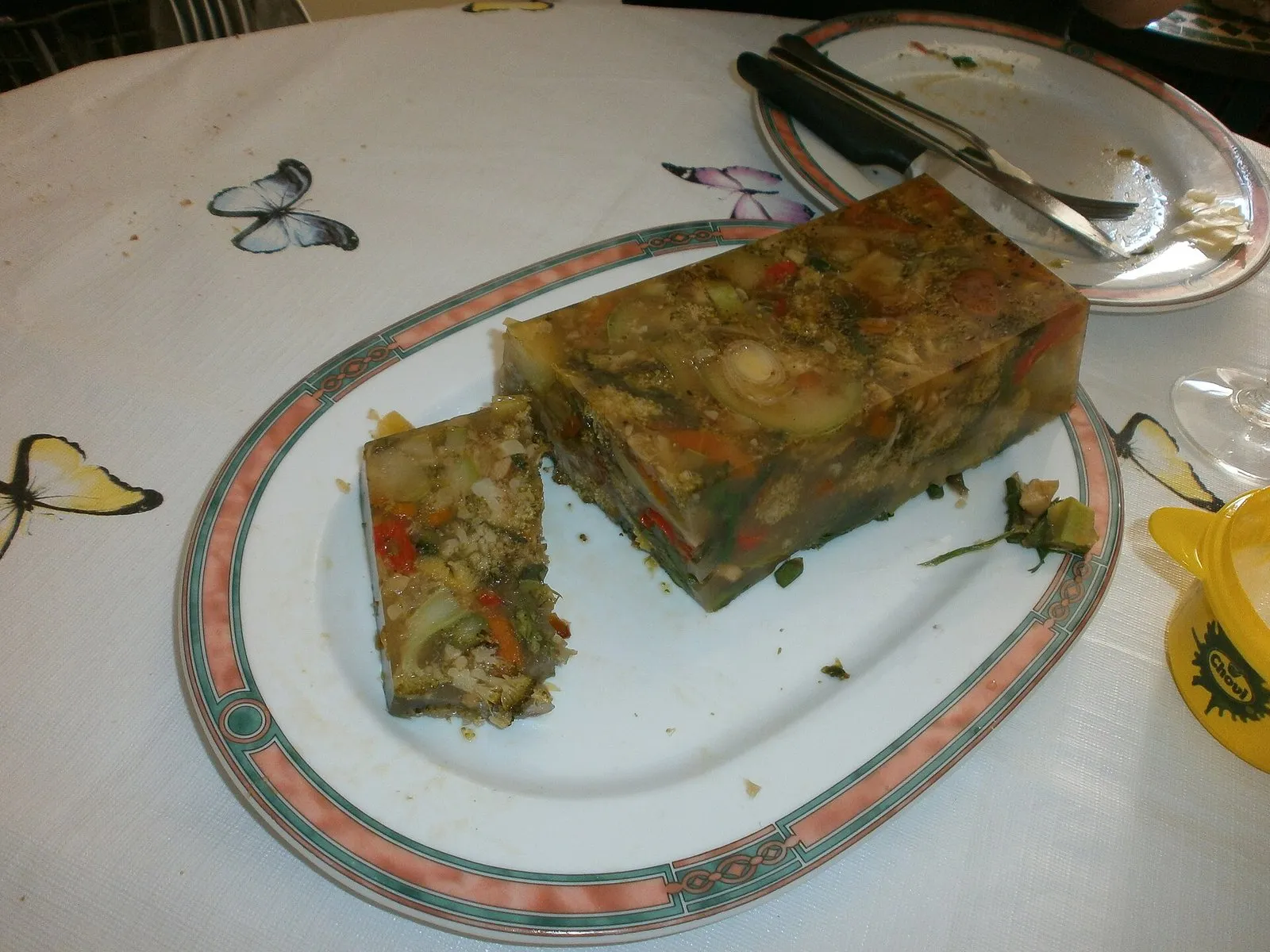
- Vegetable: made with vegetable stock and pieces of vegetables.
- Seafood: using seafood stock and pieces of seafood.
- Fruit: using fruit juices and pieces of fruit for sweet versions.
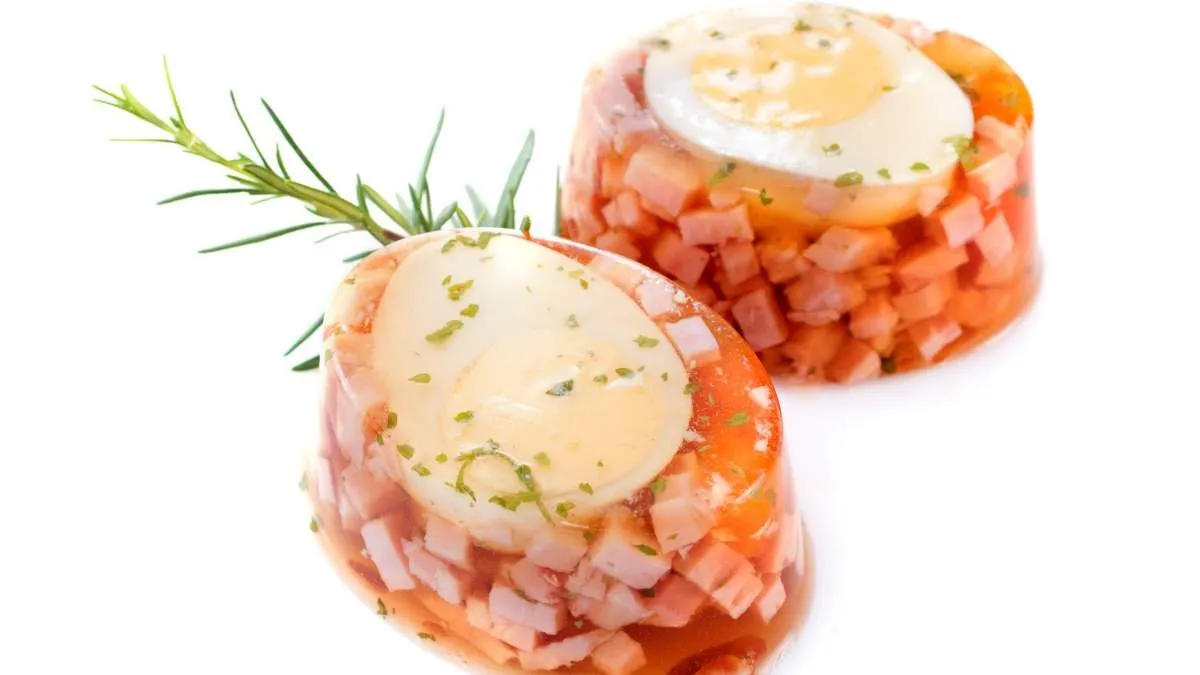
Onto that classification by ingredient another one is layered, a geographic one: aspic has a large family across central and eastern Europe. In Germany, Sülze, a sausage with pieces of meat suspended in gelatine. In Czechia and Slovakia, huspenina, with pig ears and trotters cooked for hours. In Russia and Ukraine, холодец or kholodets, also with pork cuts. And in Sicily and southern Italy, liatina, pork gelatine and the Mediterranean version of the same idea.
Table of types of aspic and their characteristics
| Type of Aspic | Main Ingredients | Culinary Uses |
|---|---|---|
| Meat Aspic | Meat stock, gelatine | Terrines, pâtés, savoury moulds |
| Fish Aspic | Fish stock, gelatine | Seafood starters |
| Vegetarian Aspic | Vegetable stock, agar-agar | Vegetarian alternative |
| Fruit Aspic | Fruit juice, gelatine or agar-agar | Desserts, sweet moulds |
Without animal gelatine: agar-agar and other alternatives
Replacing gelatine isn’t only a dietary matter. Halal and kosher rules require gelatine from animals slaughtered according to the rite, or else from fish; Hindu, Jain and Buddhist communities turn to plant-based gelling agents. The three usual ones are agar-agar, carrageenan and pectin. They don’t behave exactly like gelatine, but they allow for a fully plant-based aspic, with the same transparent block and the same suspended ingredients.
In Spain and Argentina: queso de cabeza
Two things are worth being honest about here. The first: no source has been found documenting a specifically Canarian aspic tradition, either of the classic aspic or of its relatives; when there’s no documented island heritage, none is invented. The second: in Spain and Argentina there is indeed a close relative, but it’s a cousin, not a twin.
That relative is queso de cabeza, also called “queso de cerdo” or “cabeza de jabalí” in Spain, explicitly defined as “a meat aspic made from the head of a calf or pig”. Its gelatine isn’t added: it sets on its own during cooking, thanks to the collagen from the bones of the animal’s skull, and only occasionally is it reinforced with extra gelatine. That’s the difference from French poultry, fish or vegetable aspic: there, a stock is clarified beforehand, and here it isn’t; there, the gelatine is a transparent wrapper, and here it’s the direct result of butchery.
In Argentina, the same family is called “queso de cerdo” and is a fixture of picadas, the shared platter of cold cuts. In Uruguay it’s known as “queso de chancho” or “chicharrón de prensa”, and in Peru as “chicharrón de prensa”, eaten in sandwiches, for breakfast or lunch. The origin is medieval and rural: making use of every part of the animal, including the ones that demanded hours of cooking. The German Sülze, the same idea, appears documented as early as 1410-1430 in the papers of the counts of Katzenelnbogen.
Food safety: the danger zone
An aspic is a perishable food with animal protein served cold. The USDA/FSIS “danger zone” rule states that between 4 °C and 60 °C pathogenic microorganisms multiply rapidly, peaking between 21 °C and 47 °C, and that a perishable food shouldn’t remain in that range for more than two hours. Since gelatine also starts melting from 27 °C, the consequence is twofold: it’s prepared, served and stored cold, and time on the table is counted.
Official assessments of gelatine are reassuring. In 2006 the EFSA rated the risk of bovine spongiform encephalopathy associated with gelatine derived from bones as “small”, and in 2016 the FDA established that gelatine obtained through the usual processes isn’t considered prohibited bovine material.
Practical tips for a perfect aspic
- Correct use of gelatine: the right proportion is crucial for a firm but not rubbery texture. Adjust it to the Bloom strength of the product you’re using, not to a generic figure.
- No boiling once added: above 100 °C gelatine loses its gelling power, and a stock at a rolling boil after it’s been dissolved ruins the set.
- Chilling: allow enough chilling time for the aspic to set completely.
- Unmoulding: to unmould easily, dip the mould in hot water for a few seconds. A few seconds are enough: the gel already starts to give at 27 °C.
Related terms
- Agar-agar — the plant-based gelling agent that replaces animal gelatine in the vegetarian version of aspic.
- Albumin — the egg-white protein that clarifies the stock and gives aspic its transparency.
- Water activity — the food-science concept that explains why a barrier against air and moisture preserves.
- Xanthan gum — the avant-garde texturiser classic gelatine is compared with today.
- Aperitif — aspic’s natural territory: the cold bite that opens a meal.
Sources consulted
Photos: 1. marco dodero (opens in a new tab) (Public domain) · 2. El Caminito (opens in a new tab) (CC0 (opens in a new tab))
Frequently asked questions
What is aspic and what is it used for?
Is aspic the same as gelatine?
How do you make aspic at home?
What is the difference between aspic and Jell-O?
How long has the aspic technique existed?
Can aspic be made without animal gelatine?
At what temperature does an aspic's gelatine set, and at what temperature does it melt?
How long can an aspic stay out of the fridge?
Why was aspic so important before refrigerators existed?
What traditional dishes use aspic?
Is there anything like aspic in Spanish or Argentine cuisine?
How long does it take to prepare an aspic?
Also in the glossary
Non-essential amino acids
Non-essential amino acids, those our body can synthesise by itself, play crucial roles both in our health and in the culinary world.
Omega-3 fatty acids
Omega-3 fatty acids are a type of essential polyunsaturated fat, meaning the human body cannot produce them on its own and they must be obtained through the diet.
Omega-6 fatty acids
Omega-6 fatty acids are a type of essential polyunsaturated fat, meaning the body cannot produce them and they must be obtained through the diet.