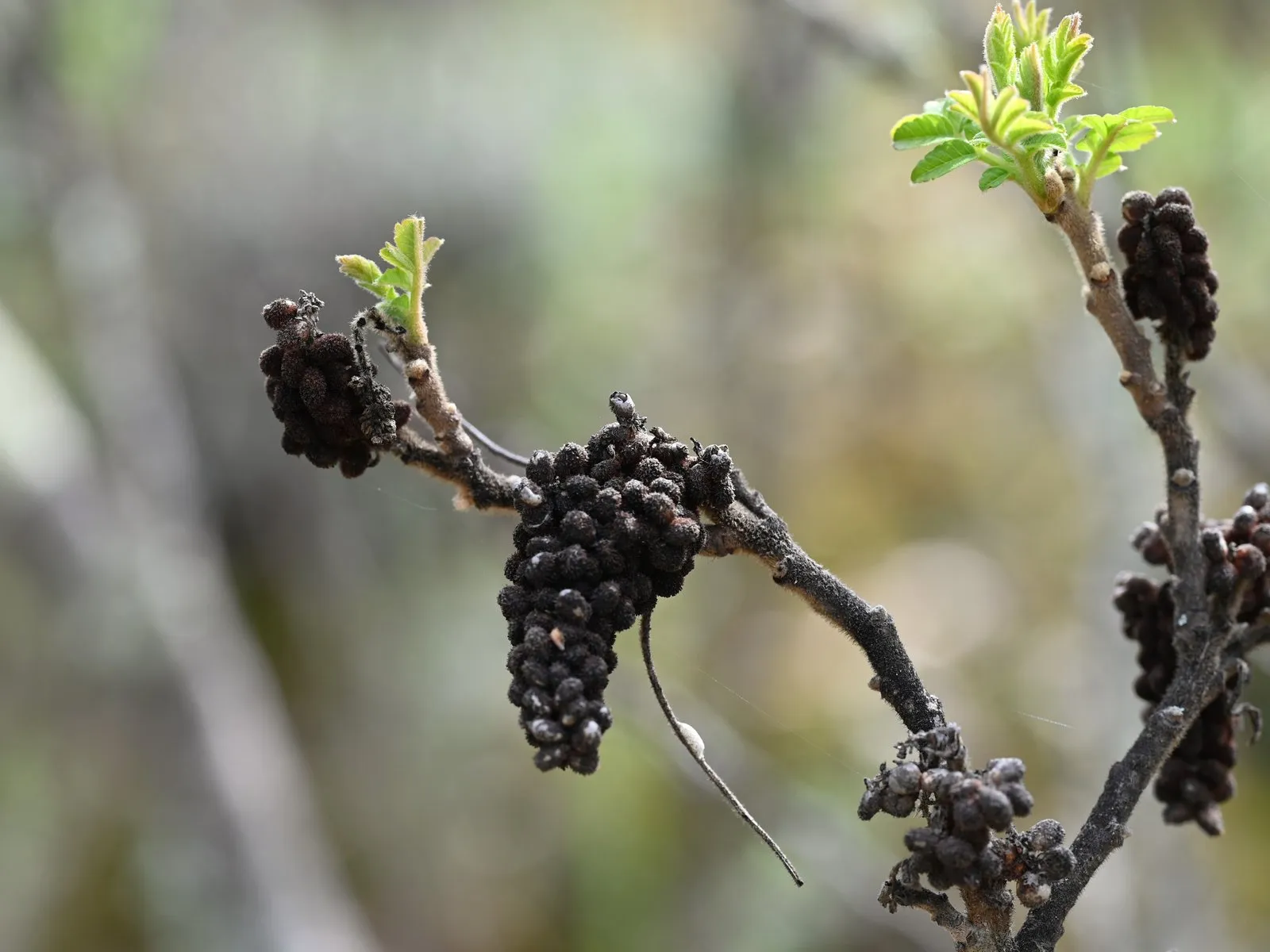
Sumac is the spice of the dried and ground fruits of Rhus coriaria, a Mediterranean shrub of sour taste, distinct from American poison sumac. The powder is dark red. It is added at the end, as an acid is added, and it stains. It is not a pepper and it is not a citrus: it is the dried fruit of a shrub of the cashew family.
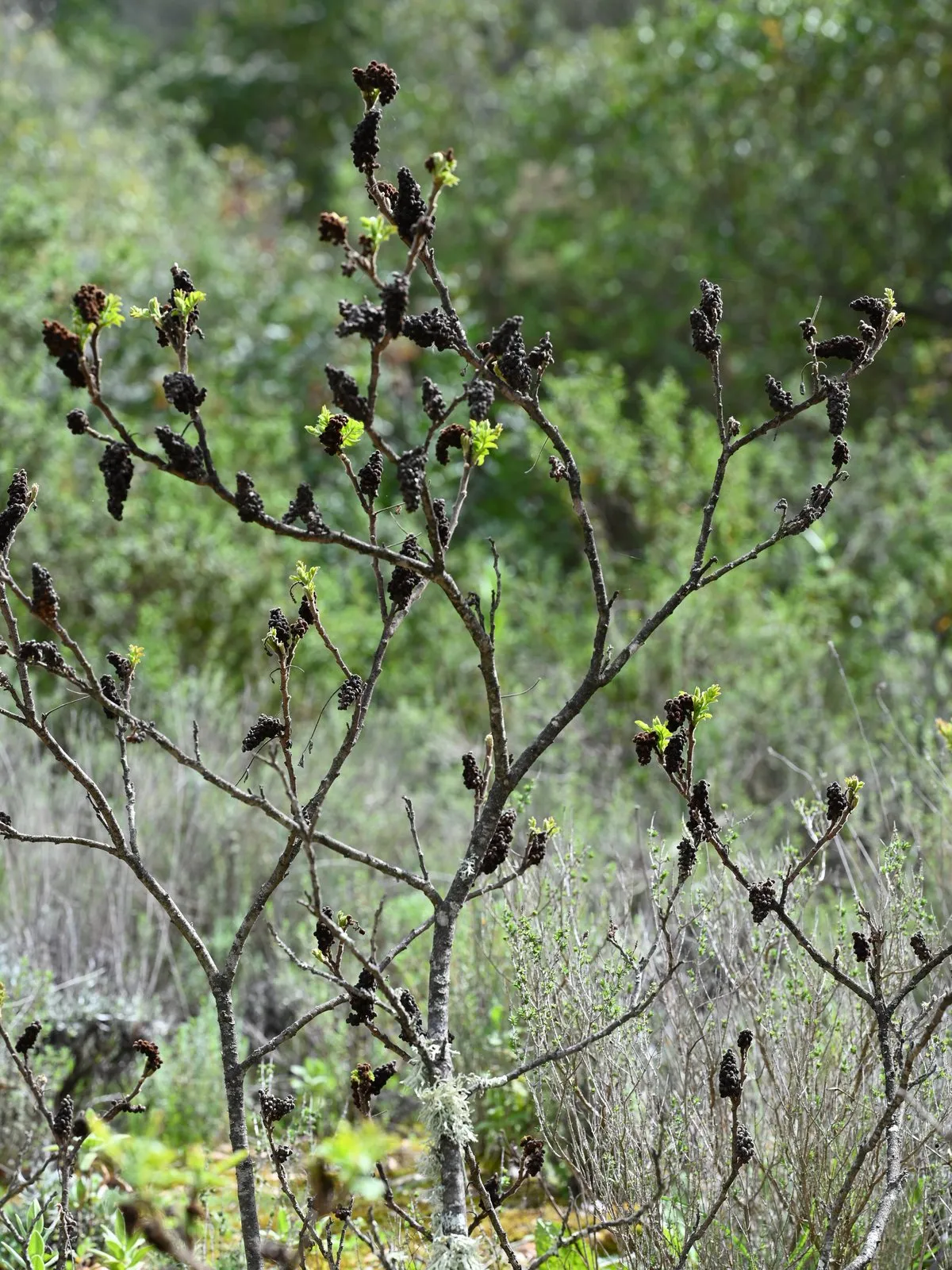
The first two photographs are Rhus coriaria in the El Castillejo Botanical Garden. The third is the powder, which is what reaches the kitchen. The plant explains the scientific name. The plate explains the format.
The species of the spice
The International Plant Names Index registers Rhus coriaria as a name. The review by Alsamri, Al-Ramadi, Adeghate and others, published in Antioxidants, describes it as a Mediterranean shrub of the family Anacardiaceae, of 3 to 4 m, with pinnate leaves in pairs of leaflets and a cluster of pale flowers. The fruit is a drupe that reddens as it ripens. Dried and ground, it gives a dark red powder, sour and astringent.
That powder is a kitchen spice in Lebanon, Syria, Jordan, Turkey and Iran, among other places. It is added straight to the salad or offered with minced meat for a point of lemon. In Lebanon and in Syria it sometimes enters zaatar, the blend of herbs and spices, or stands in that gesture for the caper and the red pepper. On an industrial scale, the same review notes uses of the leaf and of the fruit beyond the table. In the kitchen the one that matters is the ground fruit.
The acidity is not a mystery of terroir. In the fruit, organic acids have been identified: malic, citric, fumaric and tartaric. They are the ones that review summarises from the analysis of the fruit. Malic and citric explain the likeness to a sour fruit. The set, with the tannins, explains the astringency. A laboratory pH is not required to use the powder: what is required is knowing that the acid is already in the fruit and that a long fire flattens it.
Another species, another continent
There is a tree that in English is called poison sumac. In Spanish the shared name is zumaque. It is not the spice. The European and Mediterranean Plant Protection Organization lists Toxicodendron vernix with the common name poison sumac, and with the old synonym Rhus vernix. Its range is the east of the United States and of Canada, westwards to Texas and the Midwest. The EPPO note is short and it is enough: it causes severe skin irritation.
Rhus coriaria and Toxicodendron vernix shared, in the old nomenclature, the genus Rhus. Today the accepted name of the poisonous one sits in another genus. The kitchen one remains in Rhus. The fruit of the spice is the red one that is ground. The poisonous one is not a jar of powder in a spice pantry: it is an American plant of skin irritation. Confusing the jar with the tree is an error of name, not a caution about dose. The spice jar, if it is Rhus coriaria, is the kitchen one. The American tree is not cooked.
In the kitchen
The gesture is that of acid at the end. Over a griddled fish, over roasted vegetables, over a rice, over minced meat, the powder is put on when the fire has already done its work. If it enters at the start of a long stew, the acid thins out and the colour remains, little more. On a salad it goes raw, which is where the malic is noticed.
It stands in for lemon in the role of giving acidity, not in that of giving juice. It does not lighten a sauce the way a splash does. The astringency, if one overdoes it, dries the mouthful. One starts with a little. In zaatar it goes with sesame and thyme, and there the acid is one of the three, not the only one.
The acid of a vinegar is another molecule and another product. Sumac does not replace the vinegar of an escabeche: it has neither the water nor the keeping power of an acetic acid. It serves in the dressing and in the final powder. Aromatics accompany it when the zaatar carries thyme. They are not the same plant. Antioxidants are the chemical family in which that review frames the fruit; the kitchen, here, stays with the acid and with the colour, which are what the powder does on the plate.
In sensory appreciation it is named sour and astringent, and the species is stated if there is doubt with the American tree. “Sumac” alone, in a kitchen of the eastern Mediterranean, is Rhus coriaria. In a manual of North American plants it may be the other. The jar and the country of the recipe undo the mix-up.
Related terms
- Acidification — vinegar and the acids of the kitchen, of which this powder is a neighbour and not a substitute in an escabeche.
- Aromatics — thyme and other leaves that share zaatar with sumac.
- Antioxidants — the family of compounds in which the fruit has been studied, apart from the use as an acid.
- Sensory appreciation — sour and astringent as tasting words, with the species behind them.
Sources
 — view the full-size photo
Another specimen of Rhus coriaria at El Castillejo. The spice comes from the fruit, not from this leaf, even though the leaf has also been studied in the laboratory. 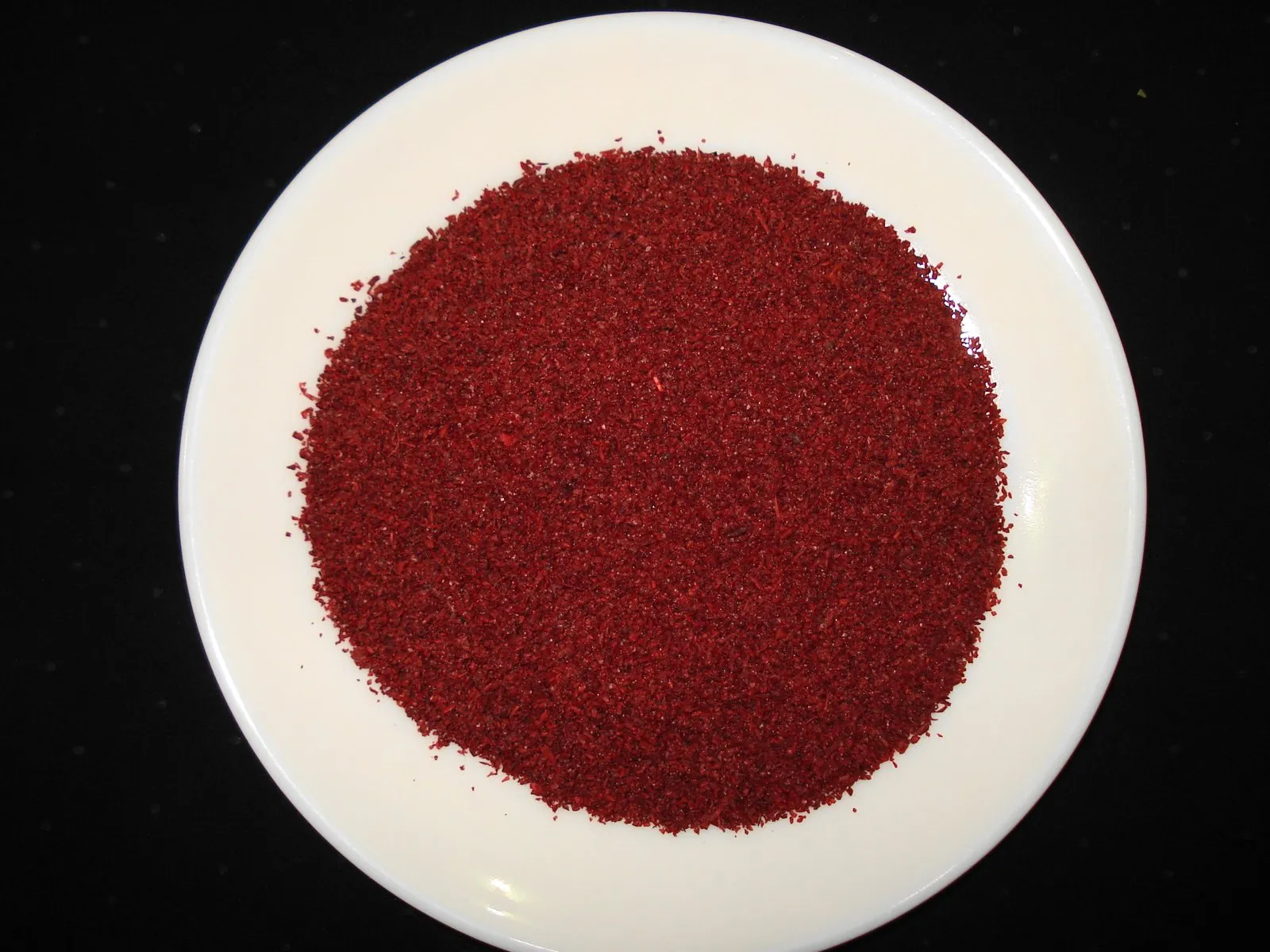 — view the full-size photo
Sumac powder, the form in which the spice reaches the kitchen.
Photos: 1. Krzysztof Ziarnek, Kenraiz (opens in a new tab) (CC BY-SA 4.0 (opens in a new tab)) · 2. Miansari66 (opens in a new tab) (Public domain)
Frequently asked questions
What is sumac?
What does it taste of?
Is it the same as poison sumac?
How is it used in the kitchen?
Can it stand in for lemon?
What is zaatar, and what does sumac add to it?
Also in the glossary
Acidification
Acidification is an essential culinary and preservation method that plays a fundamental role in modern and traditional gastronomy.
Agar-agar
Agar-agar is a natural gelling agent extracted from several species of red algae such as Gelidium, Gracilaria and Eucheuma.
Aguardiente
The definition of aguardiente as a broad category of distilled alcoholic beverages covers an impressive diversity of products around the world, each with unique characteristics that reflect the raw materials available, the production techniques and the…