Canarian taro: the corm that must be cooked
- Term
- Ñame
- Tags
- Canary Islands · Vegetables · Recipes
- Published
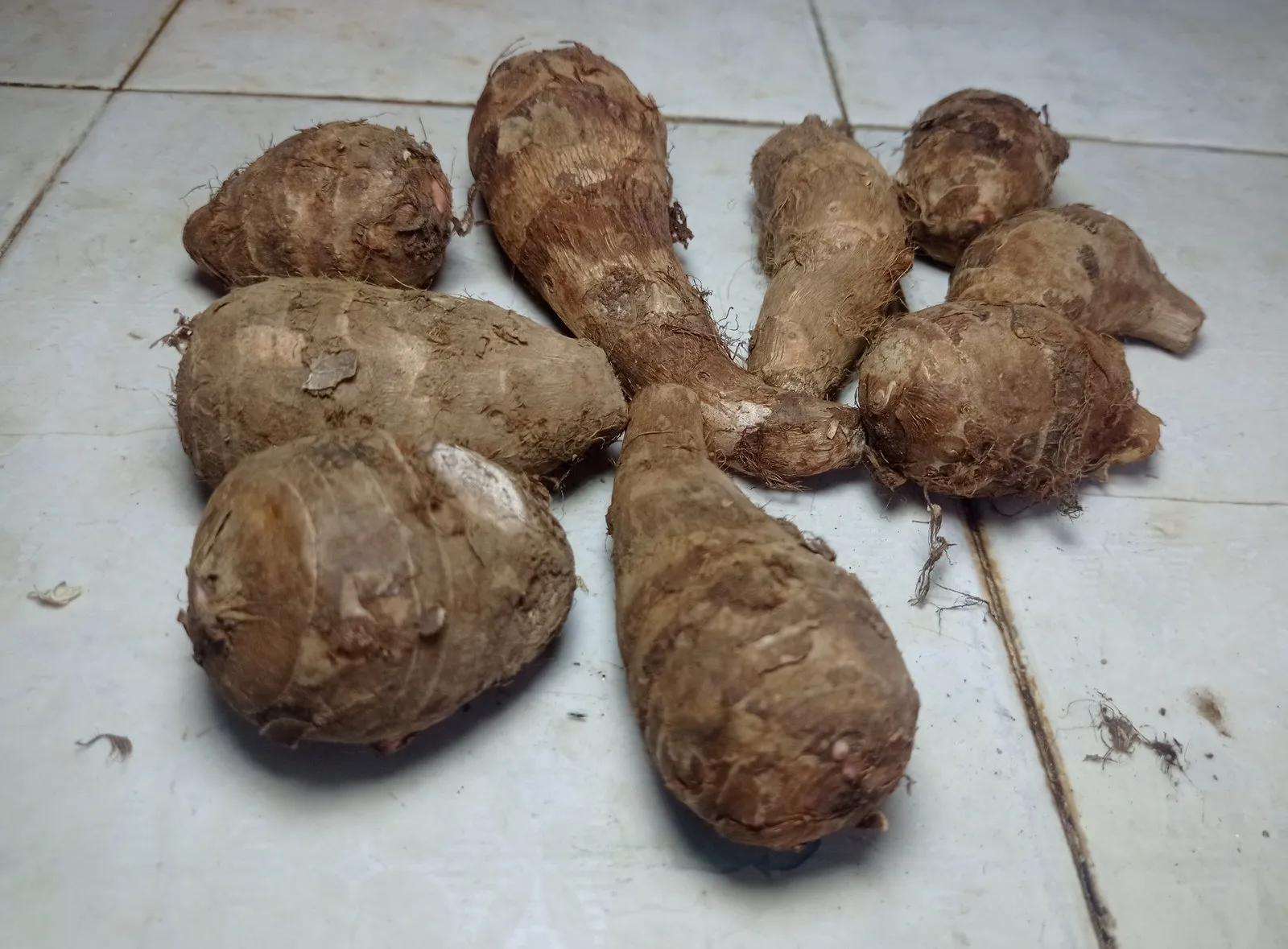
Canarian taro is the corm of Colocasia esculenta, an aroid eaten cooked in the islands because raw it irritates with calcium oxalate. The name misleads as soon as one leaves the archipelago: in much of American Spanish, ñame is a tuber of Dioscorea. Here it is this plant, the one the rest of the world calls taro. The piece that goes into the pot is a corm, a thickened underground stem, not a thin root and not a potato.
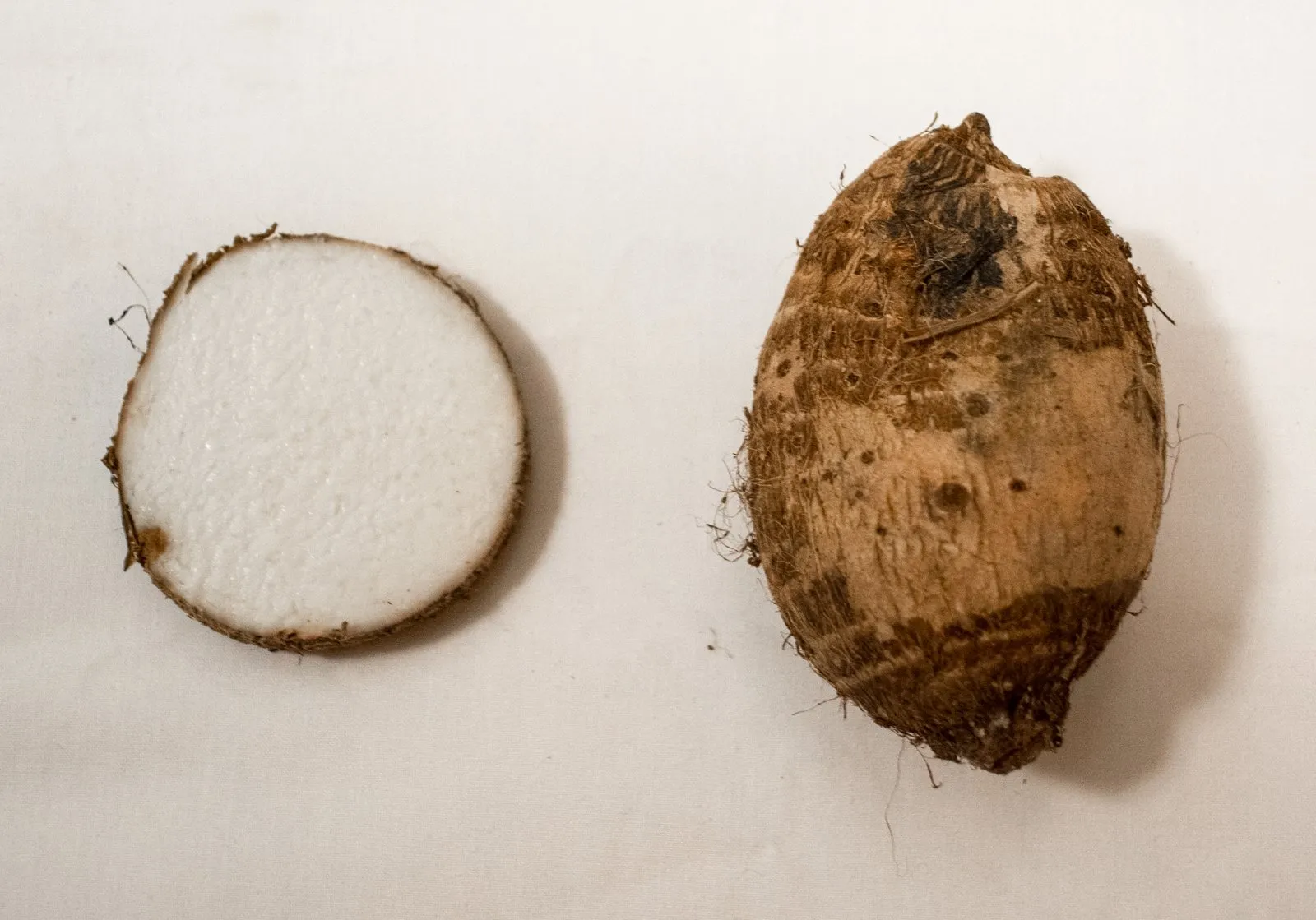
The photographs are of the species, not of a farm in San Andrés y Sauces. The lead image shows the corms with the fibrous skin. The cut shows the pale flesh with streaks. The leaves, large and heart-shaped, are the part visible in the garden. None of the three stands in for a potage served on La Palma.
The plant and the name
Colocasia esculenta belongs to the aroids. The Bank of Introduced Species of the Gobierno de Canarias records it as naturalised on La Palma, La Gomera, Tenerife and Gran Canaria, with an origin in India and South-East Asia and an arrival in the islands during the nineteenth century, escaped from cultivation. That record fixes the scientific name and the health warning. The stew belongs to the tradition of cooking it.
The inventory of traditional knowledge adds the cultivation map that matters in the kitchen. In Spain, the present food use of this species is known in the Canary Islands. The largest areas are in the north-east of La Palma, and within that island the weight falls on San Andrés y Sauces. Anaga, on Tenerife, is the second area. La Gomera and Gran Canaria enter the official bank as naturalised; the cultivation with a name and a municipality is that of La Palma and of the north of Tenerife.
Three words that the market mixes have to stay apart. Taro is the international name of this Colocasia. Malanga and other American names can fall nearby, and sometimes they name a Xanthosoma, which is another aroid. Ñame, in a Canarian mouth, is the corm in the photograph. Ñame, in a market of Antillean tubers, can be Dioscorea, with a different skin and another family. Asking for ñame without naming the island is asking for two plants.
The corm resembles a potato only in the gesture of peeling it and dropping it into the pot. The potato is a Solanum. Ñame has the leaves of the third photograph and an oxalate that the potato does not carry in that crystal. That is why the page on wrinkled potatoes is another one: there, the seal, the salt and the wrinkled skin; here, the cooking that makes the corm edible.
Oxalate and cooking
The crystal is calcium oxalate. The government record says it in one sentence of risk: it irritates the mouth and the skin, eating it raw irritates the digestive tract and, if the amount is large, it can poison. It is not a chilli heat and not a bitterness that rinses away. It is a microscopic needle. Someone who bites the raw corm feels it on the tongue before any virtue of flavour.
Canarian cooking does not leave it raw. The traditional inventory recalls that long cooking is what has been used to remove those crystals, and that this long stew was already described in the early twentieth century. The size of the corm and the fire change the minute. The sense does not change: it is cooked, and cooked for a long time. A brief sauté leaves the centre in the state that record advises against.
In the pot, the corm goes in peeled, in pieces, covered with water or set into the potage. The cooking water is thrown away or diluted into the broth of the pot, depending on the dish; what is not done is to serve the centre still raw and white as if it were a potato kept firm. The cooked flesh stays dense, a little glutinous, closer to a taro cooked through than to a floury potato. That texture belongs to the species, not to a fault of the water.
The same crystal explains the care in peeling. The official record speaks of irritation of the skin, not only of the mouth. A glove or a clean knife is not a manual’s ornament: the sap and the dust of peeling sting the hands of anyone who peels many kilos. The piece is washed, it is peeled, and the hands are rinsed. Then comes the fire.
It is not an avant-garde starch and not a gelling agent. It does not replace gofio, which is toasted and milled cereal, nor a starch added to thicken. It thickens a potage because it lets part of its body into the broth, as a potato or a sweet potato does, and it is eaten itself in pieces. The craft treats it as a pot vegetable, one of those that stand a long cooking beside broth of maize, of fish or of meat.
In the Canary Islands
The rooting is of a northern garden, humid, not of a dry coast. San Andrés y Sauces concentrates the cultivation that the inventory marks as the largest. Anaga is the other district with a name. A market in Santa Cruz or in Los Llanos can offer the corm without showing the plant; the plant is in those two areas, and naturalised also on La Gomera and Gran Canaria.
In the recipe book it enters potages and stews where it acts as starch and as a bite at the same time. It carries no protected designation. It is not on the list of old potatoes. It is recognised by the piece and by the municipality of cultivation, not by a seal. Calling it a potato on a menu is an error of species, even if both come from the same island.
Fermentation is another path. The ñame of La Palma and of Anaga is cooked. The potage does not wait for the corm to sour.
Related terms
- Wrinkled potatoes — the other tuber of the Canarian table, with a PDO and with salt, of another species.
- Protected designation of origin — the seal that covers the old potatoes and not this corm.
- Gofio — the toasted cereal that shares the pot and not the botanical family.
- Antioxidants — another chemistry of the kitchen; the oxalate of ñame is not an antioxidant.
Sources
 — view the full-size photo
The cut shows the flesh. It is still Colocasia, not an old potato. 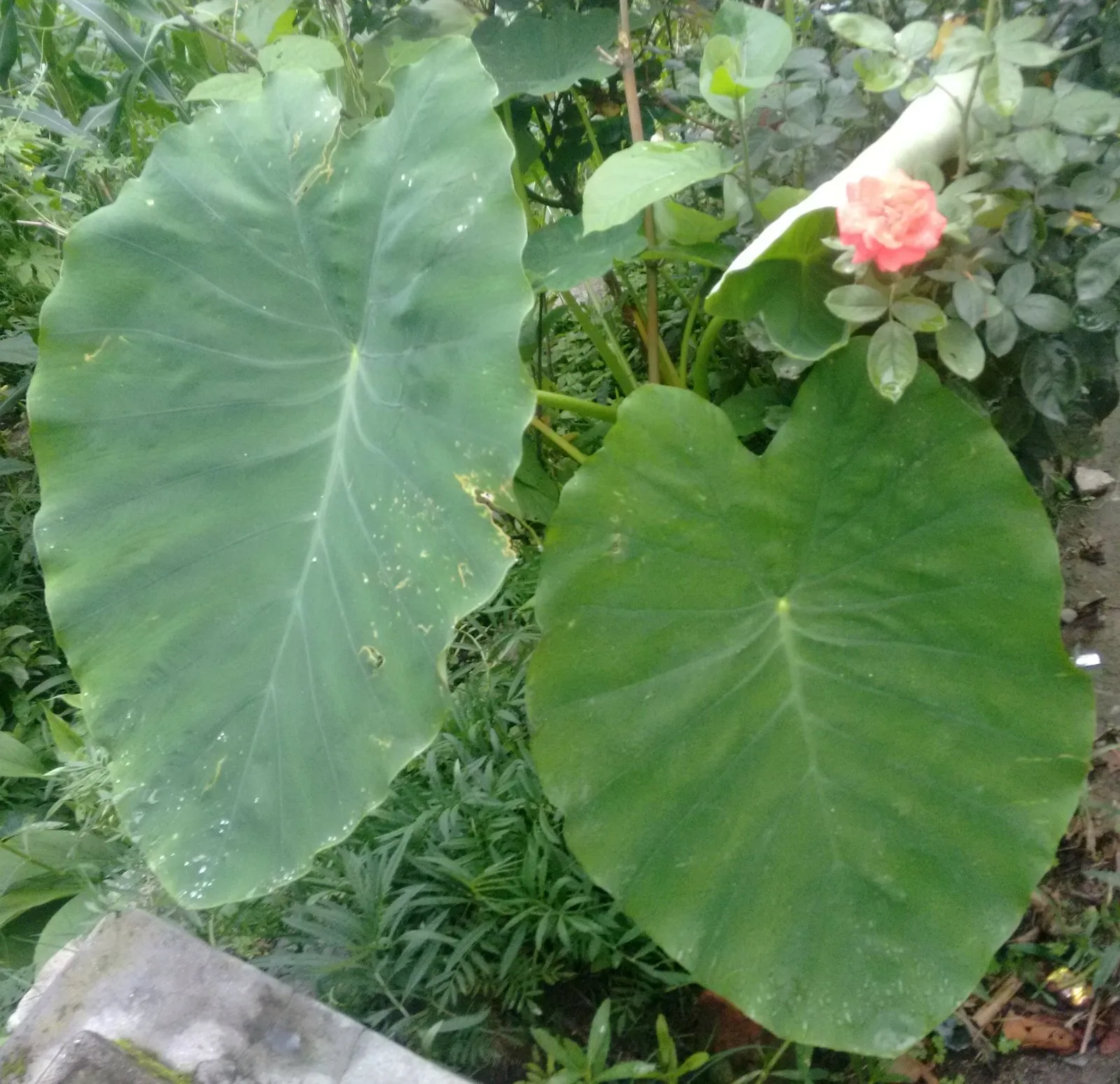 — view the full-size photo
The leaves give the plant away before the corm does. The garden shows this; the pot holds the piece from below.
Photos: 1. Tim Evanson (opens in a new tab) (CC BY-SA 2.0 (opens in a new tab)) · 2. Gs35357670 (opens in a new tab) (CC BY-SA 4.0 (opens in a new tab))
Frequently asked questions
What is ñame in the Canary Islands?
Where is it grown?
Can it be eaten raw?
Is ñame a potato?
How is it cooked?
Also in the glossary
Nitrogen, liquid
Liquid nitrogen is nitrogen in its liquid state, which at one atmosphere boils at around −196 °C and freezes whatever it touches on contact.
Non-essential amino acids
Non-essential amino acids, those our body can synthesise by itself, play crucial roles both in our health and in the culinary world.
Omega-3 fatty acids
Omega-3 fatty acids are a type of essential polyunsaturated fat, meaning the human body cannot produce them on its own and they must be obtained through the diet.