Wrinkled potatoes: the old potato, the salt and the cloth
- Term
- Papas arrugadas
- Tags
- Canary Islands · Recipes · Vegetables
- Published
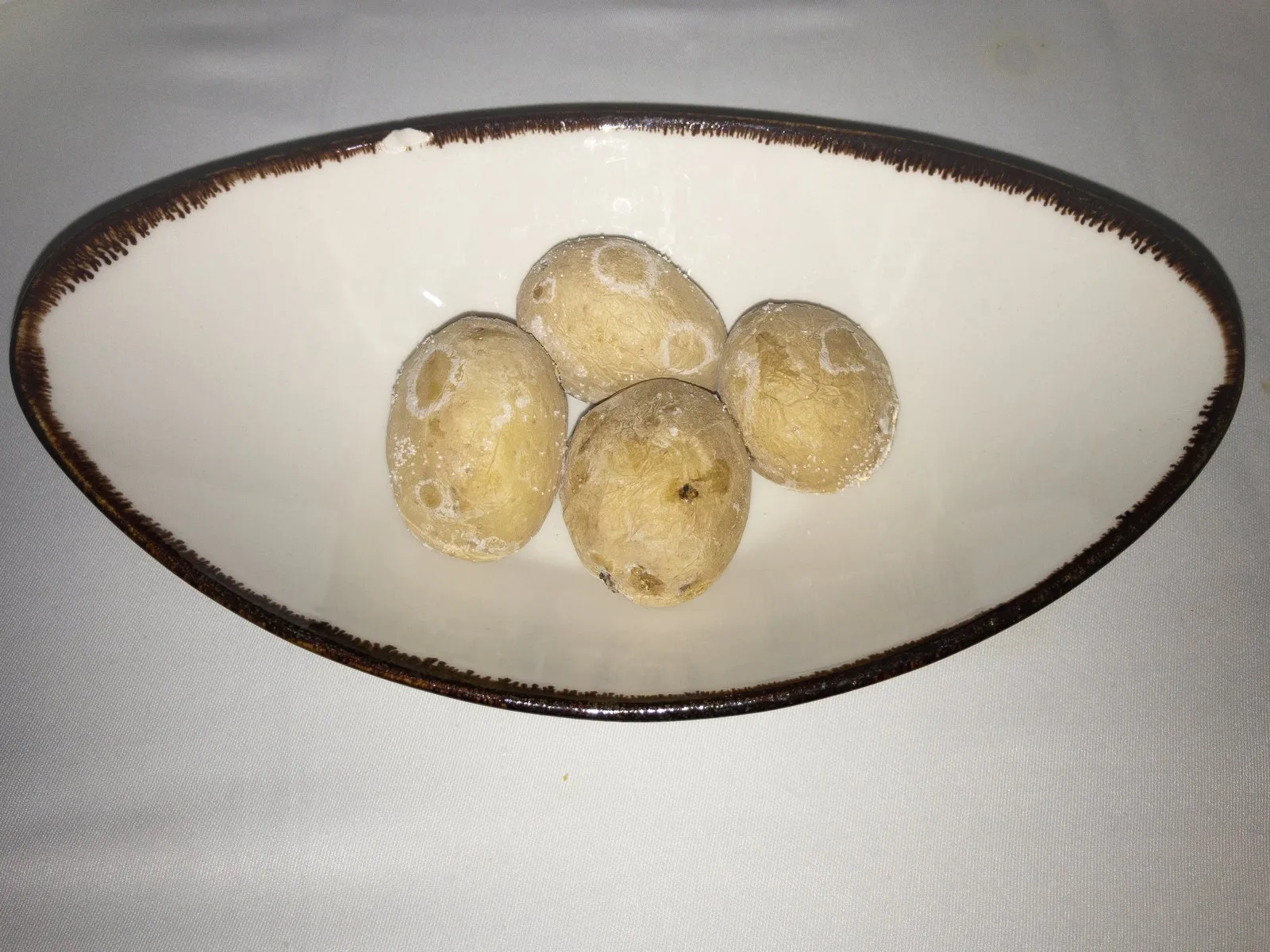
Wrinkled potatoes are old Canarian potatoes boiled with salt and dried on the heat, until the skin wrinkles and is eaten. The dish looks like a small salty potato. Behind it there is a tuber with a protected name, a short drying boil and a mojo that does not enter the pot. Separating the three things avoids calling any boiled potato wrinkled, and avoids calling the gesture of the salt a designation.
The photographs are of the table, not of the seal. The lead image is a plate from La Gomera, skin already rough. The dish in the gallery shows the whole service. The red bowl is mojo, the accompaniment. None of the three is the European seal. They are the dish as it comes to the table.
The tuber and the seal
The specification of the PDO Papas Antiguas de Canarias defines the product as tubers of varieties called old, local, traditional, coloured or of the land, grown in the Canary Islands, from seed obtained in the zone. It includes Solanum tuberosum subspecies andigena, Solanum tuberosum subspecies tuberosum and the triploid Solanum chaucha, introduced before the twentieth century. It is not a potato of recent seed arrived from outside. It is seed of the zone and a variety on that list.
The specification counts 29 vernacular varieties. Among them are Azucena Negra, Azucena Blanca, Bonita Negra, Bonita Blanca, Bonita Colorada and Negra Yema de Huevo. Azucena Negra carries garden synonyms: Azucena Roja, Pintada, Oscura, Negra. The full list lives in the table of the specification. Naming six does not erase the others. It serves to recognise, in the market, that bonita and azucena are not adjectives of just any potato.
Dry matter is above 21 % and, in some locations, above 30 %. Hence the floury look when they are cooked. The calibre runs from 1 to 8 cm: they are small pieces, not the roasting tuber of a continental oven. The skin runs from blackish purple to brown, passing through pink and orange. The flesh runs from cream to intense yellow, and that yellow strengthens with cooking. The shape is rounded, the surface irregular, the eyes deep. After cooking, the specification describes a smell that goes from maize to chestnut and even to butter, and a taste of toasted cereals and autumn nuts. Sometimes anthocyanin rings appear in the flesh.
The zone is agricultural land of the archipelago below 1,200 m. The seven islands enter: El Hierro, La Gomera, La Palma, Tenerife, Fuerteventura, Gran Canaria and Lanzarote. The specification presents them as the only European zone with these varieties. Volcanic soil is part of that frame. It is not a brochure ornament: it is in the description of the product.
The single document of the application is filed under Regulation (EC) No 510/2006 and ticks the box of the protected designation of origin. The Resolution of 26 April 2011 granted transitional national protection and published the specification. The seal covers the tuber that meets that specification. It does not, by itself, cover the gesture of wrinkling.
Wrinkling them
The cooking that gives them their name is set down by CanariWiki, of the education department. They are washed unpeeled. They are covered with water, generous salt and a piece of lemon. They are boiled. They are drained. They go back on the heat for about two minutes, shaken so they dry. Then a few minutes under a cloth. The skin is eaten.
The generous salt is not a pinch of seasoning at the end. It is in the water, and as the potato dries it stays on the skin as a fine crust. The lemon goes in that water. The cloth, at the end, finishes the absorption and holds the heat while the skin finishes wrinkling. Shaking the pot is not theatre: it is the way the water left on the surface evaporates and the salt crystallises.
CanariWiki does not fix that salt as grams per litre. Generous salt is the instruction. Someone who salts as for an everyday boiled potato falls short, and the skin comes out smooth. Someone who leaves the potato in the water without the second heat is left with a boiled potato, tasty if the variety is good, and without the wrinkle.
Mojo does not enter those steps. The red of the photograph waits in the bowl. Picón or green, it is a sauce of the Canarian table, not the liquid of the pot. Dipping the potato in the bowl is the diner’s gesture. Cooking it inside the mojo is another dish.
On the Canarian table
The dish is everyday and festive at once. It accompanies a fish, a meat, or it stands alone, with the mojo, as a first bite. The flouriness of the old variety is what bears the salt of the skin without turning into a watery paste. A new potato, with wet flesh, takes the salt in another way and does not leave the same dry yellow centre.
Ñame shares the pot in the islands and does not share species or cooking. That one is a corm cooked long because of the oxalate. This one is a potato that is boiled and then dried. Calling ñame a wrinkled potato, or a potato a ñame, mixes two plants that the market sometimes puts in the same crate.
Gofio and kid goat are the other shore of the table: toasted cereal and kid. They do not replace the potato. They appear in the same lunch. The wrinkled potato is not a side interchangeable with a purée. It is the piece, with its skin and its salt.
On the Taste 1973 menu
In the tasting menu recorded in the text on edible perfumes the dish Cherne con papas arrugadas y mojo verde appears. It is a line of that menu, not a reinvention of the tuber. The wreckfish carries the wrinkled potato and the green mojo beside it, with the names the recipe book already uses. The seal of the potato and the cooking with salt remain those of the island. The menu seats them on a tasting pass.
Related terms
- Protected designation of origin — the frame of the seal that covers the tuber, not the gesture of drying it.
- Canarian kid goat — the Canarian kid, another piece of the same table.
- Gofio — the toasted cereal that accompanies, of another material.
- Ñame — the corm of Colocasia, which is not this potato.
Sources
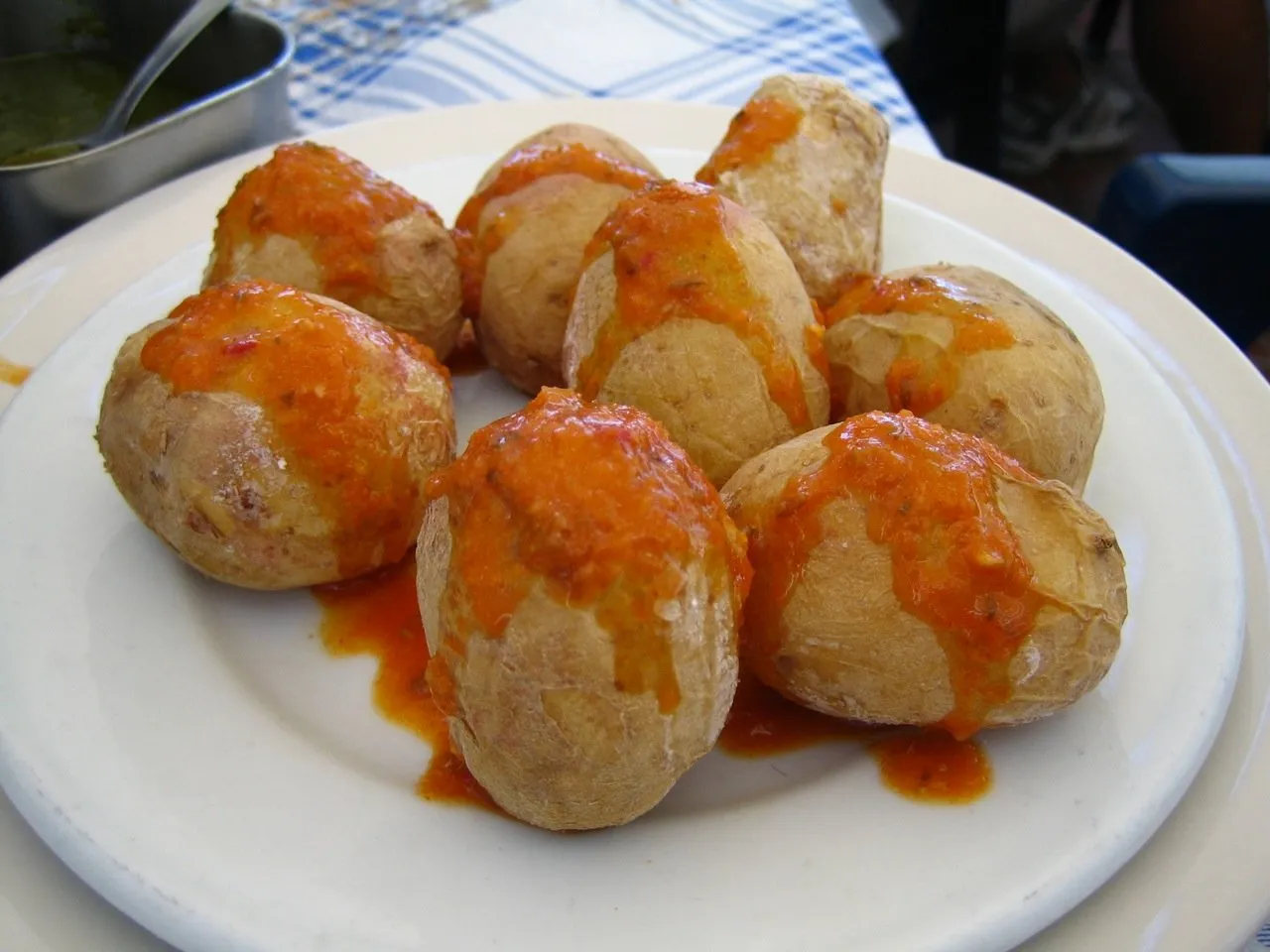 — view the full-size photo
The whole service, skin on. The mark in the corner belongs to the shot, not to a European seal. 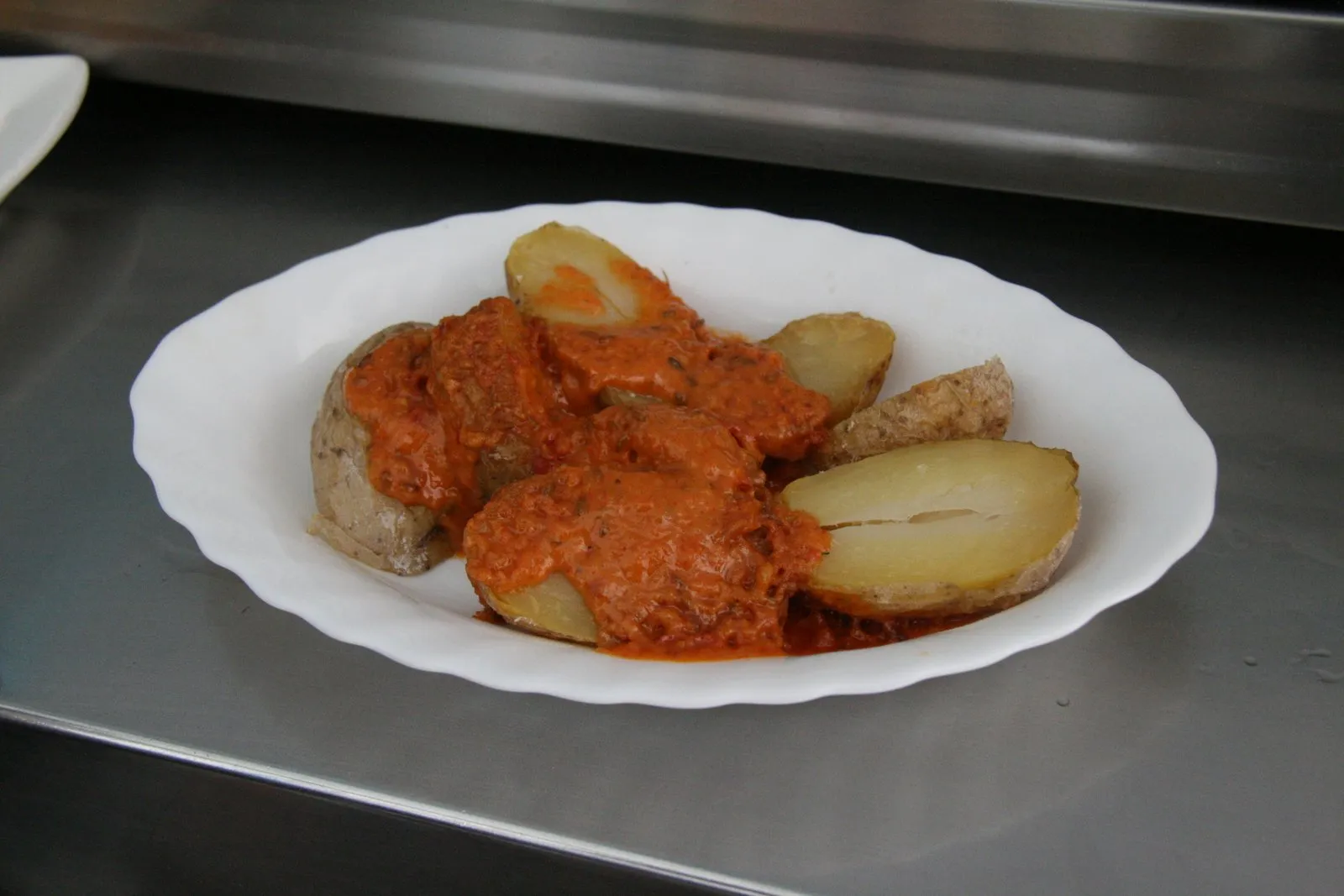 — view the full-size photo
The mojo sits beside them. It is not the cooking water and not a sauce stirred into the pot.
Photos: 1. Fer. (opens in a new tab) (CC BY 2.0 (opens in a new tab)) · 2. Tamorlan (opens in a new tab) (CC BY-SA 3.0 (opens in a new tab))
Frequently asked questions
What are wrinkled potatoes?
Will any potato do?
Is the PDO the dish or the tuber?
Are they peeled?
Is mojo part of the cooking?
Also in the glossary
Pollack
Pollack is a fish highly prized in cooking for its versatility and mild flavour.
Reaction of Maillard
The Maillard reaction is the set of reactions between sugars and amino acids that, with high heat and low moisture, browns food and changes its flavour.
Sensory appreciation
Sensory appreciation in gastronomy is a fascinating field that delves into how our senses interact with food, turning every bite into a unique experience.